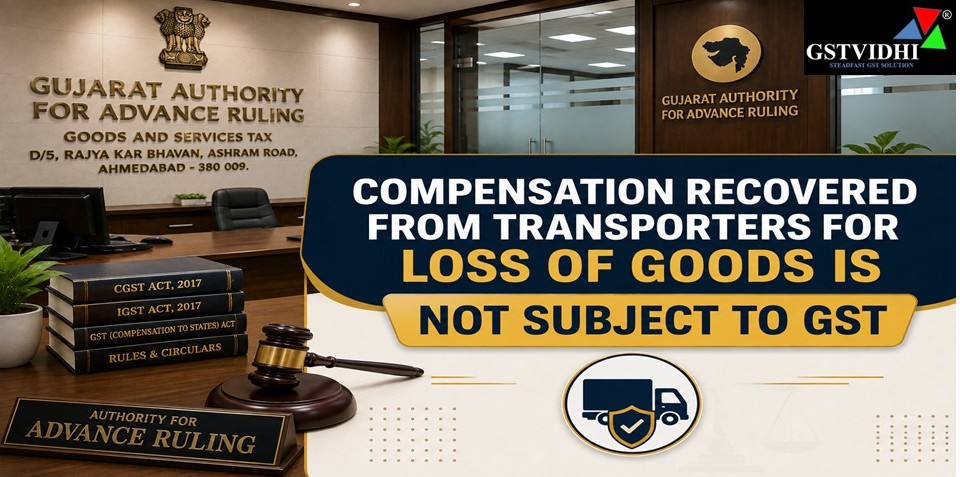
Compensation Recovered from Transporters for Loss of Goods is
Not Subject to GST – Gujarat AAR
Advance
Ruling No. GUJ/GAAR/R/2026/23 | Dated: 27 October 2026
The Gujarat Authority for
Advance Ruling (GAAR) has delivered an important ruling clarifying that compensation
recovered from transporters for loss, leakage, shortage, damage, delay,
contamination or other contractual defaults during transportation is not liable
to GST, as such recovery is merely compensatory in nature and does not
constitute consideration for any supply.
Background
M/s. Pon Pure Chemical
India Private Limited, engaged in the business of manufacturing
and trading chemicals, appoints transporters for movement of goods from
suppliers to its factory, from its factory to customers, and from ports to
various destinations.
Since chemicals are
susceptible to unavoidable transit losses such as evaporation, leakage,
spillage, moisture loss and other physical changes, the company follows an
industry practice of allowing a specified tolerance limit. However, where the
transporter is responsible for losses beyond the agreed tolerance or due to
negligence, compensation is recovered from the transporter.
Question
Before the Authority
The applicant sought an
advance ruling on the following question:
Whether compensation
received from transporters towards transit loss and damages constitutes a
taxable supply of services under Paragraph 5(e) of Schedule II read with
Section 7 of the CGST Act, 2017?
Circumstances
in Which Compensation Was Recovered
The applicant recovered
compensation from transporters in situations such as:
- Shortage of goods beyond the
permissible transit loss.
- Leakage from tankers.
- Damage or destruction of goods.
- Quality deterioration.
- Colour contamination or rust
contamination.
- Theft or pilferage during transit.
- Delay in delivery requiring alternate
transportation.
- Negligence during loading, unloading
or handling of goods.
The amount recovered
generally represented the actual loss suffered, including the cost of
damaged goods or additional expenses incurred.
Applicant's
Contentions
The applicant submitted
that:
- Compensation is recovered only after
the transporter breaches its contractual obligation.
- Such recovery merely indemnifies the
company for the loss suffered.
- There is no independent agreement
whereby the company agrees to tolerate any breach in return for
consideration.
- Therefore, the compensation cannot be
regarded as consideration for any supply under GST.
The applicant relied
heavily upon CBIC Circular No. 178/10/2022-GST dated 03.08.2022, which
clarifies that liquidated damages paid for breach of contract are generally not
taxable, provided there is no separate agreement to tolerate the breach.
The applicant also relied
upon various judicial precedents holding that damages recovered for breach of
contract are merely compensatory and not consideration for any service.
Relevant
Legal Provisions
The Authority examined:
- Section 7 of the CGST Act – Meaning
of Supply
- Section 2(31) – Definition of
Consideration
- Paragraph 5(e) of Schedule II
- CBIC Circular No. 178/10/2022-GST
dated 03.08.2022
- Sections 73 and 74 of the Indian
Contract Act relating to compensation for breach of contract.
Observations
of the Authority
The Gujarat AAR noted
that although the applicant initially stated that there was no formal agreement
regarding compensation, the transportation agreements themselves specifically
provided for recovery of damages in cases of leakage, shortages, contamination,
negligence, delay and other defaults by the transporter.
The Authority further
observed that:
- These clauses merely protect the
applicant against contractual breach.
- The transporter is contractually
liable to reimburse the actual loss suffered.
- Such payments arise because of breach
of contract and not because the applicant agreed to tolerate any act.
Accordingly, these
recoveries possess all the characteristics of liquidated damages.
Reliance on
CBIC Circular
The Authority reproduced
the clarification contained in CBIC Circular No. 178/10/2022-GST, which
states:
- Liquidated damages are compensation
for breach of contract.
- They are intended to ensure
contractual performance.
- They do not amount to consideration
for tolerating an act.
- There is no taxable supply merely
because one party receives compensation for loss caused by another party's
breach.
The Circular further
clarifies that unless there is an independent agreement to refrain from an act,
tolerate an act or do an act in return for consideration, Paragraph 5(e) of
Schedule II will not apply.
Ruling
The Gujarat Authority for
Advance Ruling held that:
- Compensation recovered from
transporters is not consideration for any supply.
- Such recovery merely compensates the
applicant for losses arising from breach of contractual obligations.
- There is no independent agreement to
tolerate any act or situation.
- Consequently, the recovery does not
qualify as a supply of services under Paragraph 5(e) of Schedule II.
- Therefore, GST is not payable
on such compensation.
Conclusion
The Gujarat AAR has
reaffirmed an important principle under GST law: compensation received for
breach of contractual obligations is not a taxable supply merely because money
changes hands. Recovery of transit losses, leakage, shortages,
contamination, theft, delays or similar damages from transporters is
compensatory in nature and does not constitute consideration for any
independent supply of services. Consequently, such recoveries fall outside the
ambit of GST, provided they are genuine damages for contractual breach and not
consideration for agreeing to tolerate an act.
Disclaimer: All the Information is based on the notification, circular advisory and order issued by the Govt. authority and judgement delivered by the court or the authority information is strictly for educational purposes and on the basis of our best understanding of laws & not binding on anyone.
Click here