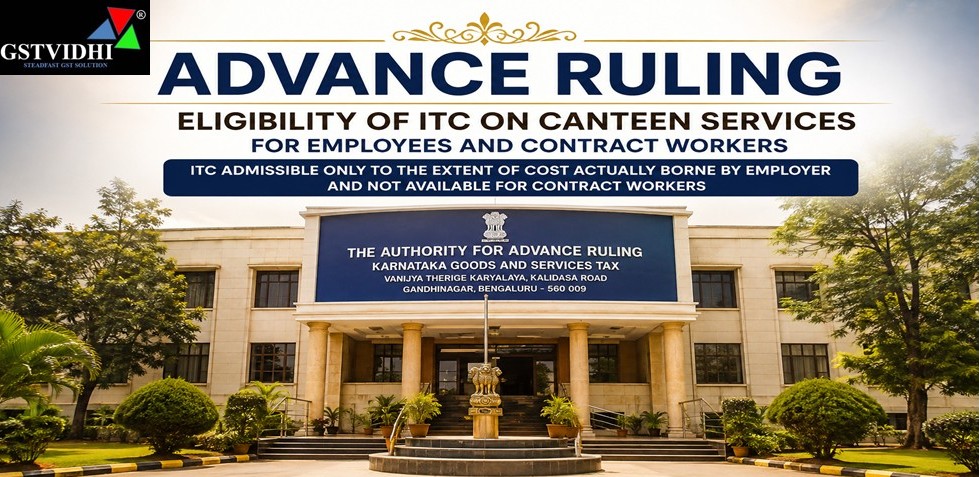
Eligibility of ITC on Canteen Services Provided to Employees and
Contract Workers
(M/s. Aditya Auto Products & Engineering India Pvt. Ltd. Vs.
Authority for Advance Ruling, Karnataka (Ruling
No. KAR.ADRG 25/2026 Dated: 19.05.2026)
1. Summary
of the Case
M/s. Aditya Auto Products
& Engineering India Pvt. Ltd. operates three manufacturing locations in
Karnataka and employs approximately 1,288 employees, apart from contract
employees. The applicant is registered under the Factories Act, 1948 and is
required to provide and maintain a canteen facility in accordance with Section
46 of the Factories Act, 1948.
For providing food
facilities, the applicant engaged Canteen Service Providers (CSPs) at
its factory premises. The canteen facility was made available to both regular
employees and contract workers at a subsidised rate.
In the case of regular
employees, the applicant recovered approximately ₹200–₹250 per employee per
month through salary deductions. The remaining cost of the canteen facility
was borne by the applicant.
In respect of contract
workers, the applicant recovered the concessional amount from the respective
contractors/suppliers by raising invoices and discharged GST at 5% on
such recoveries.
The central question
before the Authority was whether the applicant could claim ITC of GST
charged by the CSP on catering services, particularly when the canteen
facility was required to be provided under the Factories Act.
The Authority ultimately
distinguished between regular employees and contract workers and further
restricted ITC for regular employees to the portion of the canteen cost
actually borne by the applicant.
2. Sections
and Provisions Covered in the Ruling
The important provisions
considered in the ruling are:
A. Section 16 of the CGST
Act, 2017 – Eligibility for ITC
Section 16 provides the
basic entitlement of a registered person to claim ITC on goods or services used
or intended to be used in the course or furtherance of business, subject to
prescribed conditions and restrictions.
B. Section 17(5)(b) of
the CGST Act, 2017 – Blocked Credit
Section 17(5)(b)
generally restricts ITC on food and beverages, outdoor catering and certain
related services.
However, the proviso
provides an important exception where it is obligatory for an employer to
provide such goods or services to its employees under any law for the time
being in force.
C. Section 46 of the
Factories Act, 1948
Section 46 provides for
the requirement of a canteen in specified factories where the prescribed number
of workers are employed.
The Authority noted that
the applicant's statutory obligation to maintain the canteen arose under this
provision.
D. Section 97(2)(d) of
the CGST Act, 2017
The application was
admissible because the question related to admissibility of input tax credit
of tax paid or deemed to have been paid, which is specifically covered
under Section 97(2)(d).
E. Notification No.
11/2017-Central Tax (Rate) dated 28.06.2017
The Authority also
considered the GST rate applicable to catering services under Serial No. 7 of
the notification.
F. Circular No.
172/04/2022-GST dated 06.07.2022
The applicant relied upon
this Circular in support of its contention that ITC is available where an
employer is statutorily obligated to provide goods or services to employees.
3.
Submissions by the Applicant
The applicant submitted
that the canteen facility was not being provided as an independent business
activity. Rather, it was being provided because of the statutory obligation
imposed under the Factories Act, 1948.
The major submissions of
the applicant were as follows:
1. Canteen facility was a
statutory requirement
The applicant submitted
that it was registered under the Factories Act, 1948 and was required to
provide and maintain a canteen under Section 46 of the Factories Act.
Therefore, the
expenditure incurred on the canteen was in discharge of a statutory obligation.
2. No independent
catering business
The applicant contended
that it was not engaged in the business of providing catering services. The
canteen facility was only an employee welfare facility provided in compliance
with the law.
Therefore, the facility
could not be regarded as an independent commercial activity of the applicant.
3. Recovery from
employees was only partial cost recovery
The applicant submitted
that the amount recovered from employees was nominal and substantially lower
than the actual cost paid to the CSP.
The balance amount was
borne by the applicant itself. Accordingly, the recovery from employees did not
have any profit motive.
4. Reliance on Circular
No. 172/04/2022-GST
The applicant relied upon
Circular No. 172/04/2022-GST dated 06.07.2022, contending that ITC
should be available for goods or services which an employer is statutorily
obligated to provide to employees under any law.
5. Section 17(5)
restriction should not apply
According to the
applicant, the restriction under Section 17(5) should not apply because the
canteen facility was being provided pursuant to a statutory obligation under
the Factories Act.
The authorised
representative reiterated these submissions during the personal hearing held on
16.01.2026 and also relied upon advance rulings dealing with similar
issues.
4. Findings
and Decision of the Authority
The Authority examined
the issue with reference to Sections 16 and 17 of the CGST Act, 2017,
Section 46 of the Factories Act, 1948, the relevant notification and Circular
No. 172/04/2022-GST.
A. Canteen
facility for regular employees
The Authority accepted
that the applicant was statutorily required to maintain a canteen under Section
46 of the Factories Act.
The canteen was
maintained within the factory premises and the CSP was engaged for the purpose
of fulfilling the statutory requirement. The Authority observed that the
applicant was not operating the canteen as an independent catering business.
Accordingly, the
Authority held that the exception contained in the proviso to Section
17(5)(b) applies in respect of regular employees because providing the
canteen facility was obligatory under law.
Therefore, ITC on
catering services attributable to regular employees is admissible.
B. Treatment of
contract workers
The Authority made an
important distinction between regular employees and contract workers.
Although the applicant
provided canteen facilities to contract workers, the Authority observed that:
- contract workers were not
employees of the applicant;
- there was no direct employer-employee
relationship between the applicant and the contract workers; and
- the applicant was not under a
statutory obligation under the Factories Act to provide canteen facilities
to such contract workers.
Therefore, the statutory
exception under Section 17(5)(b) could not be extended to the catering services
provided to contract workers.
The Authority
consequently held that ITC attributable to catering services provided to
contract workers is blocked under Section 17(5)(b).
C. ITC only to the
extent of cost actually borne by employer
The Authority further
considered whether the applicant could claim ITC on the entire GST charged
by the CSP, including the portion of the cost recovered from employees.
The Authority held that
ITC is admissible only to the extent of the cost actually borne by the
applicant.
Since the applicant
recovered a portion of the canteen cost from its employees, the applicant had
not actually borne that portion of the expenditure. Therefore, ITC attributable
to the amount recovered from employees could not be claimed.
Thus, the ruling
establishes two separate limitations:
For regular employees: ITC
is available, but only to the extent of the canteen cost actually borne by
the employer.
For contract workers: ITC
is not available, because the statutory obligation does not extend to
them and there is no employer-employee relationship.
5.Final
Ruling
The Authority
specifically ruled that:
1. ITC
on GST charged by the CSP for canteen services provided to regular employees is
admissible, in terms of the proviso to Section 17(5)(b), since
the canteen facility is obligatory under the Factories Act, 1948.
2. However,
such ITC is restricted only to the extent of the cost actually borne by the
applicant. The portion recovered from employees is not eligible for ITC.
3. ITC
attributable to canteen services provided to contract workers is not admissible,
as the applicant has no statutory obligation or employer-employee relationship
with such workers.
6.
Conclusion
The ruling in M/s.
Aditya Auto Products & Engineering India Pvt. Ltd., KAR.ADRG 25/2026 dated
19.05.2026, provides an important clarification regarding ITC on employee
canteen facilities.
The Authority has
recognised that although food and catering services are generally covered by
the blocked-credit provisions of Section 17(5)(b) of the CGST Act, ITC
can become available where the employer is legally obligated to provide the
facility to its employees. In the present case, the statutory obligation
arose from Section 46 of the Factories Act, 1948.
However, the ruling
places two important restrictions. First, the benefit is available only for regular
employees covered by the statutory obligation, and not for contract
workers. Second, even in respect of regular employees, ITC is restricted to the
actual cost borne by the employer; any amount recovered from employees
cannot be considered for ITC.
Disclaimer: All the Information is based on the notification, circular advisory and order issued by the Govt. authority and judgement delivered by the court or the authority information is strictly for educational purposes and on the basis of our best understanding of laws & not binding on anyone.
Click here