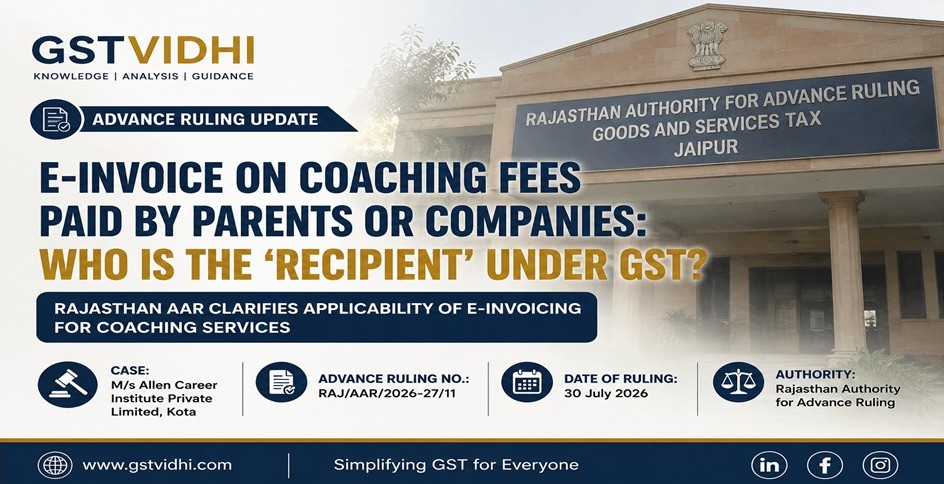
E-Invoice on Coaching Fees Paid by Parents or Companies:
Rajasthan AAR Examines Who is the “Recipient” Under GST
Case
Details
· Applicant: M/s Allen Career Institute Private Limited, Kota,
Rajasthan
· Authority: Rajasthan Authority for Advance Ruling,GST
· Advance Ruling No.: RAJ/AAR/2026-27/11
· Date of Ruling: 30 July 2026
· Relevant provisions: Section 2(93), Section 97(2)(b), Section
103, Section 104, Rule 48(4) of CGST Rules and Notification No. 13/2020-Central
Tax
Introduction
The applicability of
e-invoicing in the education and coaching sector has raised an interesting
question under the Goods and Services Tax law, particularly where the student
is the actual beneficiary of the coaching service but the course fees are paid
by a parent, guardian or business entity.
The Rajasthan Authority
for Advance Ruling has recently examined this issue in the case of M/s Allen
Career Institute Private Limited, Kota, in Advance Ruling No.
RAJ/AAR/2026-27/11, pronounced on 30 July 2026.
The core issue before the
Authority was whether Notification No. 13/2020-Central Tax, read with Rule
48(4) of the CGST Rules, relating to e-invoicing, would apply where coaching
fees are paid by a parent, guardian or business enterprise which is registered
under GST.
The case is particularly
significant because it involves the distinction between the student as the
beneficiary of the service and the person who is liable to pay the
consideration, which has implications for determining the “recipient of
services” under Section 2(93) of the CGST Act.
Facts of
the Case
M/s Allen Career
Institute Private Limited is engaged in providing education and coaching
services to students preparing for competitive examinations such as JEE, NEET
and other examinations.
Apart from physical
coaching, the Applicant also provides digital coaching programmes, including
live online classes and pre-recorded courses through its e-learning platform,
website and mobile application.
The Applicant proposed to
introduce additional commercial coaching batches. At the time of admission and
enrolment, details of the student and parent/guardian are collected.
According to the
Applicant, there may broadly be two categories of persons paying the coaching
fees:
1. Parents
or guardians of the student; and
2. Business
enterprises which sponsor the education of a particular student.
An interesting practical
situation arises where the person paying the fees is a GST-registered person.
For example, a parent or
guardian may be registered under GST as a proprietor, partner, LLP or company
and may request the coaching institute to issue the GST invoice in the name of
that registered entity by furnishing its GSTIN.
Similarly, a business
enterprise may sponsor the coaching of a student and pay the applicable course
fees.
The Applicant therefore
sought an advance ruling regarding the applicability of e-invoicing in such
circumstances.
Questions
Before the Authority
The Applicant raised two
principal questions.
Question 1
Whether Notification
No. 13/2020-Central Tax dated 31 March 2020, as amended from time to time,
is applicable to the Applicant in respect of supplies made to parents,
guardians or business enterprises registered under GST who are liable to pay
the consideration.
Question 2
Whether the applicability
of the e-invoicing provisions is affected by uncertainty regarding the
admissibility of Input Tax Credit in the hands of the recipient, or whether the
supplier is required to investigate the recipient's business purpose, ITC eligibility
or nature of expenditure.
The questions were raised
under Section 97(2)(b) of the CGST/RGST Acts, concerning the
applicability of a notification issued under the GST law.
Applicant's
Main Contention
The Applicant's principal
argument was based upon the statutory definition of “recipient” under
Section 2(93)(a) of the CGST Act.
The Applicant submitted
that, in the case of coaching services, the student may be the ultimate
beneficiary, but where the parent, guardian or business enterprise is
contractually liable to pay the consideration, such person should be regarded
as the recipient of the service.
Therefore, where such
person is registered under GST and furnishes a valid GSTIN, the Applicant
contended that the requirements of Rule 48(4) read with Notification
No. 13/2020-Central Tax would apply.
The Applicant further
submitted that e-invoicing is a mandatory statutory compliance and is not
dependent upon whether the recipient ultimately claims Input Tax Credit.
Student as
Beneficiary vs. Person Liable to Pay Consideration
One of the most important
aspects of the case is the distinction between the beneficiary and the recipient.
In a typical coaching
transaction, the student attends the classes and receives the educational
benefit. However, the fees may be paid by the student's parents or by a
business enterprise.
The Applicant therefore
argued that the person receiving the benefit and the person liable to pay
consideration need not necessarily be the same person.
Section 2(93)(a) of the
CGST Act specifically deals with the recipient where consideration is payable
for the supply.
The Applicant's position
was that where the parent, guardian or business enterprise is contractually
liable to pay the course fees, that person should be treated as the recipient
for the purpose of the relevant GST provisions.
This distinction becomes
particularly relevant for e-invoicing because the requirement under Rule 48(4)
is linked to supplies made to registered persons subject to the prescribed
conditions.
Applicability
of E-Invoicing
The Applicant submitted
that Rule 48(4) of the CGST Rules, read with Notification No.
13/2020-Central Tax and subsequent amendments, creates a mandatory requirement
for issuance of an e-invoice where the prescribed conditions are satisfied.
The Applicant therefore
contended that once:
- the supplier is covered by the
e-invoicing provisions;
- the supply is otherwise covered;
- the recipient is a registered person;
and
- a valid GSTIN is furnished,
the supplier cannot
simply refuse to issue an e-invoice merely because the ultimate beneficiary of
the service is a student.
According to the
Applicant, the relevant factor is the status of the recipient liable to pay
consideration, rather than the identity of the ultimate beneficiary.
Does the
Supplier Have to Examine the Recipient's ITC Eligibility?
The second important
issue concerned Input Tax Credit.
The Applicant argued that
the supplier should not be required to determine whether the recipient is
ultimately entitled to claim ITC.
For example, a
GST-registered business enterprise may pay coaching fees for a student. Whether
such expenditure qualifies for ITC would depend upon the recipient's own facts,
records, business nexus and compliance with Sections 16 and 17 of the CGST Act.
The Applicant submitted
that these matters are primarily within the knowledge and control of the
recipient.
Therefore, the supplier
cannot be expected to conduct an investigation into:
- the recipient's business activities;
- the purpose for which the coaching
fees are incurred;
- whether the expenditure has a
business nexus;
- whether the recipient will claim ITC;
- whether such ITC will ultimately be
admissible; or
- the internal accounting treatment
adopted by the recipient.
The Applicant also relied
upon Section 155 of the CGST Act, submitting that the burden of proving
eligibility for ITC rests upon the person claiming such credit.
Possible
Business Purposes for Sponsoring Coaching
The Applicant highlighted
that payment of coaching fees by a business enterprise may not necessarily be a
personal expenditure.
Various commercial
circumstances may exist, such as employee welfare schemes, scholarship
programmes, talent development initiatives or other business arrangements.
Consequently, the
supplier may not be in a position to determine whether the recipient is
entitled to ITC merely by looking at the nature of the service.
The Applicant therefore
submitted that the recipient's ITC eligibility should remain independent of the
supplier's obligation to comply with the e-invoicing provisions.
Department's
Stand
The jurisdictional
officer raised certain preliminary objections regarding the maintainability of
the application.
One of the important
objections was that the Applicant's proposed transactions appeared to be
expressed in contingent terms, such as transactions which were “likely” to take
place.
The Department therefore
questioned whether an advance ruling could be given on a hypothetical or
contingent fact pattern.
The Department also
pointed out that the notification referred to by the Applicant was Notification
No. 13/2020-Central Tax dated 21 March 2020, rather than 31 March 2020 as
stated at various places in the application.
The Department further
raised an important jurisdictional issue concerning determination of the
recipient and the possible consequences of such determination for place of
supply and the inter-State or intra-State character of the transaction.
Department's
Position on E-Invoice
The jurisdictional
officer did not dispute the basic proposition that a registered person
satisfying the prescribed turnover and other conditions is required to issue
e-invoices in respect of supplies genuinely made to a registered recipient
under Rule 48(4) read with Notification No. 13/2020-Central Tax.
However, the Department
questioned whether the Applicant could use the e-invoicing question as a means
to obtain a ruling on the identity of the recipient in circumstances where the
transaction itself was not clearly identified.
This aspect is important
because an advance ruling is intended to determine questions relating to a
specific supply undertaken or proposed to be undertaken by the Applicant.
Findings
and Significance of the Ruling
The ruling is important
from a practical compliance perspective because it brings attention to the
manner in which “recipient of services” is to be understood in a
transaction involving three different persons:
Student → Beneficiary
Parent/Guardian/Business
Enterprise → Person paying consideration
Coaching Institute →
Supplier
The GST consequences
cannot necessarily be determined merely by identifying who ultimately receives
the educational benefit.
The contractual and
statutory position regarding the person liable to pay consideration assumes
significance.
Where a GST-registered
person is genuinely the recipient of the supply and the prescribed conditions
of the e-invoicing framework are satisfied, the supplier's obligation to issue
an e-invoice cannot ordinarily be made dependent upon whether the recipient
ultimately succeeds or fails in claiming ITC.
ITC
Eligibility is a Separate Issue
A crucial compliance
principle emerging from the Applicant's submissions is that e-invoicing and
ITC eligibility operate in different fields.
The supplier's obligation
to issue an e-invoice is governed by the applicable provisions of the CGST
Rules and notification.
On the other hand, the
recipient's entitlement to ITC is governed principally by Sections 16 and 17 of
the CGST Act, subject to fulfilment of the prescribed conditions.
Therefore, the fact that
the recipient may ultimately be unable to claim ITC does not, by itself,
determine whether the supplier was required to comply with the e-invoicing
provisions.
This distinction is
particularly relevant for suppliers dealing with GST-registered customers.
Practical
Implications for Coaching Institutes
The ruling has practical
significance for educational and coaching institutions.
Where course fees are
paid by a parent or guardian, the institution should carefully document who is
contractually liable to pay the consideration.
Where a GSTIN is
furnished and the invoice is requested in the name of a GST-registered person,
the supplier should ensure that the transaction is correctly documented and
that the requirements of the applicable e-invoicing provisions are examined.
However, suppliers should
also be cautious about mechanically treating every person who furnishes a GSTIN
as the recipient.
The underlying
contractual arrangement, invoice particulars and actual transaction should be
consistent.
A GSTIN should not be
used merely for obtaining a B2B invoice where the registered person has no
genuine connection with the transaction.
Conclusion
The Rajasthan AAR
proceedings in the case of M/s Allen Career Institute Private Limited
raise an important GST question concerning e-invoicing for coaching services
where the person paying the consideration is different from the student
receiving the educational benefit.
The case demonstrates the
importance of examining Section 2(93), Rule 48(4), Notification No.
13/2020-Central Tax and the separate provisions governing ITC.
For taxpayers, the
broader takeaway is that supplier-side invoicing compliance should be
examined independently from recipient-side ITC eligibility. At the same
time, the supplier should ensure that the person shown as the recipient
genuinely corresponds with the underlying transaction and contractual
arrangement.
This ruling is therefore
particularly relevant for coaching institutes, educational institutions,
corporate-sponsored education programmes and other service providers where the
beneficiary and the person making payment may be different.
Disclaimer: All the Information is strictly for educational purposes and on the basis of our best understanding of laws & not binding on anyone.
Click here