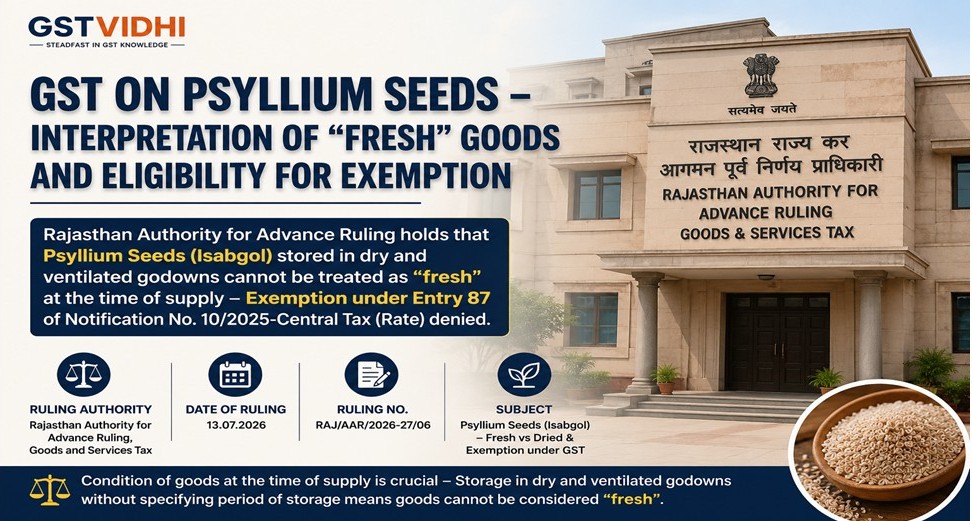
GST on Psyllium Seeds – Interpretation of “Fresh” Goods and
Eligibility for Exemption
v Name
of Applicant: M/s Rajendra Prasad Purshotam Moondra,
Jeera Mandi Road, Jodhpur, Rajasthan
v Ruling
Authority: Rajasthan Authority for Advance Ruling, Goods and
Services Tax
v Date
of Ruling: 13.07.2026
v Ruling
No.:
RAJ/AAR/2026-27/06
Summary of
Ruling
The applicant is engaged
in the trading of Psyllium Seeds (Isabgol) purchased directly from
farmers through APMC auctions. The applicant proposed to store the seeds in dry
and ventilated godowns and thereafter supply them to Isabgol processing units
without undertaking any processing such as drying, freezing, crushing, polishing
or chemical treatment.
The applicant sought a
ruling on whether such Psyllium Seeds would qualify as “fresh” Isabgol seeds
and consequently be exempt from GST under Entry 87 of Notification No.
10/2025-Central Tax (Rate) dated 17.09.2025. Alternatively, the applicant
sought clarification whether the goods would qualify as “goods of seed
quality” under Entry 77 covering Chapter 12.
The Authority did not
accept the applicant's contention that the goods would remain “fresh” at the
time of supply. The Authority observed that the seeds would be stored in
dry and ventilated godowns and that the period of storage was not specified.
According to the Authority, such storage would result in drying of the seeds.
Therefore, the goods could not be treated as “fresh” at the time of supply.
The Authority accordingly
held that the Psyllium Seeds supplied by the applicant would attract GST under
the applicable taxable entry rather than the exemption claimed by the
applicant.
Relevant
Sections / Notifications
The ruling primarily
involves the following provisions:
- Section 97(2) of the CGST Act, 2017
– specifies the questions on which an Advance Ruling can be sought.
- Section 103 of the CGST Act, 2017
– provides for the binding nature of an Advance Ruling.
- Section 104 of the CGST Act, 2017
– deals with situations where an Advance Ruling may be declared void.
- Heading 1211 of the Customs Tariff
Act, 1975 – covers plants and parts of plants,
including seeds and fruits, of a kind used primarily in perfumery,
pharmacy or for insecticidal, fungicidal or similar purposes.
- Notification No. 09/2025-Central Tax
(Rate) dated 17.09.2025 – relevant for the
taxable rate applicable to the goods.
- Notification No. 10/2025-Central Tax
(Rate) dated 17.09.2025 – provides the
relevant exemption entries, including Entry 77 relating to goods of seed
quality and Entry 87 relating to specified plants and parts of plants,
including seeds, which are fresh or chilled.
- Circular No. 163/19/2021-GST dated
06.10.2021 – considered by the Authority for
understanding the distinction between fresh and dried agricultural
products.
Submission
by the Applicant
The applicant submitted
that Psyllium Seeds (Isabgol) are an agricultural commodity obtained from the Plantago
ovata plant and are purchased directly from farmers through APMC auctions.
The applicant explained
that the farmers undertake normal agricultural activities such as cultivation,
harvesting and threshing. Threshing merely separates the seeds from the plant
and does not change the essential character of the agricultural produce.
After purchase, the
applicant proposed to store the seeds in godowns and supply them to Isabgol
processing units. The applicant specifically submitted that it would not
undertake drying, dehydration, freezing, roasting, crushing, polishing,
grading, milling, chemical treatment or any other processing.
The applicant further
submitted that the seeds remain in the same natural condition from harvesting
until their supply to the processing units.
It was also argued that
there is no established commercial practice of trading in a separate commodity
called “dried Isabgol seeds” or “frozen Isabgol seeds.” According
to the applicant, Psyllium Seeds are ordinarily traded as harvested
agricultural seeds and therefore should be regarded as “fresh.”
The applicant relied upon
the relevant GST notifications and the CBIC clarification/FAQ concerning the
classification and GST rate of Isabgol seeds and Isabgol husk.
The applicant therefore
contended that the goods should qualify for exemption under Entry 87 of
Notification No. 10/2025-Central Tax (Rate). Alternatively, the applicant
claimed exemption under Entry 77 relating to “all goods of seed quality.”
Findings of
the Authority
The Authority first
examined the classification of Psyllium Seeds under Heading 1211 of the
Customs Tariff Act, 1975.
The Authority noted that
Heading 1211 covers plants and parts of plants, including seeds and fruits,
used primarily in perfumery, pharmacy or for insecticidal, fungicidal or
similar purposes.
The Authority then
focused on the principal issue—whether the Psyllium Seeds would remain
“fresh” at the time of supply by the applicant.
The Authority observed
that the applicant proposed to store the Psyllium Seeds in dry and
ventilated godowns. Further, the applicant had not specified the period for
which the goods would remain in storage before being supplied to the processing
units.
According to the
Authority, the purpose of storing agricultural produce in dry and ventilated
godowns is to protect it from moisture and preserve it. However, such
conditions would result in the goods becoming dry over the period of storage.
The Authority therefore
held that the fact that the applicant did not intentionally undertake a
separate “drying process” was not sufficient to establish that the seeds would
remain fresh.
The Authority also
considered Circular No. 163/19/2021-GST dated 06.10.2021, particularly
the discussion concerning fresh and dried fruits and nuts. The Authority
considered the principle contained in the Circular—that exemption applicable to
fresh goods does not cover goods which have been dried in any manner or
otherwise processed—to be relevant to the present case.
The Authority further
observed that the applicant had not produced sufficient documentary evidence
establishing the time between harvesting by the farmer and final supply by the
applicant. In the absence of such evidence, the Authority was not satisfied that
the seeds would continue to remain fresh.
Judgment /
Decision of the Authority
The Authority rejected
the applicant's contention that the Psyllium Seeds would qualify as fresh
Isabgol seeds at the time of supply.
The important reasoning
of the Authority was that:
1. The
goods were to be stored in dry and ventilated godowns.
2. The
applicant had not specified the period of storage.
3. Agricultural
produce naturally loses moisture during storage.
4. The
applicant had not produced sufficient evidence to establish that the seeds
would remain fresh until the time of supply.
5. The
principles contained in Circular No. 163/19/2021-GST concerning fresh
and dried agricultural products were considered applicable.
6. Consequently,
the goods could not claim the exemption available specifically to fresh or
chilled goods under Entry 87.
The Authority thereafter
examined Notification No. 09/2025-Central Tax (Rate) and Notification
No. 10/2025-Central Tax (Rate) to determine the applicable GST treatment.
Conclusion:
The Rajasthan Authority
for Advance Ruling concluded that the Psyllium Seeds (Isabgol) supplied by
the applicant cannot be treated as “fresh” Isabgol seeds at the time of supply,
primarily because the applicant proposed to store the seeds in dry and
ventilated godowns and had not established the period of storage or
demonstrated that the goods would continue to remain fresh.
Therefore, the applicant could
not claim the exemption under Entry 87 of Notification No. 10/2025-Central Tax
(Rate) on the basis that the goods were fresh or chilled.
The ruling is
particularly important because the Authority has treated the condition of
the goods at the time of supply, rather than merely the absence of an
intentional drying process, as relevant for determining whether agricultural
produce qualifies as “fresh.”
Disclaimer: All the Information is strictly for educational purposes and on the basis of our best understanding of laws & not binding on anyone.
Click here