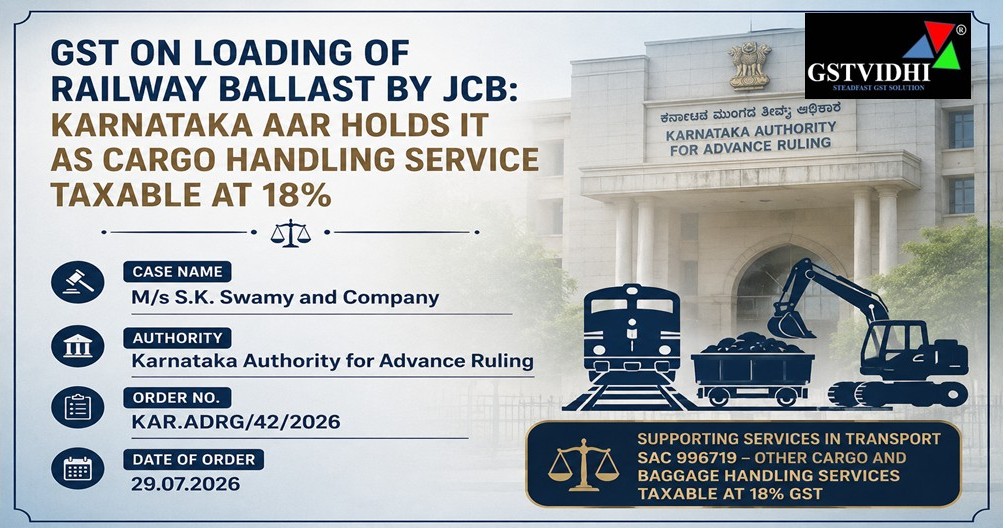
GST on Loading of Railway Ballast by JCB: Karnataka AAR Holds It
as Cargo Handling Service Taxable at 18%
v Case
Name: M/s S.K. Swamy and Company
v Authority:
Karnataka Authority for Advance Ruling
v Order
No.:
KAR.ADRG/42/2026
v Date
of Order: 29.07.2026
Summary of
the Case
The applicant was
involved in the supply of ballast to Indian Railways as well as the loading of
Railway-owned ballast into railway wagons.
The applicant contended
that the loading activity was connected with the supply of ballast and, since
ballast was taxable at 5% GST, the loading charges should also be liable
to GST at the same rate.
The applicant also relied
upon the fact that the supply of ballast constituted a substantial portion of
the overall contract.
The Karnataka Authority
for Advance Ruling examined the nature of the loading activity and the
contractual arrangement between the applicant and Indian Railways.
The Authority observed
that the supply of ballast and the loading activity were separately
identifiable. The ballast had already been supplied to and had become the
property of the Railways before the loading activity was undertaken.
Further, separate rates
were prescribed for the supply of ballast and loading activity, and the
activities were separately measurable and invoiced.
Accordingly, the
Authority held that the loading activity was an independent supply of
service and could not be treated as part of the supply of ballast.
The activity was
classified under SAC 996719 – Other cargo and baggage handling services,
taxable at 18% GST.
Relevant
Sections / Provisions
Section 2(30) – Composite
Supply
Section 2(30) of the CGST
Act defines composite supply as a supply consisting of two or more
taxable supplies of goods or services or both which are naturally bundled and
supplied in conjunction with each other in the ordinary course of business.
For a transaction to
qualify as a composite supply, the different supplies should therefore be
naturally bundled and supplied together.
Section 2(90) – Principal
Supply
Section 2(90) defines principal
supply as the supply which constitutes the predominant element of a
composite supply and to which other supplies forming part of the composite
supply are ancillary.
Section 2(119) – Works
Contract
Section 2(119) defines
works contract as a contract for building, construction, fabrication,
completion, erection, installation, fitting out, improvement, modification,
repair, maintenance, renovation, alteration or commissioning of any immovable
property involving transfer of property in goods.
Heading 9967 – Supporting
Services in Transport
Heading 9967 covers supporting
services in transport, including cargo handling services.
The loading activity in
the present case was classified under SAC 996719 – Other cargo and baggage
handling services.
The applicable GST rate
was determined to be 18%.
Submission
by the Applicant
The applicant submitted
that it was executing various contracts for Indian Railways, which included the
supply and stacking of ballast and other railway-related works.
It was submitted that the
supply of ballast constituted a substantial portion, i.e. more than 70%, of the
overall contract.
According to the
applicant, the loading of ballast into railway wagons was intrinsically
connected with the supply of ballast.
The applicant therefore
contended that the loading charges should not be treated as a separate service
for GST purposes.
Since the ballast was
subject to GST at 5%, the applicant argued that the loading activity
should also be taxed at 5%.
The applicant also sought
to establish that the activity formed part of the overall contract executed for
Indian Railways and should therefore receive the same tax treatment as the
principal supply.
Finding and
Decision of the Ruling Authority
The Karnataka Authority
for Advance Ruling examined the contractual terms and the actual manner in
which the activities were performed.
A. Loading Activity Not a
Works Contract
The Authority first
examined whether the loading activity could be classified as a works contract
under Section 2(119) of the CGST Act.
It was observed that the
activity involved merely loading ballast into railway wagons using JCB
loaders.
The activity did not
involve construction, erection, installation, repair, maintenance or any other
specified activity in relation to an immovable property.
Therefore, the essential
conditions of a works contract were not satisfied.
The Authority accordingly
held that the loading activity could not be classified as a works contract
service.
B. Supply of Ballast and
Loading Were Separate Activities
The Authority noted that
the Letter of Acceptance separately identified the supply of ballast and the
loading of ballast.
Separate rates were
prescribed for both activities.
The supply of ballast was
completed when the ballast was delivered at the railway depot or other
nominated location.
After delivery, the
ballast became the property of Indian Railways.
Thereafter, the applicant
was required to load the Railway-owned ballast into railway wagons using JCB
loaders.
Thus, the loading
activity was undertaken after the supply of ballast had already been
completed.
C. Not a Composite Supply
The Authority also
examined whether both activities could be treated as a composite supply under
Section 2(30).
It observed that the two
activities were separately identifiable and had separate consideration.
The loading activity was
performed on ballast which was already owned by the Railways.
Further, separate
invoices/consideration were attributable to the respective activities.
Therefore, the activities
were not considered to be naturally bundled supplies.
Merely because the supply
and loading activities were covered under the same overall contractual
arrangement did not automatically make them a composite supply.
Accordingly, the benefit
of the GST rate applicable to the ballast could not be extended to the separate
loading service.
D. Classification as
Cargo Handling Service
The Authority thereafter
examined the actual nature of the loading activity.
The applicant used JCB
loaders for lifting and loading the ballast into railway wagons.
The applicant was not
undertaking transportation of the ballast.
There was also no
shunting, towing, marshalling or movement of the railway wagons by the
applicant.
The essential nature of
the activity was therefore found to be loading and handling of goods for
onward transportation.
Accordingly, the activity
was classified under:
SAC 996719 – Other cargo
and baggage handling services
under Heading 9967 –
Supporting services in transport.
E. GST Rate of 18%
Since the activity was
classified as a cargo handling service under SAC 996719, the Authority held
that the applicable GST rate was:
18% GST – 9% CGST + 9%
SGST
or 18% IGST, as
applicable.
The Authority therefore
rejected the applicant's contention that the loading activity should be taxed
at 5% merely because the ballast supplied under the contract attracted a 5%
rate.
Conclusion
The Karnataka Authority
for Advance Ruling in M/s S.K. Swamy and Company, Order No. KAR.ADRG/42/2026
dated 29.07.2026, held that the activity of loading Railway-owned ballast
into railway wagons using JCB loaders constitutes an independent cargo
handling service.
The activity was neither
a works contract under Section 2(119) nor a composite supply
along with the supply of ballast under Section 2(30) of the CGST Act.
Since the ballast had
already been supplied to and owned by the Railways and the subsequent loading
activity was separately contracted, priced and performed, the loading service
was required to be independently classified.
The Authority classified
the activity under SAC 996719 – Other cargo and baggage handling services,
falling under Heading 9967, and held it taxable at 18% GST.
Disclaimer: All the Information is strictly for educational purposes and on the basis of our best understanding of laws & not binding on anyone.
Click here