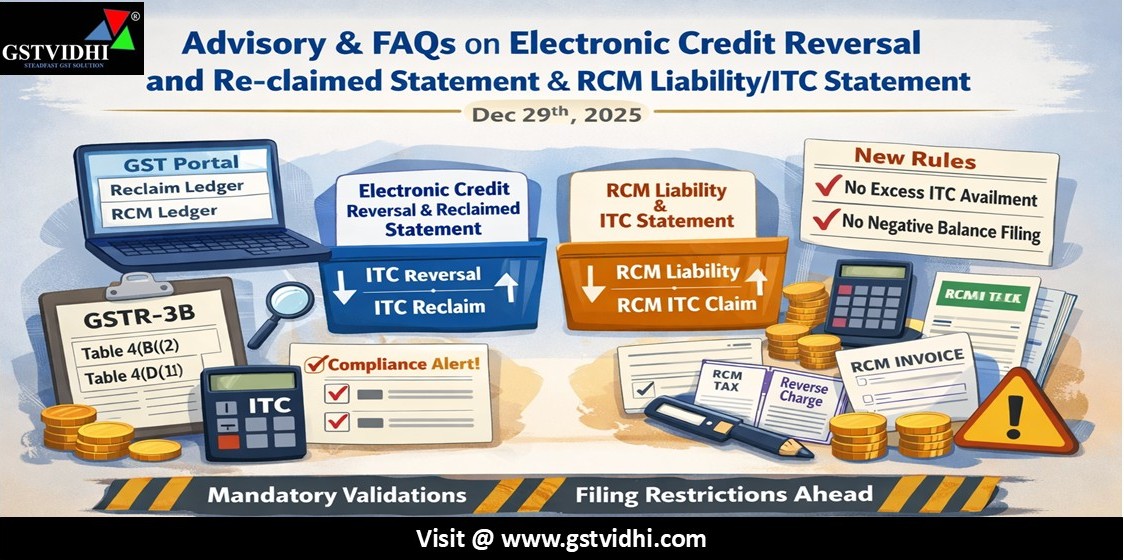
Advisory & FAQs on Electronic Credit Reversal and Re-claimed
Statement and RCM Liability/ITC Statement
(GSTN Advisory dated 29 December 2025)
1.
Introduction – Why this Advisory is Important:
The GST law allows
taxpayers to avail Input Tax Credit (ITC) subject to conditions and also
requires reversal of ITC in specific situations such as non-payment to vendors,
ineligible credits, or provisional reversals. Similarly, under the Reverse
Charge Mechanism (RCM), tax must first be paid and only then ITC can be
claimed.
Over the years, GST
authorities noticed frequent clerical errors, excess reclaim of ITC,
premature RCM ITC claims, and mismatch between liability paid and ITC availed.
To address these issues and to bring system-based discipline, GSTN
introduced two important system-generated statements (popularly called
ledgers):
1. Electronic
Credit Reversal and Re-claimed Statement (ITC Reclaim Ledger)
2. RCM
Liability/ITC Statement (RCM Ledger)
The advisory dated 29
December 2025 makes it clear that very soon the GST portal will strictly
block excess ITC availment, and taxpayers will not be allowed to file
GSTR-3B if these ledgers show negative balances or mismatches.
This article explains
both statements, upcoming validations, and practical steps taxpayers must take
to remain compliant.
2.
Electronic Credit Reversal and Re-claimed Statement – Concept and Purpose:
The Electronic Credit
Reversal and Re-claimed Statement was introduced to ensure accurate
tracking of ITC that is temporarily reversed and later reclaimed.
This statement is
applicable:
- From August 2023 onwards for monthly
filers, and
- From July–September 2023 quarter
onwards for quarterly filers.
What does this statement
capture?
This statement tracks:
- ITC reversed temporarily
in Table 4(B)(2) of GSTR-3B, and
- ITC reclaimed later
in:
- Table 4(A)(5), and
- Table 4(D)(1) of GSTR-3B.
In simple terms, it acts
as a memory ledger of how much ITC you reversed earlier and how much of
that reversal you have already reclaimed.
3. Filing
Experience So Far – Warning Without Restriction:
At present, if a taxpayer
tries to reclaim more ITC in Table 4(D)(1) than what is available in the
Reclaim Ledger, the system:
- Shows a warning message, but
- Still allows filing of GSTR-3B.
Because of this
flexibility, many taxpayers ended up with negative closing balances,
indicating excess reclaim of ITC.
4. Opening
Balance Facility – Multiple Chances Given:
GSTN has been fairly
liberal and provided multiple opportunities to taxpayers to:
- Declare opening balance of ITC
which was reversed earlier but not reclaimed, and
- Correct historical mismatches that
existed prior to introduction of this statement.
This opening balance
facility was meant to ensure that legacy reversals were properly reflected and
future compliance remained clean.
5. How to
View the Electronic Credit Reversal and Re-claimed Statement:
Taxpayers can view this
statement by following the below navigation on the GST portal:
Dashboard → Services →
Ledger → Electronic Credit Reversal and Re-claimed
Regular review of this
ledger is now critical, as it will directly impact the ability to file
returns.
6.
Introduction of RCM Liability/ITC Statement – A Second Control Ledger:
To further strengthen
compliance under Reverse Charge Mechanism, GSTN introduced another statement
called the RCM Liability/ITC Statement.
This statement is
applicable:
- From August 2024 onwards for monthly
filers, and
- From July–September 2024 quarter
for quarterly filers.
What does the RCM Ledger
track?
The RCM Ledger captures:
- RCM liability reported
in Table 3.1(d) of GSTR-3B, and
- RCM ITC claimed
in:
- Table 4(A)(2) (RCM –
services), and
- Table 4(A)(3) (RCM – inward
supplies from ISD, etc.).
This ensures that RCM
ITC is claimed only after tax is paid.
7. Warning
Mechanism in RCM Ledger:
Currently, if a taxpayer
claims RCM ITC exceeding:
- Closing balance of the RCM Ledger plus
- RCM liability reported in Table
3.1(d) of the same return,
The system generates a warning,
but still allows return filing.
However, this is about to
change.
8. Opening
Balance and Amendment Facility in RCM Ledger:
Just like the ITC Reclaim
Ledger, taxpayers were given multiple chances to:
- Declare opening balance of excess
RCM liability or ITC, and
- Correct past errors that occurred before
implementation of this statement.
This facility was a one-time
compliance correction window and should be utilised carefully.
9.
Accessing the RCM Liability/ITC Statement:
The RCM Ledger can be
accessed as follows:
Services → Ledger → RCM
Liability/ITC Statement
Taxpayers dealing
frequently with RCM transactions should monitor this statement every return
period.
10. Major
Change Ahead – Hard System Validations:
GSTN has now clearly
informed taxpayers that shortly, the portal will not allow:
- Negative balances in either ledger,
or
- Excess ITC availment beyond available
balance.
New Validations to be
Enforced
(a) For ITC Reclaim
Ledger
The ITC reclaimed in Table
4(D)(1) shall be less than or equal to:
Closing balance of ITC
Reclaim Ledger
plus
ITC reversed in Table 4(B)(2) of the current GSTR-3B.
(b) For RCM Ledger
RCM ITC claimed in Table
4(A)(2) & 4(A)(3) shall be less than or equal to:
Closing balance of RCM
Liability/ITC Statement
plus
RCM liability paid in Table 3.1(d) of the same GSTR-3B.
11.
Consequences of Negative Closing Balance – Filing Will Be Blocked:
If a taxpayer already has
a negative closing balance in either ledger, the system will not
allow filing of GSTR-3B until corrective action is taken.
(a) Negative Balance in
ITC Reclaim Ledger
This means excess ITC
was reclaimed earlier.
To file GSTR-3B, the
taxpayer must:
- Reverse the excess ITC in Table
4(B)(2) of the current return.
If no ITC is available in
the current period:
- The reversed amount will be added
to output tax liability and must be paid in cash.
Example:
If the ledger shows –₹10,000, the taxpayer must reverse ₹10,000 in Table
4(B)(2) to proceed with filing.
(b) Negative Balance in
RCM Liability/ITC Statement
This indicates excess
RCM ITC claimed earlier.
To correct this, the
taxpayer has two options:
1. Pay
additional RCM liability in Table 3.1(d) equivalent to
the negative balance, OR
2. Reduce
RCM ITC claim in Table 4(A)(2) or 4(A)(3) in the
current return.
Example:
If the RCM Ledger shows –₹5,000, the taxpayer must either:
- Pay ₹5,000 as RCM liability, or
- Reduce RCM ITC claim by ₹5,000.
Only after this
correction will return filing be allowed.
12. FAQs –
Key Clarifications
The FAQs issued by GSTN
largely reiterate the above principles and clearly indicate that system-based
compliance is now mandatory, not optional.
The emphasis is on:
- Correct reporting,
- No excess reclaim or premature ITC,
and
- Matching of liability paid and ITC
availed.
13.
Conclusion
The GST portal is
steadily moving towards a fully system-controlled compliance regime,
where manual flexibility will no longer be available. The introduction
and strict enforcement of the Electronic Credit Reversal and Re-claimed
Statement and the RCM Liability/ITC Statement marks a decisive step
in that direction.
Taxpayers who proactively
review and correct their ledgers will face smooth return filing, while
those ignoring these statements may soon find themselves blocked at the
filing stage with forced reversals or cash payments.
Early action, proper
reconciliation, and disciplined reporting are the only way forward under GST
Disclaimer: All the Information is based on the notification, circular advisory and order issued by the Govt. authority and judgement delivered by the court or the authority information is strictly for educational purposes and on the basis of our best understanding of laws & not binding on anyone.
Press On Click Here To Download Order File
Click here