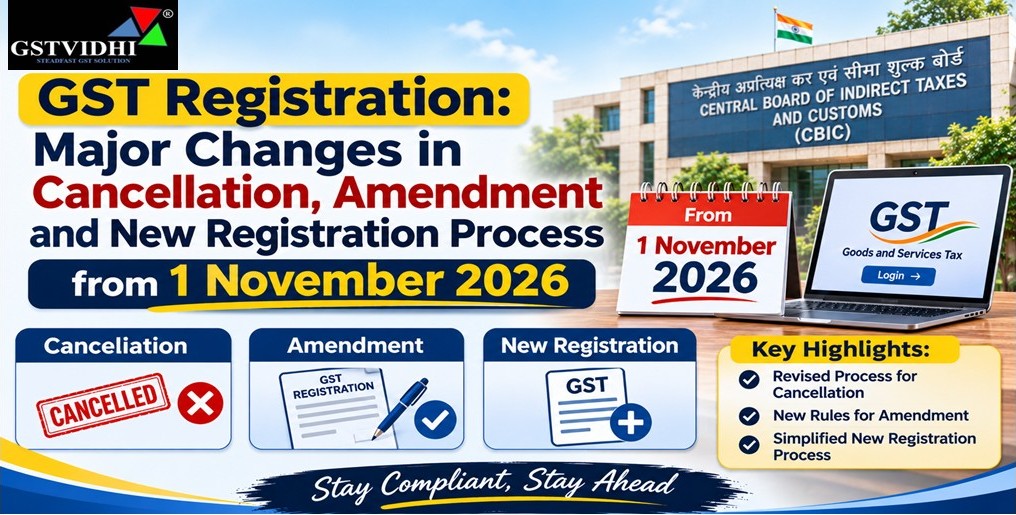
GST Registration: Major Changes in Cancellation, Amendment and
New Registration Process from 1 November 2026
The GST registration
process has undergone significant changes with effect from 1 November 2026. The
GST portal has introduced several system-based validations and automated
procedures to make registration, amendment and cancellation processes faster,
simpler and more transparent.
These changes have been
implemented pursuant to Notification No. 05/2026-Central Tax dated 26.10.2026
and Circular No. 257/03/2026-GST dated 26.10.2026.
The revised system
focuses on online verification of details, validation of identification
numbers, standardisation of supporting documents and electronic approval of
applications without unnecessary intervention by the tax officer.
Let us understand these
changes in simple language and their practical impact on taxpayers.
1. Changes
in GST Registration Cancellation – Form GST REG-16
The process of
cancellation of GST registration on the taxpayer's own request has been
revised. Under the new system, the GST portal will check the filing status of
returns and other prescribed conditions before processing the cancellation
application.
The objective is to
ensure that taxpayers complete their pending return-filing obligations before
their registration is cancelled.
A. Verification of
Pending Returns
When a taxpayer files an
application for cancellation in Form GST REG-16, the GST portal will verify
whether all applicable returns due on or before the effective date of
cancellation have been furnished.
- If any applicable return is already
due but has not been filed, the taxpayer will not be able to proceed with
the cancellation application.
- If the taxpayer has furnished outward
supply details in GSTR-1 or through the Invoice Furnishing Facility (IFF)
for a particular tax period, the corresponding GSTR-3B must also be filed.
Practical guidance:
Before applying for cancellation, taxpayers should check their return-filing
status and ensure that all returns due up to the proposed effective date of
cancellation have been filed.
B. Application Pending
for Returns Filing
In certain cases, some
returns may not yet be due on the date of filing the cancellation application
but will become due subsequently.
In such cases, the
application may move to the status "Pending for Returns Filing".
The taxpayer will be
required to furnish these returns within their respective prescribed due dates.
If the taxpayer files the
required returns within the prescribed timelines, the cancellation application
will proceed for further system-based processing.
C. What Happens If
Returns Are Not Filed?
If the taxpayer fails to
furnish the required returns within the prescribed timelines, the cancellation
application will be assigned to the jurisdictional tax officer for further
action.
Therefore, taxpayers
should not assume that filing Form GST REG-16 automatically results in
cancellation of registration.
D. Automatic Cancellation
Without Officer Intervention
One of the important
changes is the introduction of electronic approval of cancellation applications
through system-based processing.
The procedure will depend
upon the category of taxpayer and the amount of output tax liability.
1. Composition Taxpayers
and Specified Categories
For the following
taxpayers, registration will be cancelled through electronic approval without
intervention by the tax officer, subject to fulfilment of prescribed
conditions:
- Composition taxpayers.
- Non-Resident Taxable Persons (NRTPs).
- OIDAR taxpayers.
- Input Service Distributors (ISDs).
2. Regular, Casual and
SEZ Taxpayers
For regular taxpayers,
casual taxable persons and SEZ taxpayers, the GST portal will examine the
output tax liability (OTL) for each tax period.
The following procedure
will apply:
|
Output
Tax Liability
|
Cancellation
Procedure
|
|
₹2.5
lakh or less in each tax period
|
Electronic
cancellation without officer intervention.
|
|
More
than ₹2.5 lakh in any tax period
|
Filing
of GSTR-10 within the prescribed timeline will be required, wherever
applicable.
|
E. Requirement to File
Final Return – GSTR-10
Where the output tax
liability exceeds ₹2.5 lakh in any tax period, the taxpayer will be required to
furnish the final return in Form GSTR-10 within three days from the applicable
date.
The three-day period will
be calculated as follows:
- Where the application is pending for
returns filing, three days will be counted from the due date of the
returns identified at that stage.
- Where there is no
pending-for-returns-filing stage, three days will be counted from the date
of submission of the cancellation application.
Thereafter:
- If GSTR-10 is filed within the
prescribed period: The registration will be cancelled electronically
without officer intervention.
- If GSTR-10 is not filed within the
prescribed period: The application will be assigned to the jurisdictional
tax officer for further action.
F. GSTR-10 Where
Cancellation Is Approved by the Tax Officer
If the application is
referred to the jurisdictional tax officer and the officer subsequently cancels
the registration, the taxpayer will be required to file Form GSTR-10 under the
existing procedure, i.e., within 90 days from the effective date of cancellation,
wherever applicable.
Practical guidance for
taxpayers: Before applying for cancellation, reconcile the output tax liability
for each tax period, check all pending returns and examine whether GSTR-10 will
be required. Timely compliance can help avoid unnecessary officer intervention
and delays in cancellation.
2. Changes
in GST Registration Amendment – Form GST REG-14
The amendment process
under Rule 19 of the CGST Rules, 2017 has been revised vide Notification No.
05/2026-Central Tax dated 26.10.2026.
Under the revised
procedure, certain amendments will continue to require examination and approval
by the Proper Officer, whereas other amendments will be approved electronically
after successful online verification and validation.
The amendments have been
divided into two categories:
A. Amendment of Principal
Place of Business (PPOB)
If a taxpayer wants to
change the Principal Place of Business, the application will continue to be
examined by the Proper Officer under Rule 19 of the CGST Rules, 2017.
Thus, a change in the
principal place of business will not receive automatic approval merely upon
submission of the amendment application.
The taxpayer should
ensure that the correct address details and prescribed supporting documents are
uploaded with Form GST REG-14.
B. Amendment of Other
Registration Particulars
For amendments other than
the Principal Place of Business, the revised system provides for automatic
amendment of registration after successful online verification and validation.
These amendments include:
- Change in the legal name of the
business.
- Addition or deletion of partners,
directors, Karta, members or trustees, as applicable.
- Addition or deletion of Additional
Place of Business.
- Other changes in the particulars
furnished in Form GST REG-01, except the Principal Place of Business.
Once the prescribed
online validations are successfully completed, the amended registration
certificate will be made available on the GST portal without requiring
examination by the Proper Officer, wherever applicable.
C. Mandatory OTP
Verification
An important change is
the introduction of OTP-based verification of mobile numbers and email
addresses.
The following persons
will be required to complete online verification:
1. Primary
Authorised Signatory.
2. One
selected Promoter/Partner/Director/Karta/Member/Trustee, as applicable.
The verification can be
completed through the GST portal using the following link:
GST
Portal – OTP Verification
Alternatively, taxpayers
can access this facility through:
Services → Registration →
OTP Verification of GSTIN
Important: Taxpayers will
get three days from the date of submission of the amendment application to
complete the prescribed OTP verification. If verification is not completed
successfully within this period, the ARN will not be generated.
D. Online Validation of
PAN and DIN
The GST portal will also
carry out system-based validation of the following details, wherever
applicable:
- Permanent Account Number (PAN).
- Director Identification Number (DIN).
The Application Reference
Number (ARN) will be generated only after successful completion of the
prescribed validations.
Practical guidance:
Before filing Form GST REG-14, taxpayers should ensure that the mobile numbers
and email addresses of the relevant persons are active and accessible. They
should also verify PAN and DIN details and keep supporting documents ready to avoid
delays in ARN generation.
3. Major
Changes in New GST Registration – Form GST REG-01
The GST portal has also
introduced a revised Form GST REG-01 for persons applying for fresh GST
registration.
The revised application
requires additional information and introduces standardised documentary
requirements relating to the constitution of business, business premises and
other registration particulars.
The important changes are
explained below.
A. One Person Company
(OPC) Introduced as a Separate Category
One Person Company (OPC)
has been introduced as a separate category under the constitution of business.
Applicants will be
required to upload relevant documents according to their business constitution,
such as:
- Certificate of Incorporation.
- Partnership Deed.
- Registration Certificate.
- Other documents supporting the
constitution of the business, as applicable.
B. Separate Field for SEZ
Entity ID
A new field has been
introduced for entering the SEZ Entity ID.
This requirement is
relevant for applicants seeking GST registration as:
Applicants falling under
these categories should keep their SEZ Entity ID ready while filing the
registration application.
C. Separate Details for
E-Commerce Operators under Section 9(5)
A separate section has
been introduced for applicants seeking registration as an e-commerce operator
liable to pay tax under Section 9(5) of the CGST Act, 2017.
Such applicants will be
required to provide details regarding:
- Physical presence in the State or
Union Territory.
- Authorised representative, wherever
applicable.
This will help the GST
portal capture the relevant information separately for e-commerce operators
covered under Section 9(5).
D. Revised Details of
Existing Registrations
The particulars relating
to existing registrations have also been revised.
Applicants may now be
required to furnish details such as:
- Existing GSTIN.
- Professional Tax Registration Number.
- Professional Tax Enrolment
Registration Number.
- Other applicable registration
particulars.
Taxpayers should
carefully disclose their existing registrations while applying for a new GST
registration.
E. Revised Classification
of Principal and Additional Places of Business
The classification of
possession of business premises has been standardised.
The revised form provides
separate categories for different types of premises, including:
1. Owned
premises.
2. Premises
in the name of a deceased ancestor.
3. Rented
or leased premises.
4. Premises
held with the consent of the owner.
5. Co-working
spaces.
6. SEZ
premises.
The supporting documents
required for each category have also been specified.
Practical guidance:
Applicants should select the correct category of possession and upload the
corresponding documents. For example, a taxpayer operating from rented premises
should select the appropriate rented/leased category and furnish the prescribed
supporting documents.
F. Expansion of Nature of
Business Activities
The list of business
activities in Form GST REG-01 has been expanded to capture additional business
information.
The revised form includes
additional categories and disclosures relating to:
- Factory registration particulars.
- Authorised Economic Operator (AEO)
details.
- Co-working space.
- Health and fitness clubs.
- Renting or leasing of immovable
property.
- Renting or hiring of motor vehicles.
- Renting or hiring of vessels or
aircraft.
Applicants should
carefully select all business activities relevant to their operations.
G. Bank Account Details
at the Time of Registration
Another important change
relates to furnishing bank account details.
Under the revised
process:
- Applicants are required to furnish
bank account details, wherever available, at the time of filing Form GST
REG-01.
- Details of up to 10 bank accounts can
be furnished.
- If bank account details are not
available at the time of application, the taxpayer must furnish them
within 30 days from the date of issuance of the registration certificate
in Form GST REG-06.
Practical guidance:
Applicants should preferably keep their bank account details ready before
starting the registration process. If the details are not available, they
should ensure that the information is furnished within the prescribed 30-day
period.
H. DIN of Designated
Partners in LLP
For applicants seeking
registration as a Limited Liability Partnership (LLP), the revised form
requires the Director Identification Number (DIN) of the designated partners to
be furnished.
Applicants should ensure
that the DIN particulars are correctly entered in the registration application.
I. Online Validation of
Identification Numbers
The GST portal will also
undertake online validation of certain identification numbers, wherever
applicable.
These include:
- Corporate Identification Number
(CIN).
- Foreign Company Registration Number
(FCRN).
- Limited Liability Partnership
Identification Number (LLPIN).
- Foreign Limited Liability Partnership
Identification Number (FLLPIN).
The ARN will be generated
only after successful online validation of the required information.
4.
Important Guidance for Taxpayers and Professionals
The revised GST
registration process places greater emphasis on system-based verification and
timely compliance. Taxpayers and GST practitioners should keep the following
points in mind:
|
Area
|
What
taxpayers should do
|
|
Cancellation
(REG-16)
|
File
all applicable pending returns before applying for cancellation.
|
|
GSTR-1
and GSTR-3B
|
Ensure
GSTR-3B is filed for periods for which GSTR-1/IFF has been furnished.
|
|
Final
Return (GSTR-10)
|
Check
whether the output tax liability exceeds ₹2.5 lakh in any tax period and
comply with the prescribed three-day timeline, wherever applicable.
|
|
Amendment
(REG-14)
|
Complete
OTP verification within three days.
|
|
Change
in PPOB
|
Upload
appropriate documents and await examination by the Proper Officer.
|
|
Fresh
Registration (REG-01)
|
Select
the correct constitution and premises category and upload supporting
documents.
|
|
Bank
Details
|
Furnish
bank account details at application stage or within 30 days of issuance of
REG-06.
|
|
PAN/DIN/CIN
|
Ensure
that all identification particulars are correct and available for online
validation.
|
5.
Conclusion: Towards a More Automated GST Registration System
The revised registration
process represents another step towards the digitisation and automation of GST
administration.
Earlier, several
registration-related amendments and cancellation applications required
intervention by the jurisdictional tax officer. Under the revised mechanism,
many such applications can now be processed electronically after successful
system-based verification.
However, this also means
that taxpayers must be more careful while furnishing information, uploading
supporting documents and completing online verification within the prescribed
timelines.
For businesses, the
revised process can reduce unnecessary visits to GST offices and delays in
routine registration matters. For GST practitioners, it becomes important to
review the revised forms and educate clients about the additional compliance
requirements.
In simple terms, the new
system aims to make GST registration, amendment and cancellation faster through
automation, while ensuring that taxpayers fulfil the prescribed statutory
requirements.
Reference
Documents:
1.
Notification No.
05/2026-Central Tax dated 26.10.2026.
2.
Circular No.
257/03/2026-GST dated 26.10.2026.
3.
GSTN Advisory on
Revised Process for Approval of Registration Cancellation under Form GST REG-16
dated 01.11.2026.
4.
GSTN Advisory on
Changes in GST Registration Amendment and Revised Form GST REG-01 dated
01.11.2026.
Disclaimer: All the Information is based on the notification, circular advisory and order issued by the Govt. authority and judgement delivered by the court or the authority information is strictly for educational purposes and on the basis of our best understanding of laws & not binding on anyone.
Click here