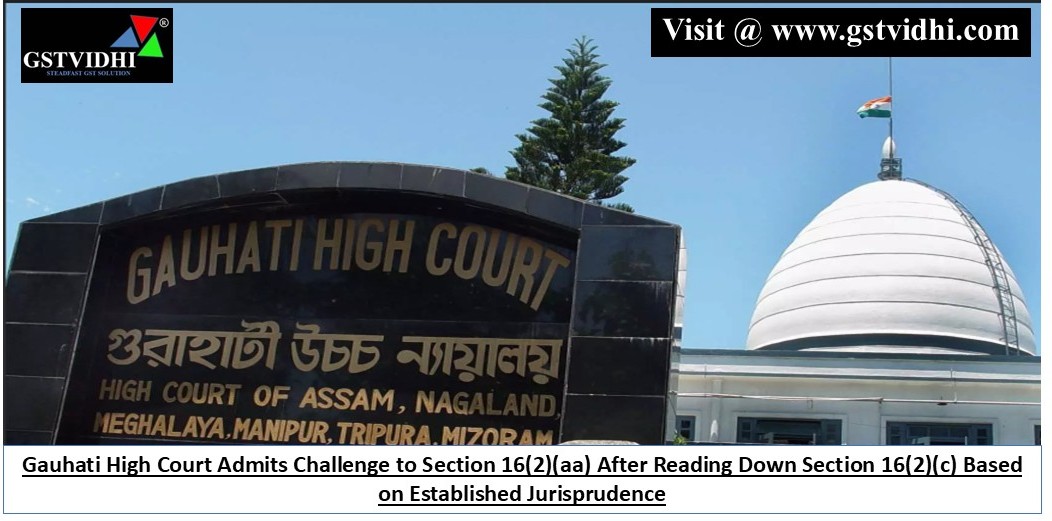
M/S Mcleod Russel India Ltd. Vs. Union Of India & Others (Gauhati
High Court - WP(C)/5725/2022)
(Gauhati
High Court Admits Challenge to Section 16(2)(aa) After Reading Down Section
16(2)(c) Based on Established Jurisprudence)
Introduction: The
Gauhati High Court, in an important order dated 27 February 2025,
considered a constitutional challenge raised by M/s McLeod Russel India
Limited against the validity of certain provisions governing Input Tax
Credit (ITC) under the GST regime. While the Court had already settled the
legality of Section 16(2)(c) in a prior judgment, the present petition
specifically questioned both Section 16(2)(c) and the newly inserted Section
16(2)(aa) of the CGST/AGST Acts, along with Rule 36(4) of the CGST Rules.
However, during the
hearing, the petitioner did not press the challenge to Rule 36(4) as it had
already been upheld in a previous case. The Court ultimately admitted the
petition to examine the constitutional validity of Section 16(2)(aa), while
applying its earlier ruling to Section 16(2)(c).
Case
Details
- Case Title:
M/s McLeod Russel India Limited vs. Union of India & Others
- Court:
Gauhati High Court (Assam, Nagaland, Mizoram & Arunachal Pradesh)
- Case Number:
WP(C)/5725/2022
- Coram:
Hon’ble Chief Justice Vijay Bishnoi & Hon’ble Justice N. Unni Krishnan
Nair
- Date of Order:
27 February 2025
- Petitioner:
M/s McLeod Russel India Limited
- Respondents:
1. Union
of India
2. State
of Assam
3. Commissioner,
CGST, Guwahati
4. Commissioner
of State Taxes, Assam
Background
of the Case: The petitioner, a
well-known public limited company in Assam, challenged the following three
provisions:
1. Section
16(2)(aa) of the CGST/AGST Act
2. Section
16(2)(c) of the CGST/AGST Act
3. Rule
36(4) of the CGST/AGST Rules
These provisions impose
conditions for availing ITC, particularly linking the purchaser’s ITC
entitlement to the supplier’s actions—such as uploading invoices, paying tax to
the Government, and reflecting the supplies in GSTR-1.
The petitioner argued
that these conditions unfairly burden bona fide purchasing dealers and violate
constitutional protections.
Petitioner’s
Submissions
1. Challenge to Rule
36(4) Not Pressed
The petitioner
acknowledged that the validity of Rule 36(4) had already been upheld by
the Gauhati High Court in WP(C) 4787/2024, decided just two days earlier
(25.02.2025). Therefore, this challenge was not pressed further.
2. Section 16(2)(c) Must
Be Read Down
The petitioner drew
attention to an earlier judgment of the same High Court in WP(C) 2863/2022
(decided 05.08.2024), where:
- Section 16(2)(c) was read down,
not struck down
- The Court relied on Delhi High
Court’s landmark ruling in On Quest Merchandising India Pvt. Ltd.
- The principle established was:
If the supplier fails to
deposit tax collected from the purchasing dealer, the proper remedy is to
proceed against the supplier. ITC cannot be denied to the buyer unless evidence
of collusion exists.
The petitioner requested
that the same interpretation be applied to this case.
3. Challenge to Section
16(2)(aa)
The petitioner argued
that Section 16(2)(aa)—a newer condition added w.e.f. 01.01.2022—also deserves
constitutional scrutiny because it mandates ITC only if the supplier uploads
invoice details in GSTR-1.
This condition, according to the petitioner, is:
- Arbitrary
- Unreasonable
- Against the scheme of GST
- Punitive to genuine purchasers
The petitioner sought the
Court’s intervention.
Respondents’
Submissions: The Government counsel did not object to
deciding the challenge to Section 16(2)(c) in line with the Court’s
earlier judgment dated 05.08.2024.
With respect to the
challenge to Section 16(2)(aa), the respondents argued that the matter
requires detailed hearing, as the condition was introduced to prevent invoice
fraud and strengthen compliance.
Court’s
Findings:
1. Section 16(2)(c)
Challenge Already Settled
The Court agreed with
both sides that:
- In its earlier decision (WP(C)
2863/2022), it had already applied the On Quest Merchandising
principles.
- That decision read down Section
16(2)(c), stating that the department must first act against the defaulting
supplier, not the buyer—unless collusion is shown.
Thus, in this case, the
Court disposed of the challenge to Section 16(2)(c) by applying the
earlier ruling.
2. Petition Regarding
Section 16(2)(aa) Requires Detailed Consideration
The Court held that:
- Since arguments on Section 16(2)(aa)
raise substantial constitutional questions,
- And no prior ruling of the same court
conclusively addresses its validity,
the matter requires
admission and full hearing.
Thus, the Court formally admitted
the petition with respect to Section 16(2)(aa).
3. Rule 36(4) Not
Examined
Since the petitioner did
not press the challenge against Rule 36(4), the Court did not examine it.
Order:
The Gauhati High Court
held as follows:
1. Challenge
to Rule 36(4) – Not pressed by petitioner; therefore
dismissed as such.
2. Challenge
to Section 16(2)(c) – Already decided in WP(C) 2863/2022;
accordingly disposed of in those terms.
3. Challenge
to Section 16(2)(aa) –
o The
matter is admitted for final hearing.
o No
formal notice required, as all respondents are already represented.
The case will now proceed
to the next stage, where the constitutional validity of Section 16(2)(aa) will
be evaluated in depth.
Conclusion:
This
order of the Gauhati High Court marks a crucial development in ongoing
challenges relating to Input Tax Credit restrictions under the GST framework.
While Section 16(2)(c) continues to be interpreted in a buyer-friendly
manner—requiring authorities to first act against defaulting suppliers—Section
16(2)(aa) is now set for thorough judicial scrutiny.
Disclaimer: All the Information is based on the notification, circular advisory and order issued by the Govt. authority and judgement delivered by the court or the authority information is strictly for educational purposes and on the basis of our best understanding of laws & not binding on anyone.
Press On Click Here To Download Order File
Click here