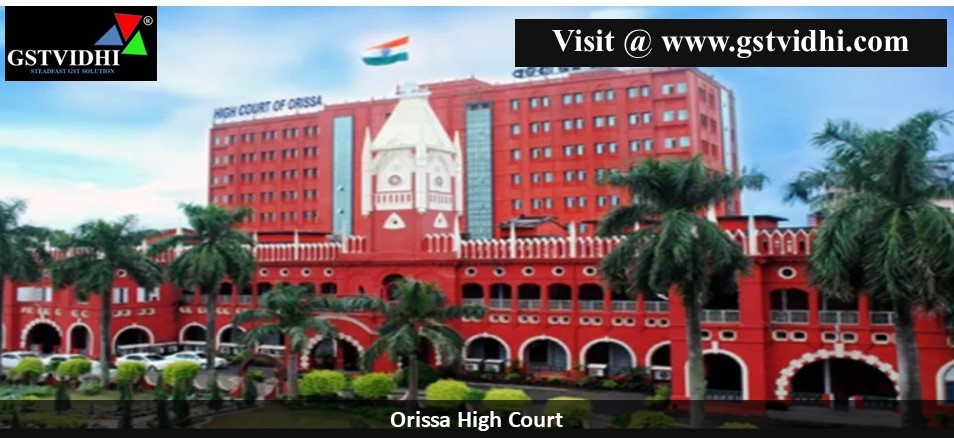
Interest Is Payable On Refund Of IGST Collected Under An
Unconstitutional Levy – Orissa High Court In Paradeep Phosphates Limited
(M/s Paradeep Phosphates Limited v. Additional Commissioner, GST
(Appeals) & Others / W.P.(C) No.11618 of 2024 / Orissa High Court, Cuttack
/ 22 January 2026)
Introduction
The Orissa High Court, in
a significant judgment delivered in January 2026, has settled an important
issue relating to interest on refund of IGST paid on ocean freight under
CIF contracts. While the illegality of levying IGST on ocean freight already
stood concluded by the Supreme Court in Union of India v. Mohit Minerals
Pvt. Ltd., the present case addresses a critical but often litigated
consequence—
From which date is
interest payable when tax itself was collected without authority of law?
The ruling in Paradeep
Phosphates Limited draws a clear distinction between statutory delayed
refunds under Section 56 of the CGST Act and refunds arising from
unconstitutional or unauthorized tax collection, holding that interest is
payable from the date of deposit till the date of refund.
Facts of
the Case
M/s Paradeep Phosphates
Limited, a manufacturer of fertilizers, imported raw materials such as
phosphoric acid, ammonia, sulphur, etc., during April–May 2018 on a CIF
(Cost, Insurance and Freight) basis.
Key factual aspects
include:
- IGST was paid on imported goods
including the ocean freight component
- Additional IGST @ 5% was paid on
ocean freight under reverse charge mechanism (RCM) in terms of:
- Notification No. 8/2017–IGST (Rate)
- Notification No. 10/2017–IGST (Rate)
- The tax was paid under protest
- The assessee challenged the levy
before the Orissa High Court in 2019
Meanwhile, similar
notifications were struck down by the Gujarat High Court in Mohit Minerals
Pvt. Ltd., which was later affirmed by the Supreme Court in May 2022.
Background:
Mohit Minerals and Its Impact
In Union of India v.
Mohit Minerals Pvt. Ltd. (2022), the Supreme Court held that:
- CIF imports constitute a composite
supply
- Ocean freight cannot be artificially
vivisected and taxed separately
- Levy of IGST on ocean freight amounts
to double taxation
- Such levy violates Sections 2(30)
and 8 of the CGST Act
Following this, the
Orissa High Court disposed of Paradeep Phosphates’ writ petition and allowed
refund of IGST paid on ocean freight.
Refund
Granted but Interest Denied
Pursuant to the judgment:
- Refund of ₹8.37 crore IGST was
sanctioned in September 2022
- No interest
was granted on the refunded amount
The assessee applied
separately for interest, which was rejected on the ground that:
- Refund was sanctioned within 60 days
of filing RFD-01
- Section 56 of CGST Act allows
interest only for delayed refunds
The rejection was upheld
by the Appellate Authority, leading to the present writ petition.
Core Legal
Issue
Whether interest is
payable on refund of IGST collected under an unconstitutional levy, and if yes,
from which date?
Specifically:
- Is interest governed strictly by Section
56 of CGST Act, or
- Does Article 265 of the
Constitution mandate interest from the date of unlawful collection?
Arguments
by the Petitioner
The petitioner contended
that:
- IGST on ocean freight was collected without
authority of law
- Payment was made under protest
- Once levy is declared
unconstitutional, the State cannot retain the money even temporarily
- Interest is compensatory in nature
and must run from the date of deposit, not from the date of refund
application
It was argued that
Section 56 applies only to statutory refunds, not to refunds arising
from unconstitutional taxation.
Stand of
the Department
The Department relied
strictly on Sections 54 and 56 of the CGST Act, arguing that:
- Refund was granted within 60 days
- Therefore, no interest is payable
- No specific statutory provision
allows interest prior to filing of refund application
Findings of
the Orissa High Court
The High Court decisively
rejected the Department’s approach and made the following crucial observations:
1. Distinction Between
Statutory Refund and Unauthorised Collection
The Court held that:
- This is not a case of delayed
refund
- It is a case of unauthorised levy
and collection of tax
Section 56 deals with
delay in processing valid refunds—not with compensation for illegal exaction.
2. Article 265 Overrides
Statutory Limitations
The Court emphasized
Article 265 of the Constitution:
“No tax shall be levied
or collected except by authority of law.”
Once the levy is declared
unconstitutional:
- Retention of tax becomes illegal
- The taxpayer is entitled not only to
refund but also interest for deprivation of money
3. Payment Under Protest
is a Key Factor
The Court noted that:
- IGST was paid under protest
- The challenge to levy was pending
- Therefore, the State was aware of the
disputed nature of collection
This strengthens the
taxpayer’s claim for interest from the date of deposit.
4. Section 56 Not a Bar
in Such Cases
The Court categorically
held that:
- Section 56 cannot be used to deny
interest where tax itself was illegally collected
- Interest in such cases is a constitutional
consequence, not merely statutory
Final
Decision
The Orissa High Court
held that:
- The orders rejecting interest were illegal
and unsustainable
- The petitioner is entitled to interest
@ 6%
- Interest shall be calculated from
the date of deposit of IGST till the date of actual refund
The writ petition was
allowed accordingly
Conclusion
The decision in Paradeep
Phosphates Limited reinforces a fundamental constitutional principle:
The State cannot profit
from an illegal levy.
By granting interest from
the date of deposit, the Orissa High Court ensures that taxpayers are fully
compensated for unlawful deprivation of funds. This judgment will serve as a powerful
precedent in GST refund litigation, particularly where tax demands collapse
due to constitutional invalidity rather than mere procedural lapses.
Disclaimer: All the Information is based on the notification, circular advisory and order issued by the Govt. authority and judgement delivered by the court or the authority information is strictly for educational purposes and on the basis of our best understanding of laws & not binding on anyone.
Press On Click Here To Download Order File
Click here