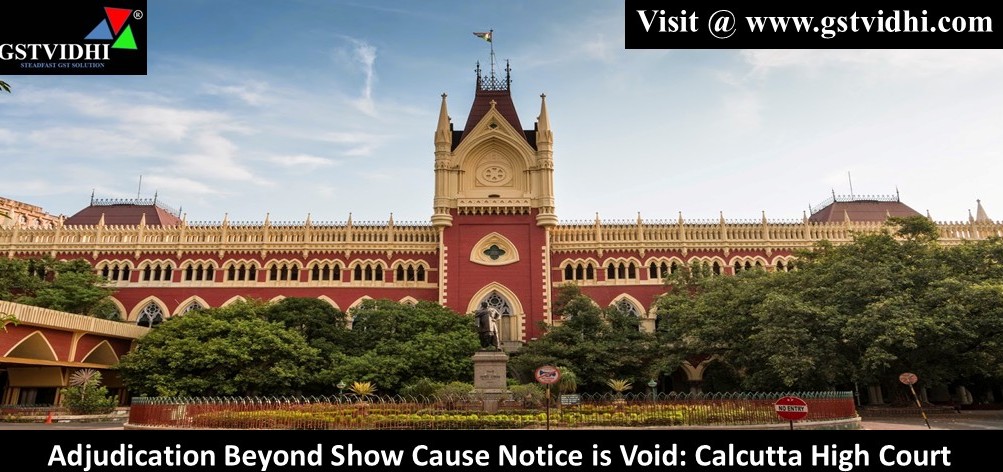
Adjudication Beyond Show Cause Notice is Void: Calcutta High
Court Reiterates Mandatory Compliance with Section 75(7) of the CGST Act
(M/s Duakem Pharma Pvt. Ltd. & Anr. v. The Deputy
Commissioner of Revenue & Ors. (WPA 9951 of 2025, order dated 21 January
2026)
Introduction
The Calcutta High Court,
in M/s Duakem Pharma Pvt. Ltd. & Anr. v. The Deputy Commissioner of
Revenue & Ors. (WPA 9951 of 2025, order dated 21 January 2026), has
once again reaffirmed a foundational principle of GST adjudication—an order
cannot travel beyond the scope of the show cause notice. Any adjudication
based on grounds not proposed in the notice is a clear violation of Section
75(7) of the CGST Act, 2017 and is liable to be set aside.
This ruling is
particularly significant in cases involving ITC reversal, exemption
disputes, and classification issues, where adjudicating authorities often
introduce new grounds at the stage of final order without giving the taxpayer
an opportunity to respond.
Brief Facts
of the Case
The writ petition was
filed challenging an adjudication order dated 24 February 2025, passed
under Section 74 of the CGST/WBGST Act, 2017.
Earlier, a show cause
notice dated 11 November 2024 was issued under Section 73(1),
proposing reversal of Input Tax Credit allegedly attributable to exempt
supplies, aggregating to:
- ₹23,12,870 under IGST, and
- ₹3,79,210.65 each under CGST and
SGST.
The allegation in the
notice was limited to proportionate reversal of ITC under Section 17(2)
on the premise that the petitioner had made exempt supplies.
The petitioner submitted
a detailed reply asserting that:
- No ITC reversal was required, and
- The exempt turnover declared by the
department was factually incorrect.
Impugned
Adjudication Order – A Clear Change of Ground
While passing the
adjudication order, the Proper Officer went far beyond the allegations in the
show cause notice and held that the product supplied by the
petitioner—Dicalcium Phosphate (DCP)—was not eligible for exemption at all.
The adjudicating
authority concluded that:
- The invoices did not establish that
DCP supplied was animal feed grade conforming to IS Specification No.
5470:2002, and
- Therefore, the supply was taxable
under HSN 2309 at 18% GST.
Based on this entirely
new finding:
- The authority re-characterized
exempt turnover as taxable,
- Raised fresh tax demands, and
- Ordered ITC reversal with interest
under Sections 50(1) and 50(3).
This classification
and exemption dispute was never part of the show cause notice.
Core Legal
Issue
The principal issue
before the High Court was:
Whether an adjudication
order can be sustained when it is based on a ground never proposed in the show
cause notice, thereby violating Section 75(7) of the CGST Act, 2017?
Petitioner’s
Arguments
The petitioner strongly
contended that:
- The only issue in the show cause
notice was proportionate ITC reversal due to exempt supplies.
- The question of taxability or
exemption of DCP was never raised.
- The adjudicating authority introduced
a completely new allegation, namely, denial of exemption, without
issuing any notice or granting opportunity of hearing on that aspect.
It was further argued
that this amounted to:
- Violation of principles of natural
justice, and
- Direct breach of Section 75(7),
which statutorily restricts adjudication to matters specified in the
notice.
The petitioner also
relied upon an earlier order of the same High Court in WPA 18295 of 2024,
involving the same assessee, where a similar adjudication order was set aside
on identical grounds.
Revenue’s
Stand
The State argued that:
- Since the notice referred to ITC
reversal in relation to exempt supplies,
- The adjudicating authority was
justified in examining whether the outward supply was actually exempt.
According to the
department, the adjudication did not introduce a new ground but merely examined
the correctness of the exemption claim.
High
Court’s Analysis
The Calcutta High Court
carefully examined the contents of the show cause notice and found that:
- At no point was the taxability or
classification of DCP put in issue.
- The notice only questioned quantification
of exempt turnover and consequent ITC reversal.
- The petitioner was never called
upon to prove that DCP was exempt under HSN 2309.
The Court observed that
the adjudicating authority:
- Practically decided a
classification dispute without issuing a notice, and
- Fastened tax liability on an entirely
new factual and legal foundation.
Section 75(7) – A
Mandatory Safeguard
The Court emphasized that
Section 75(7) of the CGST Act clearly mandates:
“The amount of tax,
interest and penalty demanded in the order shall not be in excess of the amount
specified in the notice and no demand shall be confirmed on grounds other than
the grounds specified in the notice.”
This provision is not
procedural but substantive in nature, meant to ensure:
- Fair play in adjudication,
- Transparency in tax proceedings, and
- Effective opportunity of defense to
the taxpayer.
Finding and
Decision
The Court held that:
- The adjudication order was passed on grounds
absolutely different from those mentioned in the show cause notice.
- Such an order is ex facie illegal
and unsustainable.
- The impugned order dated 24 February
2025 violated Section 75(7) and principles of natural justice.
Accordingly, the High
Court:
- Set aside the adjudication order in
entirety.
Conclusion
The Calcutta High Court’s
decision in M/s Duakem Pharma Pvt. Ltd. is a strong reaffirmation of
taxpayer protections under GST law. It sends a clear message to tax
authorities that adjudication is not a fishing expedition and cannot go
beyond the four corners of the show cause notice.
Disclaimer: All the Information is based on the notification, circular advisory and order issued by the Govt. authority and judgement delivered by the court or the authority information is strictly for educational purposes and on the basis of our best understanding of laws & not binding on anyone.
Press On Click Here To Download Order File
Click here