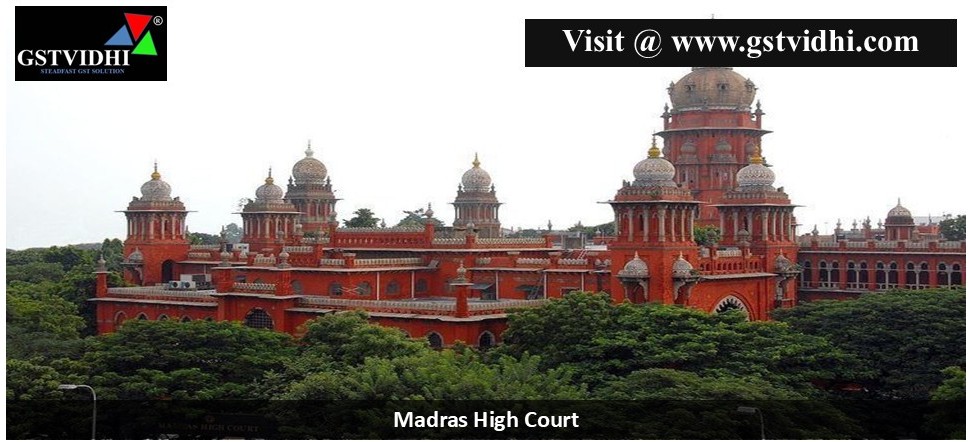
Wrong Claim of ITC Under CGST/SGST Instead of IGST Can Be
Rectified – No Further Proceedings After ASMT-12: Madras High Court
(Periyasamy Karthikeyan vs. State Tax Officer, Karur-4
Assessment Circle
W.P.(MD) No. 3049 of 2025 / Madras High Court (Madurai Bench) / Decision
Date: 06 January 2026)
Introduction
In a significant ruling
protecting bona fide taxpayers from repetitive and mechanical GST proceedings,
the Madras High Court has held that once an explanation offered during
scrutiny proceedings is accepted and ASMT-12 is issued, no further proceedings
can be initiated on the same issue. The Court further clarified that wrong
availment of ITC under CGST and SGST instead of IGST due to clerical error can
be rectified through GSTR-9 and GSTR-9C, and such error does not
automatically result in revenue loss.
This judgment reiterates
the statutory bar under Section 61(2) of the CGST Act, 2017, and
provides much-needed clarity on ITC head-wise classification errors.
Brief Facts
of the Case
The petitioner, a
registered taxpayer, while filing GSTR-3B for FY 2018-19, had erroneously
claimed Input Tax Credit amounting to ₹1,94,77,496/- under CGST and SGST
instead of IGST. The mistake was purely clerical in nature and occurred
during monthly return filing.
Subsequently:
- The error was clearly disclosed in
the Annual Return (GSTR-9).
- The discrepancy was certified and
rectified through GSTR-9C by a Chartered Accountant.
- The department initiated scrutiny
proceedings by issuing ASMT-10.
- After considering the reply, the
officer accepted the explanation and issued ASMT-12 on 18.03.2022,
thereby dropping the proceedings.
Despite this, the
department again issued DRC-01A and DRC-01, followed by an assessment
order dated 09.12.2024, alleging excess ITC claim and revenue loss.
Aggrieved, the petitioner
approached the High Court.
Key Legal
Issues
1. Whether
the department can initiate further proceedings after issuing ASMT-12
under Section 61(2)?
2. Whether
wrong classification of ITC under CGST/SGST instead of IGST amounts to excess
availment or revenue loss?
3. Whether
rectification through GSTR-9 and GSTR-9C cures the defect in GSTR-3B?
Statutory
Provision Involved
Section 61(2) of the CGST
Act, 2017
“In case the explanation
is found acceptable, the registered person shall be informed accordingly and no
further action shall be taken in this regard.”
This provision creates a clear
jurisdictional bar on further proceedings once scrutiny is concluded in
favour of the taxpayer.
Contentions
of the Petitioner
- The ITC was available and genuine,
only the head was wrongly selected.
- There was no suppression, fraud,
or misstatement.
- The error was voluntarily
disclosed and rectified through GSTR-9 and GSTR-9C.
- Once ASMT-12 was issued, the
department lost jurisdiction to initiate fresh proceedings on the
same issue.
- Excess CGST/SGST ITC does not cause
revenue loss when IGST ITC was otherwise available.
Department’s
Stand
The department argued
that:
- Excess CGST and SGST ITC was claimed
every month.
- Such excess claim reduced cash
payment and caused revenue loss.
- The petitioner failed to reverse
excess ITC.
- Proceedings under DRC-01 were
justified based on scrutiny of GSTR-9C.
Findings
and Observations of the High Court
1. Finality of Scrutiny
Proceedings
The Court categorically
held that once ASMT-12 is issued after accepting the explanation, Section
61(2) bars any further action on the same issue. Issuance of DRC-01A and
DRC-01 thereafter was held to be without jurisdiction and illegal.
2. Rectification Through
GSTR-9 and GSTR-9C Is Valid
The Court accepted that:
- The mistake was a wrong entry in
GSTR-3B.
- The error was properly rectified
in GSTR-9C.
- Once rectified, the question of
excess claim or short payment does not survive.
The Court observed that
if GSTR-9C had not been filed, proceedings could have been justified—but that
was not the case here.
3. No Revenue Loss in
Head-Wise ITC Error
Rejecting the
department’s argument, the Court clarified:
- Excess CGST/SGST ITC arose only
because IGST ITC was wrongly classified.
- There was no situation where ITC
was availed without entitlement.
- Excess ITC remained with the
Government and amounted to advance tax, not loss.
- Revenue loss arises only when ITC is
availed without underlying eligibility.
4. Mechanical and
Unsustainable Assessment Order
The impugned order was
found to be:
- Passed without jurisdiction,
- Based on misconception of law,
- Ignoring the statutory bar under
Section 61(2).
Accordingly, the
assessment order dated 09.12.2024 was quashed.
Final
Decision
The Madras High Court:
- Allowed the writ petition,
- Quashed the assessment order,
- Held that no further proceedings
were permissible after ASMT-12,
- Closed all connected miscellaneous
petitions.
Conclusion
This judgment is a strong
reaffirmation of taxpayer rights under GST and sends a clear message to tax
authorities against repetitive and jurisdictionally barred proceedings. It also
reinforces that GST is a self-assessment regime grounded in substance over
form, and genuine errors, when corrected, should not invite penal
consequences.
Disclaimer: All the Information is based on the notification, circular advisory and order issued by the Govt. authority and judgement delivered by the court or the authority information is strictly for educational purposes and on the basis of our best understanding of laws & not binding on anyone.
Press On Click Here To Download Order File
Click here