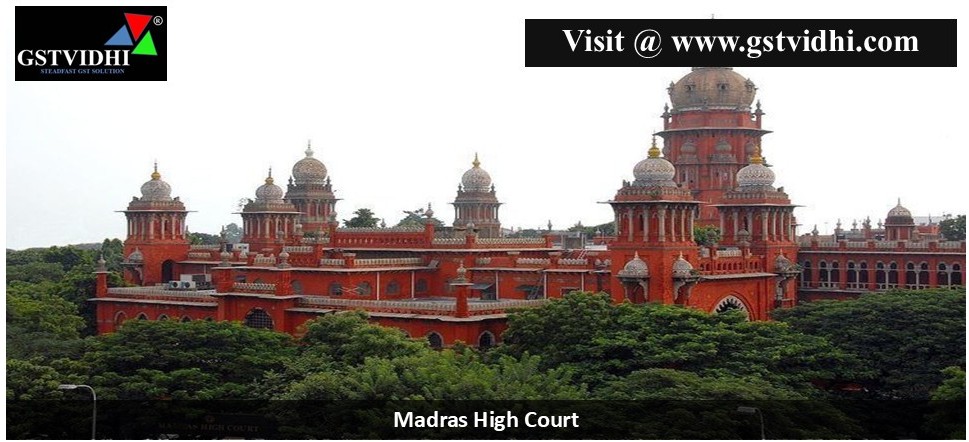
ITC Cannot Be Denied Merely on Limitation Grounds After Section
16(5) Amendment – Madras High Court
(M/s Rajagopal and Co. vs Assistant Commissioner (GST &
Central Excise) Madras High Court (Madurai Bench) W.P.(MD) No. 2651 of 2026 | Order dated 03.02.2026)
Introduction
The Madurai Bench of the
Madras High Court, in M/s Rajagopal and Co. vs Assistant Commissioner (GST
& Central Excise), has once again reaffirmed that Input Tax Credit
(ITC) cannot be denied solely on the ground of limitation under Section 16(4)
of the CGST Act, where the benefit is otherwise protected by the retrospective
insertion of Section 16(5).
This judgment follows the
landmark batch decision of the Madras High Court dated 17.10.2024 and
strengthens taxpayer relief for delayed filing of GSTR-3B returns for FYs
2017-18 to 2020-21 due to genuine hardships such as COVID-19 and financial
constraints.
Parties to the Case
·
Petitioner: M/s
Rajagopal and Co., Represented by Partner Mr. V. Rajagopal,
GSTIN: 33AAIFV1937F1Z8
·
Respondent:The
Assistant Commissioner, GST and Central Excise, Thanjavur
Facts of
the Case
The petitioner is a
registered GST dealer engaged in taxable supplies and had duly filed GSTR-1
returns within time. However, due to unavoidable circumstances such as:
- Financial stress during COVID-19
lockdowns
- Operational disruptions
- Practical difficulties in compliance
the petitioner could not file
GSTR-3B returns within the time prescribed under Section 16(4).
The department issued a show
cause notice, followed by an order dated 23.04.2024, whereby:
- Input Tax Credit was reversed
- Demand of tax, interest, and
penalty was raised
- Bank accounts were reportedly frozen
Aggrieved by this order,
the petitioner approached the Madras High Court by filing a writ petition
under Article 226 of the Constitution of India.
Core Issue
for Consideration
Whether ITC can be denied
merely due to delayed filing of GSTR-3B when Section 16(5) of the CGST Act
retrospectively allows ITC up to 30.11.2021 for FYs 2017-18 to 2020-21?
Statutory
Provisions Involved
Section 16(4) of CGST Act
(Original Provision)
Section 16(4) restricts
ITC availment beyond 30th November following the end of the financial year
or the date of annual return, whichever is earlier.
Section
16(5) – Retrospective Amendment (Finance Act, 2024)
By virtue of the Finance
Act (No.2), 2024, Section 16(5) was inserted with retrospective effect
from 01.07.2017, providing that:
Notwithstanding Section
16(4), ITC relating to FYs 2017-18 to 2020-21 can be availed through any
GSTR-3B filed up to 30.11.2021.
This amendment was
followed by:
- Notification No. 17/2024-CT dated
27.09.2024
- CBIC Circular No. 237/31/2024-GST
clarifying the
implementation of Sections 16(5) and 16(6).
Arguments
by the Petitioner
- ITC denial was purely on
limitation grounds, not on merits
- Delay was not deliberate, but
caused by exceptional circumstances
- Section 16(5) expressly overrides
Section 16(4)
- The impugned order was passed ignoring
subsequent legislative developments
- The issue was already squarely
covered by the Madras High Court’s batch judgment dated 17.10.2024
Stand of
the Department
The department fairly
conceded that the issue is covered by the earlier common order of the
Madras High Court and did not seriously dispute the applicability of Section
16(5).
Findings of
the High Court
The Court relied
extensively on its earlier batch decision and observed:
- Section 16(5) has overriding
effect over Section 16(4)
- The amendment applies retrospectively
from 01.07.2017
- ITC for FYs 2017-18 to 2020-21 cannot
be denied if GSTR-3B was filed on or before 30.11.2021
- Orders passed solely on limitation
grounds are unsustainable in law
The Court reiterated that
procedural lapses cannot defeat substantive ITC rights, especially when
the legislature itself has provided retrospective relief.
Final
Directions of the Court
The Madras High Court
passed the following key directions
RAJAGOPAL AND CO
:
1. Impugned
order dated 23.04.2024 was quashed to the extent ITC was
denied on limitation
2. The
department was restrained from initiating recovery proceedings on this
ground
3. Refund
liberty granted to the petitioner for any tax already
recovered
4. Bank
accounts, if frozen, to be immediately defreezed
5. Amounts
already debited from cash/credit ledger to be:
o Refunded,
or
o Allowed
to be adjusted against future tax liability
6. Liberty
given to the department to proceed only on other issues such as:
o Fake
ITC
o Excess
ITC
o Wrong
availment on merits
Conclusion
The decision in M/s
Rajagopal and Co. reinforces the principle that substantive tax benefits
cannot be defeated by procedural rigidity, especially when the legislature
itself has provided retrospective correction.
This ruling further
strengthens taxpayer confidence and aligns GST administration with fairness,
equity, and legislative intent.
Disclaimer: All the Information is based on the notification, circular advisory and order issued by the Govt. authority and judgement delivered by the court or the authority information is strictly for educational purposes and on the basis of our best understanding of laws & not binding on anyone.
Press On Click Here To Download Order File
Click here