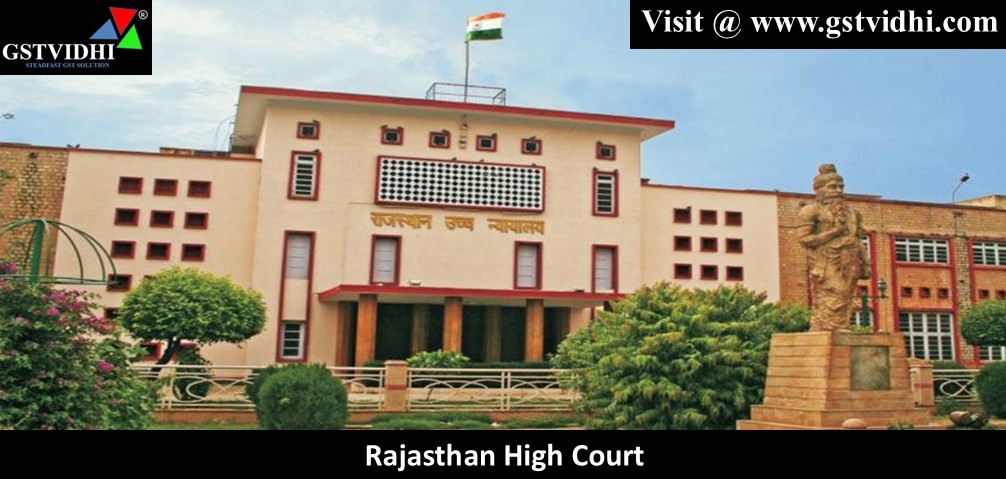
Rajasthan High Court Condones 160 Days’ Delay in GST Appeal (M/s
M R Traders v. Union of India)
Introduction
In a significant judgment
concerning GST appellate limitation, the Rajasthan High Court has held that
while the Appellate Authority under Section 107 of the CGST Act cannot condone
delay beyond the statutory limit, the High Court, exercising jurisdiction under
Article 226 of the Constitution of India, retains the constitutional power to
condone such delay in appropriate cases.
The Court condoned a
delay of 160 days in filing the GST appeal and restored the matter to the
Appellate Authority for decision on merits.
This judgment harmonizes
statutory limitation with constitutional remedies and clarifies the distinction
between statutory authority and constitutional jurisdiction.
Facts of
the Case
Case Title: M/s M R
Traders v. Union of India
Court: Rajasthan
High Court
Case Number: D.B.
Civil Writ Petition No. 4558/2025
Citation: [2026:RJ-JD:485-DB]
Date of Order: 07.01.2026
Key Events:
1. The
petitioner opted for quarterly return filing under Section 39(1) of the CGST
Act.
2. A
Show Cause Notice dated 15.01.2023 was issued proposing cancellation of GST
registration due to non-filing of returns for six months.
3. The
GST registration was suspended and subsequently cancelled by Order-in-Original
dated 09.03.2023.
4. The
cancellation was made retrospectively from 01.04.2022.
5. The
petitioner filed an appeal under Section 107 of the CGST Act on 18.12.2023.
6. There
was a delay of approximately 160 days beyond the permissible period.
7. The
Appellate Authority dismissed the appeal as time-barred on 11.10.2024.
Aggrieved, the petitioner
approached the High Court under Article 226.
Issue
Before the Court
Whether the High Court
can condone delay beyond the statutory outer limit prescribed under Section
107(4) of the CGST Act?
And whether the Appellate
Authority can invoke Section 5 of the Limitation Act to condone delay beyond
the statutory cap?
Petitioner’s
Arguments
The petitioner contended:
- Delay occurred due to bona fide
reasons:
- Miscommunication with
accountant/consultant.
- Illness of petitioner’s father.
- The petitioner relied on a prior
Division Bench decision of the Rajasthan High Court in:
M/s Molana Construction
Company v. Central Goods and Service Tax Department
where the Court had
entertained writ petitions despite limitation issues.
- It was argued that:
- A litigant should not suffer due to
fault of counsel.
- Right to appeal is a valuable
statutory right.
- High Court retains plenary powers
under Article 226.
- Cancellation of GST registration
affects fundamental right to carry on business under Article 19(1)(g).
Respondents’
Arguments
The Department contended:
- Section 107 clearly prescribes:
- 3 months limitation
- Additional 1 month condonable period
- The appeal was filed beyond even the
extended period.
- Appellate Authority has no
jurisdiction beyond statutory cap.
- Writ jurisdiction cannot be used to
defeat statutory limitation.
- Subsequent Division Bench decisions
had refused relief in similar matters.
Court’s
Analysis
The Court undertook a
structured examination of three core aspects:
1. Power of Appellate
Authority Under Section 107
The Court held:
- Section 107(4) provides a strict
outer limit of one additional month.
- The Appellate Authority is a creature
of statute.
- It cannot enlarge its jurisdiction.
- Section 5 of the Limitation Act does
NOT apply.
- Importing Section 5 would render the
statutory cap meaningless.
The Court disagreed with
the Calcutta High Court view in:
S.K. Chakraborty &
Sons v. Union of India
which had held that
Section 5 of the Limitation Act could apply.
The Rajasthan High Court
clarified that the statutory authority has no power beyond the explicit limit.
2. Power of High Court
Under Article 226
The Court drew a clear
distinction:
|
Appellate
Authority
|
High
Court
|
|
Statutory
body
|
Constitutional
court
|
|
Bound
by Section 107
|
Governed
by Article 226
|
|
Cannot
exceed 1 month condonation
|
Can
condone delay in exceptional cases
|
The Court reaffirmed the
principle laid down in:
M/s Molana Construction
Company v. Central Goods and Service Tax Department
It held:
- Constitutional jurisdiction is not
curtailed by statutory limitation.
- Article 226 powers are founded on
justice, equity, and good conscience.
- High Court may intervene where denial
of remedy causes disproportionate hardship.
3. Impact on Business and
Fundamental Rights
The Court observed:
- GST is not merely revenue-collection
legislation.
- It is a facilitative economic
framework.
- Permanent denial of registration can
paralyze business.
- Non-restoration may violate Articles
14 and 21 if disproportionate.
The Court emphasized that
cancellation should not permanently push a taxpayer out of the GST regime where
compliance intention exists.
Findings of
the Court
1. Appellate
Authority cannot invoke Section 5 of Limitation Act.
2. Section
107(4) is a jurisdictional cap.
3. High
Court under Article 226 can condone delay in appropriate cases.
4. The
present case showed bona fide explanation supported by affidavit.
5. Mere
absence of consultant’s affidavit was not fatal.
Final Order
- Appellate Order dated 11.10.2024 was
set aside.
- Delay of 160 days was condoned.
- Appeal restored to Appellate
Authority.
- Matter remanded for adjudication on
merits.
Conclusion
This judgment is a
landmark clarification in GST appellate jurisprudence. It upholds the rigidity
of statutory limitation for authorities while simultaneously preserving the
constitutional safety valve available through writ jurisdiction. The Rajasthan
High Court has reaffirmed that procedural timelines cannot become instruments
of economic destruction where justice demands intervention.
Disclaimer: All the Information is based on the notification, circular advisory and order issued by the Govt. authority and judgement delivered by the court or the authority information is strictly for educational purposes and on the basis of our best understanding of laws & not binding on anyone.
Press On Click Here To Download Order File
Click here