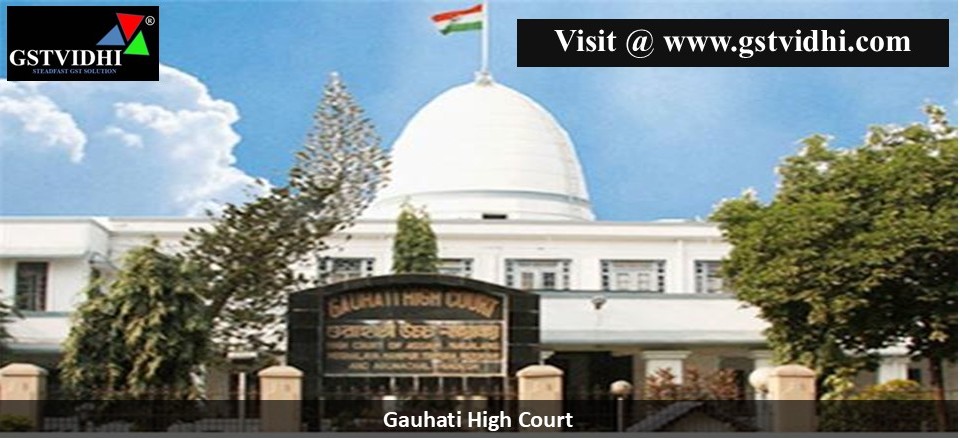
Registration Cancelled for Non-Filing of Returns – Court Allows
Fresh Opportunity under Rule 22(4) of CGST Rules
In a significant judgment
reinforcing the principle of natural justice under GST law, the Gauhati High
Court, in WP(C)/956/2026, delivered on 20.02.2026 by Hon’ble Mr. Justice
Sanjay Kumar Medhi, granted relief to a taxpayer whose GST registration was
cancelled due to non-filing of returns. The Court permitted the petitioner to
approach the authorities for restoration of registration upon compliance with
statutory requirements.
This decision highlights
the importance of the proviso to Rule 22(4) of the CGST Rules, 2017 and
reiterates that cancellation of GST registration has serious civil
consequences.
Case Details
- Case Name:
Mrs. Bobismrita Chetia Gogoi vs. Union of India & Ors.
- Case No.:
WP(C)/956/2026
- Court:
Gauhati High Court
- Date of Judgment:
20 February 2026
- Coram:
Hon’ble Mr. Justice Sanjay Kumar Medhi
Facts of
the Case
The petitioner, Mrs.
Bobismrita Chetia Gogoi, was carrying on business under the name and style of M/s
Poly Enterprise. She was a sole proprietor registered under the CGST and
AGST Acts.
Due to non-filing of GST
returns for a continuous period of six months, a show cause notice dated
07.10.2024 was issued under Section 29(2)(c) of the CGST Act. The notice
required her to submit a reply within 30 days, failing which the case would be
decided ex parte.
Since no reply was filed,
the Superintendent, Dibrugarh-I Range, passed an order dated 11.11.2024
cancelling her GST registration.
Reason for
Non-Compliance
The petitioner contended
that due to miscommunication with her tax consultant, she was unaware of the
show cause notice. By the time she became aware, the time for filing reply had
already expired and the cancellation order had been uploaded on the GST portal.
Subsequently, she:
- Filed all pending returns up to
November 2024
- Paid all GST dues
- Paid applicable interest and late
fees
However, when she
attempted to file an application for revocation of cancellation, the GST portal
displayed that the 270-day timeline for filing revocation had expired.
Aggrieved by the
inability to seek revocation through the portal, she approached the High Court
by filing a writ petition.
Legal
Provisions Involved
Section 29(2)(c) of the
CGST Act, 2017
This provision empowers
the proper officer to cancel registration if a registered person fails to
furnish returns for a continuous period of six months.
Rule 22 of the CGST
Rules, 2017
Rule 22 prescribes the
procedure for cancellation of registration.
Of particular importance
is the Proviso to Rule 22(4), which provides that:
If a person, instead of
replying to the show cause notice, furnishes all pending returns and makes full
payment of tax dues along with applicable interest and late fee, the proper
officer shall drop the proceedings and pass an order in FORM GST REG-20.
This proviso formed the
central issue in the present case.
Petitioner’s
Submission
The petitioner submitted
that:
- She has already furnished all pending
returns.
- All tax liabilities along with
interest and late fees have been paid.
- She is ready to comply with all
formalities under Rule 22(4).
- Cancellation of registration causes
serious civil consequences and affects business operations.
The petitioner relied
upon an earlier decision of the High Court in WP(C) No. 6366/2023 (Sanjoy Nath
vs Union of India & Ors.), where similar relief was granted.
Respondent’s
Stand
The Standing Counsel for
CGST submitted that:
- There was delay in approaching the
Court.
- Any order passed should not be
treated as a precedent.
Observations
of the Court
The Court examined:
- Section 29(2)(c) of the CGST Act
- Rule 22 of the CGST Rules, 2017
- Particularly the proviso to Rule
22(4)
The Court observed that:
- Cancellation of GST registration
entails serious civil consequences.
- The law itself provides a mechanism
for dropping proceedings if pending returns are furnished and dues are
paid.
- The petitioner has already updated
returns and discharged liabilities.
The Court found that the
proviso to Rule 22(4) clearly enables restoration where compliance is made.
Decision of
the Court
The High Court disposed
of the writ petition with the following directions:
1. The
petitioner shall approach the concerned authority within two months seeking
restoration of GST registration.
2. If
the petitioner complies with the requirements under the proviso to Rule 22(4),
the proper officer shall consider restoration in accordance with law.
3. The
authority shall take necessary steps for restoration expeditiously.
4. The
petitioner shall remain liable to pay arrears of tax, interest, penalty and
late fee.
5. Limitation
under Section 73(10) shall be computed from the date of the High Court’s order
(except FY 2024-25, which shall follow Section 44).
The writ petition was
disposed of without costs.
Legal
Significance of the Judgment
1. Emphasis on
Substantive Compliance
The Court prioritised
substantive compliance (filing returns and payment of dues) over procedural
lapses.
2. Relief Beyond Portal
Limitations
Even though the GST
portal blocked revocation due to expiry of 270 days, the Court intervened to
ensure that statutory rights are not defeated by technical barriers.
3. Recognition of Civil
Consequences
Cancellation of GST
registration impacts:
- Business continuity
- Input Tax Credit chain
- Commercial reputation
- Contractual obligations
Hence, the Court
exercised writ jurisdiction to prevent irreversible hardship.
4. Strengthening Rule
22(4) Proviso
The judgment reinforces
that the proviso to Rule 22(4) is a beneficial provision intended to allow
genuine taxpayers to regularise defaults.
Conclusion
The decision of the Gauhati
High Court in Mrs. Bobismrita Chetia Gogoi vs Union of India & Ors.
reaffirms the principle that GST law is not intended to permanently shut down
businesses for procedural lapses, especially when tax dues are fully
discharged. By permitting restoration subject to compliance, the Court struck a
balance between statutory discipline and business continuity. This ruling
serves as an important precedent in matters involving cancellation of GST
registration due to non-filing of returns and highlights the remedial scope of
Rule 22(4) of the CGST Rules, 2017.
Disclaimer: All the Information is based on the notification, circular advisory and order issued by the Govt. authority and judgement delivered by the court or the authority information is strictly for educational purposes and on the basis of our best understanding of laws & not binding on anyone.
Click here