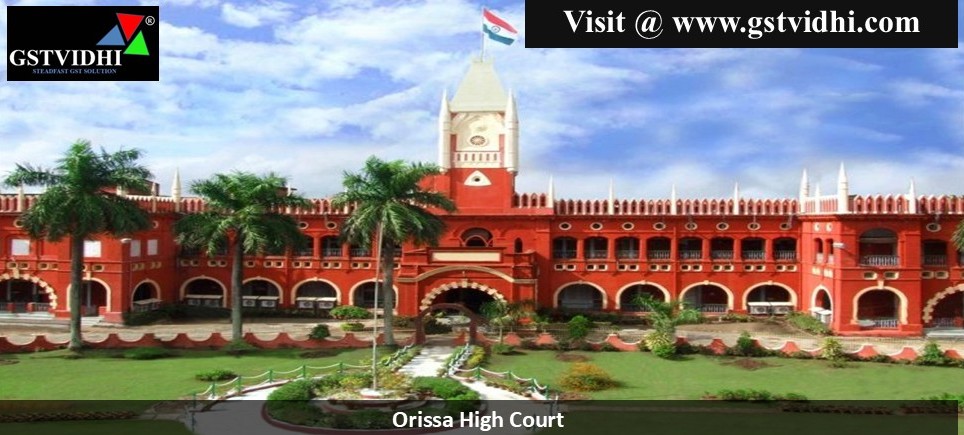
Orissa High Court Allows Revocation of GST Registration on
Payment of Dues – M/s Jayanti Sahoo v. Commissioner
Introduction
Cancellation of GST
registration due to non-filing of returns has become a common issue faced by
many taxpayers. Once the registration is cancelled, the taxpayer loses the
legal ability to conduct taxable business activities and also cannot file
pending returns unless the registration is restored. In many cases, taxpayers
approach the High Courts seeking relief where the time limit for revocation has
already expired.
In a recent decision, the
Orissa High Court in W.P.(C) No. 4943 of 2026 provided relief to a
taxpayer whose GST registration had been cancelled. The Court allowed the
petitioner to seek revocation of the cancellation subject to payment of tax,
interest, late fee and penalty.
The judgment follows the
principle already laid down in an earlier decision of the same Court in M/s
Mohanty Enterprises v. Commissioner, CT & GST, Odisha, where the Court
condoned the delay in filing an application for revocation of cancellation.
This order again reflects
the judiciary’s approach that procedural delays should not permanently deprive
taxpayers of their registration when they are willing to comply with statutory
requirements.
Case
Details
Case Title:
M/s Jayanti Sahoo v. Commissioner, CGST, CX & Customs, Bhubaneswar &
Another
Court: Orissa High Court
Case Number: W.P.(C) No. 4943 of 2026
Date of Order: 9 March 2026
Coram: Chief Justice and Justice Murahari Sri Raman
Petitioner: M/s Jayanti Sahoo
Respondents: Commissioner, CGST, CX & Customs, Bhubaneswar &
Another
Background
of the Case
The petitioner, M/s
Jayanti Sahoo, was a registered taxpayer under the GST law. Due to certain
compliance issues, the department initiated proceedings for cancellation of GST
registration.
The following sequence of
events took place:
1. A
Show Cause Notice dated 8 March 2025 was issued by the GST department
proposing cancellation of the petitioner’s registration.
2. Subsequently,
the proper officer passed an order dated 11 April 2025 cancelling the
GST registration of the petitioner under the State Goods and Services Tax Act,
2017.
3. Because
of the cancellation, the petitioner could not file returns or continue regular
business activities.
4. The
petitioner approached the High Court by filing a writ petition seeking relief
against the cancellation order.
The petitioner submitted
before the Court that he was ready and willing to comply with all statutory
requirements including payment of:
- Outstanding tax
- Interest
- Late fee
- Penalty
- Any other amount required under the
GST law
The main request of the
petitioner was that the Court should permit restoration of the GST registration
so that pending returns could be filed and business operations could continue.
Arguments
of the Petitioner
The counsel appearing on
behalf of the petitioner argued that the cancellation of registration had
caused serious hardship to the taxpayer. The petitioner expressed readiness to
regularize all pending compliances.
The key submissions of
the petitioner were as follows:
First, it was argued that
the petitioner was willing to deposit the entire amount of tax, interest, late
fee and penalty that may be payable for the purpose of accepting the pending
returns.
Second, the petitioner
relied upon a previous judgment of the Orissa High Court in the case of M/s
Mohanty Enterprises v. Commissioner, CT & GST, Odisha, decided on 16
November 2022.
In that earlier case, the
Court had condoned the delay in filing an application for revocation of
cancellation under the GST Rules and directed the authorities to consider the
revocation application after payment of all statutory dues.
The petitioner submitted
that the present case was similar and therefore the same relief should be
granted.
Third, it was argued that
procedural delay in filing the revocation application should not permanently
prevent a taxpayer from restoring registration, particularly when the taxpayer
is ready to comply with the law.
Submissions
of the Department
The department was
represented by the Junior Standing Counsel.
The departmental counsel
appeared before the Court and opposed the petition. However, the order
indicates that the main issue before the Court was whether the petitioner could
be granted relief similar to the one granted in the Mohanty Enterprises
case.
Since the precedent of
the High Court already existed, the Court examined whether the petitioner’s
request fell within the same legal principle.
Earlier
Precedent Relied Upon
The Court reproduced
paragraph 2 from its earlier decision in M/s Mohanty Enterprises v.
Commissioner, CT & GST, Odisha, which stated that:
The delay in invoking the
proviso to Rule 23 of the OGST Rules is condoned, and subject to the petitioner
depositing all taxes, interest, late fee and penalty and complying with other
formalities, the application for revocation will be considered in accordance
with law.
This precedent
established an important principle:
If a taxpayer is willing
to pay all statutory dues and complete compliance requirements, the delay in
applying for revocation of cancellation may be condoned by the Court.
Observations
of the High Court
After hearing both
parties and examining the earlier judgment, the Court observed that the
petitioner’s claim for relief was covered by the decision in Mohanty
Enterprises.
The Court considered the
following important factors:
- The petitioner had expressed
readiness to clear all outstanding dues.
- The petitioner was willing to comply
with statutory requirements.
- The legal issue involved had already
been addressed by the Court in a previous case.
Therefore, the Court
decided that similar relief should be granted in the present matter.
The Court effectively
extended the same benefit to the petitioner that was granted in the earlier
judgment.
Directions
Issued by the Court
The Orissa High Court
directed that:
- The delay in seeking revocation of
cancellation may be condoned.
- The petitioner must deposit all
taxes, interest, late fee, penalty and other statutory dues.
- After fulfilling these conditions,
the petitioner’s application for revocation of cancellation of GST
registration should be considered by the department in accordance with
law.
Thus, the Court provided
an opportunity to the petitioner to restore GST registration subject to
compliance.
Conclusion
The decision in M/s
Jayanti Sahoo v. Commissioner, CGST, CX & Customs, Bhubaneswar &
Another once again highlights the balanced approach adopted by the
judiciary in GST matters.
The Orissa High Court
recognized that procedural delays should not permanently deprive a taxpayer of
the opportunity to conduct business under GST. By granting relief subject to
payment of tax, interest, late fee and penalty, the Court ensured that
compliance with the law is achieved while also protecting the taxpayer’s right
to continue business.
This judgment will be
helpful for many taxpayers whose GST registrations have been cancelled and who
are willing to regularize their
compliance but are unable to file revocation applications due to expiry of
statutory timelines.
The ruling reiterates
that the objective of GST administration should be to encourage compliance
rather than impose irreversible consequences for procedural lapses.
Disclaimer: All the Information is based on the notification, circular advisory and order issued by the Govt. authority and judgement delivered by the court or the authority information is strictly for educational purposes and on the basis of our best understanding of laws & not binding on anyone.
Click here