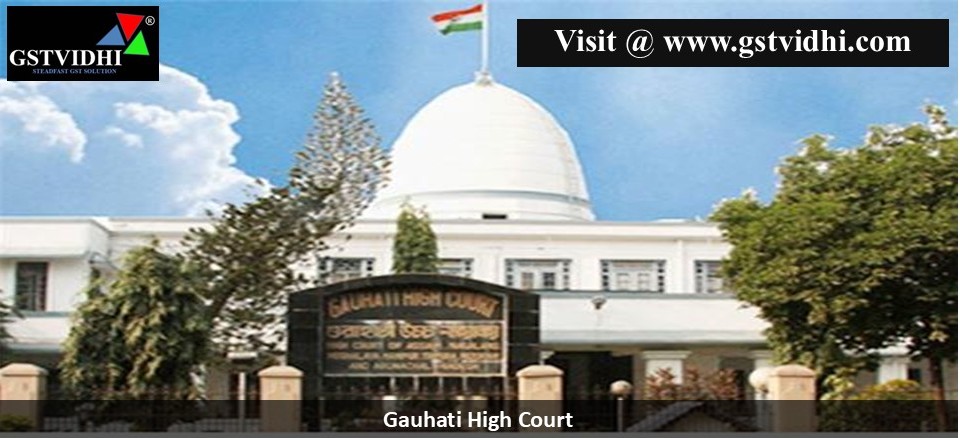
Gauhati High Court Quashes GST Demand Order for Absence of
Proper Show Cause Notice and Personal Hearing
(Garg Associates vs State of Assam & Others – Gauhati High
Court (Court: Gauhati High Court / Case Number: WP(C) No. 1450 of 2026 / Date
of Order: 13 March 2026)
Introduction
In an important ruling
concerning GST adjudication procedures, the Gauhati High Court held that a
summary of show cause notice in Form GST DRC-01 cannot substitute a proper show
cause notice required under Section 73 of the GST Act. The Court also
emphasized that passing an adverse order without granting an opportunity of
personal hearing violates Section 75(4) of the GST Act and principles of
natural justice.
The Court quashed the
demand order passed against the taxpayer and permitted the department to
initiate fresh proceedings in accordance with law.
This judgment reiterates
that procedural compliance under GST law is mandatory, and authorities
cannot bypass statutory safeguards while determining tax liability.
Background
and Facts of the Case
The petitioner in this
case was a partnership firm named Garg Associates, having its registered
office in Guwahati, Assam.
The GST department
initiated proceedings against the petitioner for the tax period July 2017 to
March 2018. A summary of show cause notice in Form GST DRC-01 dated
29 September 2023 was uploaded on the GST portal along with an attachment
containing details regarding the determination of tax liability.
According to the
petitioner, although the summary of show cause notice was uploaded, no
proper show cause notice was issued or attached on the portal. Because of
this, the petitioner did not submit any reply to the summary.
Subsequently, the
department passed an order in Form GST DRC-07, determining tax liability
on the ground that the assessee failed to make payment within 30 days of the
notice.
The petitioner challenged
the order before the Gauhati High Court by filing a writ petition.
Issues
Before the Court
The High Court examined
the following key legal issues:
1. Whether
a valid show cause notice was issued before passing the order under Section
73(9) of the GST Act.
2. Whether
the document attached with Form GST DRC-01 could be treated as a valid show
cause notice.
3. Whether
the order passed by the department violated Section 75(4) of the GST Act by not
granting an opportunity of hearing.
4. Whether
the documents attached to GST forms without authentication or signature could
be considered legally valid.
Arguments
of the Petitioner
The petitioner argued
that the proceedings initiated by the GST department were legally invalid for
several reasons.
First, the petitioner
submitted that only a summary of show cause notice in Form GST DRC-01 was
issued, but no proper show cause notice under Section 73(1) was
served.
Under the GST law, the
issuance of a proper show cause notice is a mandatory requirement before
determining tax liability. The summary issued in DRC-01 is only an additional
procedural requirement and cannot replace the actual show cause notice.
Second, the petitioner
contended that the attachment uploaded with DRC-01 merely contained the determination
of tax liability and did not contain any direction requiring the taxpayer
to show cause. Therefore, the document could not be treated as a valid
show cause notice.
Third, it was argued that
the documents uploaded on the portal were not authenticated or digitally
signed by the Proper Officer. As per the GST rules, notices and orders must
be authenticated through digital signature or e-signature.
Fourth, the petitioner
pointed out that no opportunity of personal hearing was provided before
passing the order. Even though the summary mentioned the last date for
submission of reply, the column relating to date and time of personal
hearing was left blank.
According to the
petitioner, this was a clear violation of Section 75(4) of the GST Act,
which mandates the grant of personal hearing when an adverse decision is
contemplated.
Arguments
of the Department
The department argued
that the summary of show cause notice in Form GST DRC-01 was uploaded
along with the attachment containing details of tax determination. According to
the department, the attachment contained sufficient information for the
petitioner to submit a reply.
The department also
contended that although the attachment did not contain a physical signature,
the documents uploaded on the GST portal are authenticated through the portal
system.
However, the department
admitted that no separate show cause notice apart from the attachment was
issued.
Legal
Provisions Examined by the Court
The High Court analyzed
the relevant provisions of the GST law.
Ø Section 73 of the GST Act: Section 73 of the
Central Goods and Services Tax Act 2017 deals with determination of tax in
cases where tax has not been paid, short paid, or input tax credit has been
wrongly availed without fraud or suppression of facts. Under this
provision, the Proper Officer must issue a show cause notice before
determining tax liability.
Ø Rule 142 of the GST Rules:
Rule 142 of the Central Goods and Services Tax Rules
2017 requires that a summary of the show cause notice must be uploaded
electronically in Form GST DRC-01. However, the rule clearly states that
this summary is to be issued along with the show cause notice, not in
place of it.
Ø Section 75(4) of the GST Act: Section 75(4) of
the Central Goods and Services Tax Act 2017 provides that an opportunity of
hearing must be granted when:
·
a request for hearing is made by the
taxpayer, or
·
an adverse decision is contemplated
against the taxpayer.
Court’s
Analysis and Findings
After examining the facts
and legal provisions, the High Court made several significant observations.
Ø Summary of SCN Cannot Replace Actual SCN: The
Court held that the GST law clearly distinguishes between a show cause
notice and a summary of show cause notice. The summary issued in Form
GST DRC-01 is only supplementary and cannot replace the actual show cause
notice required under Section 73. Therefore, initiating proceedings solely on
the basis of the summary without issuing a proper show cause notice is not
permissible under the law.
Ø Attachment to DRC-01 Is Not a Valid SCN: The
Court noted that the attachment uploaded with DRC-01 only contained the determination
of tax liability. It did not specifically require the petitioner to show
cause why the proposed demand should not be confirmed. Therefore, the
attachment could not be treated as a valid show cause notice.
Ø Authentication of Notices Is Mandatory: The Court also examined the requirement of
authentication of notices and orders. Under the GST Rules, notices and orders
must be issued electronically with digital signature or e-signature of the
Proper Officer. Since the attachments uploaded with the forms were unsigned
and unauthenticated, the Court held that they lacked legal validity.
Ø Personal Hearing Is Mandatory Before Adverse Decision: The
Court also found that the department had failed to grant an opportunity of
personal hearing. Even though the petitioner did not file a reply, the
department could not pass an adverse order without granting a hearing. The
Court clarified that the language of Section 75(4) uses the word “or”,
which means that hearing must be granted even if the taxpayer does not
request it, provided an adverse decision is contemplated. Therefore,
passing an order without granting a hearing violated both:
·
statutory provisions, and
·
principles of natural justice.
Decision of
the Court
After considering all the
aspects, the Gauhati High Court held that:
- A summary of show cause notice
cannot substitute a proper show cause notice under Section 73.
- The attachment uploaded with
DRC-01 cannot be treated as a valid show cause notice.
- The documents lacked proper
authentication.
- The order was passed without
granting personal hearing, violating Section 75(4).
Accordingly, the Court set
aside the impugned demand order passed by the GST department.
Conclusion
The Gauhati High Court’s
ruling in the case of Garg Associates vs State of Assam provides
important clarity on the procedural requirements for GST adjudication.
The Court reaffirmed that
issuance of a valid show cause notice, proper authentication of documents,
and grant of opportunity of hearing are fundamental requirements before
determining tax liability.
Failure to comply with
these requirements renders the proceedings legally unsustainable.
This judgment will serve
as an important precedent for taxpayers facing GST demands issued solely
through summary notices without proper show cause notices or hearing.
Disclaimer: All the Information is based on the notification, circular advisory and order issued by the Govt. authority and judgement delivered by the court or the authority information is strictly for educational purposes and on the basis of our best understanding of laws & not binding on anyone.
Click here