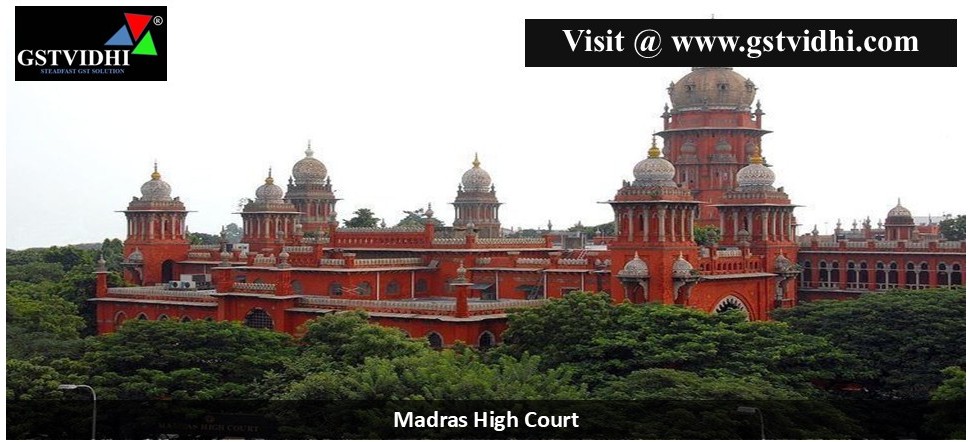
Proceedings Against Deceased Assessee and Recovery Action Held
Void: Madras High Court Remands Matter
Introduction
The Madras High Court, in
the case of Ramasamy Singaravelan (Deceased) vs Deputy State Tax Officer,
has once again reiterated the settled legal principle that any proceedings
initiated against a deceased person are void ab initio. The Court not only set
aside the assessment orders but also quashed consequential recovery
proceedings, emphasizing strict adherence to principles of natural justice and
procedural fairness under GST law. This judgment further strengthens the
consistent judicial view that proceedings must be conducted against legal
representatives and not against a dead person.
Factual
Background of the Case
In the present case, the
assessee, Mr. Ramasamy Singaravelan, proprietor of Sri Bhagavathi Amman
Electricals, passed away on 07 May 2022. Despite his death, the GST department
continued to issue notices in his name, which ultimately culminated in assessment
orders dated 26 December 2023 and 28 March 2024 for different tax periods.
Additionally, consequential recovery proceedings were also initiated by the
department based on such orders. The legal heir, being the wife of the
deceased, was unaware of these proceedings and came to know about them only
when recovery action was initiated by the department.
Challenge
by the Legal Heir
Aggrieved by the impugned
orders and recovery proceedings, the legal heir approached the High Court by
way of writ petitions. It was contended that all notices and orders issued in
the name of the deceased person are void ab initio and liable to be set aside.
The petitioner further submitted that she was deprived of any opportunity to
respond or contest the proceedings, thereby resulting in a gross violation of
principles of natural justice. The petitioner also expressed willingness to
file replies and contest the matter if an opportunity is granted.
Stand of
the Department
The department,
represented by the Government Advocate, did not seriously dispute the
procedural defect and submitted that if the petitioner is willing to
participate in the proceedings, appropriate orders may be passed by the Court.
This indicated tacit acknowledgment of the procedural irregularity in issuing
notices and passing orders in the name of a deceased person.
Findings of
the Court
The Madras High Court,
upon examination of the records, observed that the assessee had admittedly died
prior to the issuance of notices and passing of assessment orders. Despite
this, the department continued proceedings in the name of the deceased and even
initiated recovery action. The Court held that such proceedings are ex parte in
nature and suffer from a fundamental violation of principles of natural
justice. It was further observed that notices issued to a dead person and
orders passed pursuant to such notices are inherently void and unsustainable in
law.
Violation
of Principles of Natural Justice
The Court emphasized that
the legal heir was not given any opportunity to respond to the notices or
participate in the adjudication process. Since the proceedings were conducted
without proper notice to a competent person, they were vitiated on account of
denial of natural justice. The Court highlighted that procedural fairness is a
cornerstone of tax adjudication, and any deviation from this principle renders
the proceedings invalid.
Judgment
and Directions of the Court
In view of the above
findings, the Madras High Court set aside the impugned assessment orders as
well as the consequential recovery proceedings. However, instead of granting
complete relief, the Court remitted the matter back to the adjudicating
authority for fresh consideration. Specific directions were issued allowing the
legal heir to file replies to the show cause notices within a stipulated
period, and thereafter, the department was directed to provide an opportunity
of personal hearing and pass a reasoned order in accordance with law.
Legal
Position Emerging from the Judgment
This judgment clearly
establishes that not only adjudication proceedings but also recovery actions
initiated on the basis of such invalid proceedings are unsustainable if they
originate from notices issued to a deceased person. The Court has reinforced that
legal heirs must be properly brought on record and provided an opportunity to
defend the case before any determination of liability or recovery action is
undertaken.
Practical
Implications
From a practical
perspective, this ruling has significant implications for both taxpayers and
tax authorities. For legal heirs, it provides strong legal support to challenge
not only assessment orders but also recovery proceedings initiated in the name
of deceased persons. For the department, the judgment serves as a cautionary
precedent, highlighting the importance of verifying the status of the taxpayer
and ensuring that proceedings are directed against the correct legal entity.
Failure to do so may result in the entire proceedings being set aside and
remanded, causing unnecessary litigation and administrative burden.
Conclusion
The Madras High Court has
once again underscored that adherence to procedural safeguards is indispensable
in tax administration. Even where tax liability may exist, the same cannot be
enforced through defective proceedings initiated against a deceased person. By
setting aside both assessment and recovery actions and remitting the matter for
fresh adjudication, the Court has balanced the interests of revenue with the
rights of taxpayers, ensuring that justice is served in accordance with law.
Disclaimer: All the Information is based on the notification, circular advisory and order issued by the Govt. authority and judgement delivered by the court or the authority information is strictly for educational purposes and on the basis of our best understanding of laws & not binding on anyone.
Click here