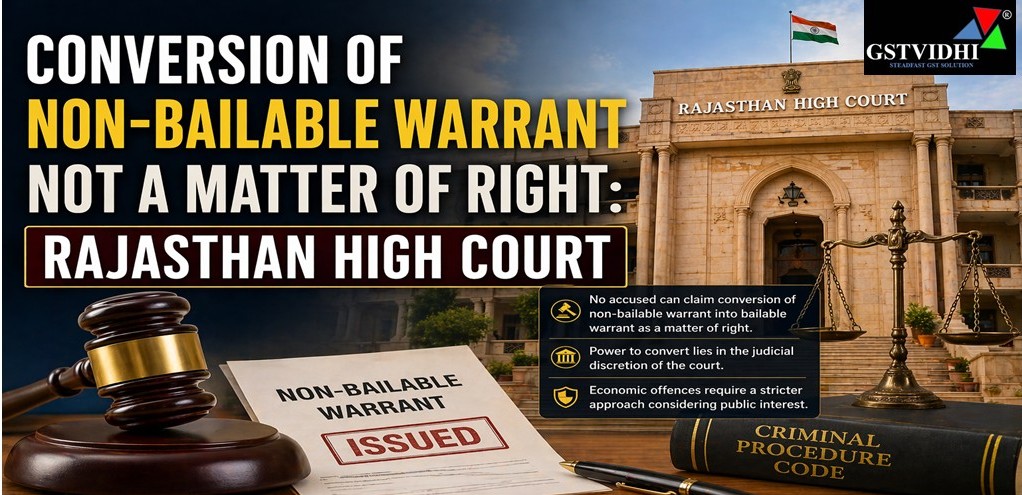
Conversion of Non-Bailable Warrant Not a Matter of Right:
Rajasthan High Court Clarifies in GST & Economic Offences Context
Introduction
In a significant ruling
impacting criminal proceedings in GST and other economic offence cases, the High
Court of Judicature for Rajasthan has clarified that conversion of a
non-bailable warrant into a bailable warrant cannot be claimed as a matter of
right by the accused. The Court addressed an important legal question
arising from conflicting interpretations in prior decisions and provided
much-needed clarity on the scope of judicial discretion under criminal
procedure laws.
The Larger Bench
comprising Justice Mahendar Kumar Goyal, Justice Anoop Kumar Dhand,
and Justice Bhuwan Goyal delivered its order dated 30 March 2026 in a
criminal reference concerning proceedings under GST and allied economic laws.
Background
and Reference to Larger Bench
The matter originated
from a petition where the accused sought conversion of a non-bailable warrant
(NBW) into a bailable warrant by invoking provisions under Section 70(2) of the
Code of Criminal Procedure and Section 72(2) of the Bharatiya Nagarik Suraksha
Sanhita (BNSS). The trial court had rejected such a request, leading to further
challenge before the High Court.
While hearing the matter,
a Single Bench noticed that different coordinate benches of the High Court had
expressed varying approaches in similar situations involving economic offences
under laws such as the GST Act, Prevention of Money Laundering Act (PMLA), and
Customs Act. In view of this perceived inconsistency, the following question
was referred to a Larger Bench:
Whether an accused in
economic or heinous offences can claim conversion of a non-bailable warrant
into a bailable warrant as a matter of right?
Examination
of Earlier Judicial Precedents
The Larger Bench
undertook a detailed examination of earlier judgments, including cases such as Girdhar
Gopal Bajoria, Shyam Sunder Singhvi, and P.C. Purohit. These
decisions were scrutinized to determine whether any binding legal principle had
been laid down regarding conversion of warrants.
Upon analysis, the Court
found that none of the earlier rulings had established any absolute legal
right in favour of the accused for such conversion. Instead, each case had
been decided based on its own facts and circumstances, considering factors such
as the nature of allegations, conduct of the accused, and stage of
investigation.
The Court clarified that
the apparent divergence in outcomes did not amount to a conflict of legal
principles but merely reflected fact-specific judicial discretion.
Court’s
Findings and Legal Position
The Larger Bench
categorically held that no accused can claim, as a matter of right,
conversion of a non-bailable warrant into a bailable warrant under the
relevant provisions of criminal law. The power to convert such warrants lies
within the discretionary domain of the court and must be exercised judiciously.
The Court emphasized that
the issuance of a non-bailable warrant itself is based on satisfaction
regarding the seriousness of the offence, the conduct of the accused, and the
likelihood of evasion of the legal process. Therefore, any request for conversion
must be assessed in light of these factors rather than treated as an automatic
entitlement.
Importantly, the Court
observed that economic offences, including GST evasion and money laundering,
are to be treated with greater seriousness, given their wider impact on the
financial system and public interest.
Reference
Declared Unnecessary
After a thorough
examination, the Larger Bench concluded that the reference made by the Single
Judge did not actually require adjudication on a settled question of law. Since
no conflicting legal principles were found in prior judgments, the Court held that
the issue did not warrant a definitive answer by the Larger Bench.
Accordingly, the
reference was disposed of, with liberty to the Single Bench to decide the case
on its own merits based on the facts presented.
Judicial
Reasoning: Emphasis on Discretion Over Right
A key takeaway from the
judgment is the reaffirmation of judicial discretion as the cornerstone of
criminal procedure. The Court made it clear that procedural provisions
enabling conversion of warrants are not intended to create enforceable rights
but to provide flexibility to courts in administering justice.
The ruling also aligns
with broader judicial trends where economic offences are viewed as distinct
from ordinary crimes. Courts have consistently held that such offences involve
deep-rooted conspiracies and have far-reaching consequences on the economy, thereby
justifying a stricter approach.
Implications
for GST and Economic Offence Litigation
This judgment has
significant implications for taxpayers, professionals, and legal practitioners
involved in GST litigation and criminal proceedings. It reinforces that
procedural reliefs, such as conversion of warrants, cannot be mechanically
sought and must be supported by strong factual grounds.
For accused persons in
GST-related prosecutions, the decision underscores the importance of
demonstrating bona fide conduct, cooperation during investigation, and absence
of intent to evade legal process. Mere reliance on statutory provisions without
substantive justification is unlikely to succeed.
Conclusion
The Rajasthan High
Court’s ruling provides much-needed clarity on an important procedural aspect
in criminal law, particularly in the context of GST and economic offences. By
holding that conversion of non-bailable warrants is not a matter of right, the Court
has reinforced the principle that judicial discretion must prevail over
procedural entitlement.
The decision also
highlights that each case must be evaluated on its own merits, ensuring that
the administration of justice remains both flexible and grounded in the
specific facts of each matter. As GST enforcement continues to intensify, such
rulings will play a crucial role in shaping the procedural landscape of
economic offence litigation in India.
Disclaimer: All the Information is based on the notification, circular advisory and order issued by the Govt. authority and judgement delivered by the court or the authority information is strictly for educational purposes and on the basis of our best understanding of laws & not binding on anyone.
Click here