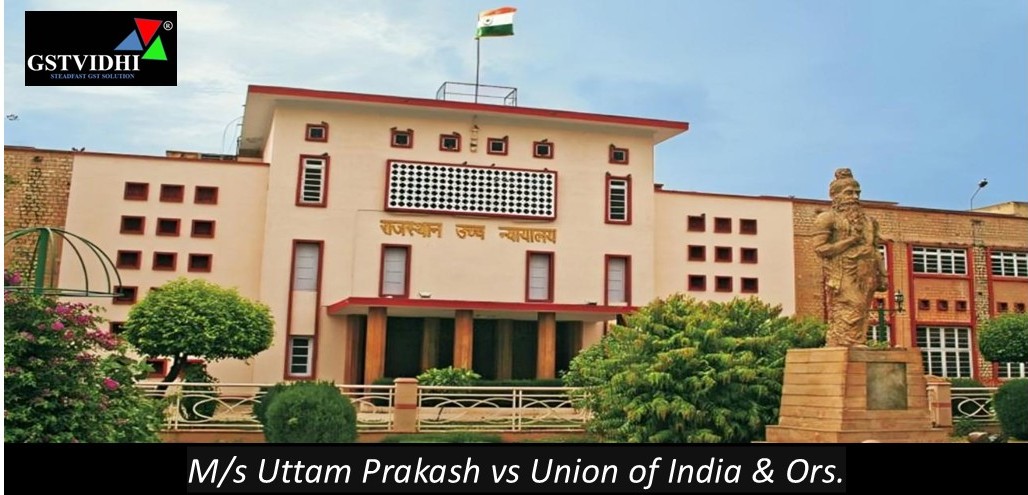
Delay in Filing GST Appeal Can Be Condoned by High Court Beyond
Statutory Limit: Rajasthan High Court
Introduction
The judgment delivered by
the Rajasthan High Court in M/s Uttam Prakash vs Union of India & Ors.
provides an important clarification on the interplay between statutory
limitation under GST law and the constitutional powers of High Courts. The case
addresses a critical issue frequently faced by taxpayers—rejection of appeals
on the ground of delay, even where the underlying order was not properly
communicated. The ruling reinforces that procedural constraints cannot override
the fundamental objective of delivering justice.
Facts of
the Case
In the present case, the
petitioner challenged the order of the Appellate Authority which had dismissed
the appeal as time-barred under Section 107 of the CGST Act, 2017. The
adjudication order dated 30.08.2024 had been uploaded on the GST portal; however,
the petitioner contended that the same was not communicated through any of the
prescribed modes under Section 169, such as email or other recognized means.
Due to lack of proper communication, the petitioner remained unaware of the
order and could not file the appeal within the prescribed time limit. When the
appeal was eventually filed, it was rejected solely on the ground of delay.
Issue
Before the Court
The primary issue for
consideration was whether a taxpayer can be denied the right to appeal due to
delay when such delay is caused by absence of proper communication of the
order, and whether the High Court can condone such delay beyond the statutory
limit prescribed under Section 107 of the CGST Act.
Statutory
Framework
Section 107 of the CGST
Act prescribes a limitation period of three months for filing an appeal before
the Appellate Authority, with a further condonable period of one month. Beyond
this extended period, the Appellate Authority has no jurisdiction to condone
delay. Thus, the statutory scheme imposes a strict timeline, leaving no
discretion with the appellate authority once the outer limit is crossed.
Contentions
of the Petitioner
The petitioner argued
that mere uploading of the order on the GST portal does not amount to valid
service as required under Section 169. It was submitted that no communication
was received through email or any other prescribed mode, and therefore the limitation
period could not be said to have commenced. The petitioner emphasized that the
delay was neither intentional nor due to negligence, but was a direct
consequence of failure on the part of the department to properly communicate
the order. It was further contended that denial of an opportunity to appeal
would result in grave injustice.
Contentions
of the Department
The department contended
that the petitioner was a regular taxpayer and actively engaged with the GST
portal for filing returns. Therefore, it was argued that the petitioner ought
to have been aware of the order uploaded on the portal. The department maintained
that the Appellate Authority had rightly rejected the appeal, as it lacked the
statutory power to condone delay beyond the prescribed period.
Court’s
Analysis
The High Court carefully
examined the statutory provisions as well as judicial precedents, including the
decision of the Hon’ble Supreme Court in Tecnimont Private Limited vs State of
Punjab. The Court acknowledged that the Appellate Authority is bound by the
limitations prescribed under Section 107 and cannot condone delay beyond the
permissible period.
However, the Court
emphasized that the powers of the High Court under Article 226 of the
Constitution are wide and cannot be curtailed by statutory provisions. It
observed that in appropriate cases, where denial of relief would result in
injustice, the High Court can exercise its writ jurisdiction to condone delay
and allow the matter to be decided on merits.
A significant aspect of
the Court’s reasoning was the requirement of proper communication of orders.
The Court held that mere uploading of an order on the portal does not
necessarily establish that the taxpayer had knowledge of it, particularly in
the absence of communication through other prescribed modes. In such
circumstances, it would be unjust to strictly apply the limitation period
against the taxpayer.
Findings
and Judgment
The Court upheld the
legal position that the Appellate Authority had correctly rejected the appeal
due to lack of power to condone delay beyond the statutory period. However,
invoking its constitutional powers, the High Court condoned the delay in filing
the appeal. It directed that if the petitioner files the appeal afresh, the
same shall be revived and decided on merits by the Appellate Authority in
accordance with law. The Court thus ensured that the petitioner is not deprived
of the opportunity to contest the case substantively.
Key Legal
Principles
The judgment establishes
that while statutory authorities are bound by strict limitation periods,
constitutional courts retain the power to intervene in order to prevent
miscarriage of justice. It reiterates that proper communication of orders is
essential for triggering limitation and that taxpayers cannot be penalized for
delays arising from procedural lapses on the part of the department. Most
importantly, the Court reaffirmed the principle that no person should be left
without a remedy due to technical constraints.
Practical
Implications
This ruling has
significant practical implications for taxpayers. It provides a remedy in cases
where appeals are dismissed on limitation grounds despite lack of proper
communication of orders. Taxpayers can invoke writ jurisdiction before the High
Court in such situations. At the same time, the decision underscores the
importance for tax authorities to ensure strict compliance with provisions
relating to service of orders.
Conclusion
The Rajasthan High Court
has struck a careful balance between adherence to statutory timelines and the
need to ensure justice. By exercising its writ jurisdiction to condone delay,
the Court has upheld the principle that procedural laws are meant to aid justice
and not defeat it. This judgment serves as an important precedent, reinforcing
that substantive rights cannot be sacrificed at the altar of technicalities,
particularly in a complex regime like GST.
Disclaimer: All the Information is based on the notification, circular advisory and order issued by the Govt. authority and judgement delivered by the court or the authority information is strictly for educational purposes and on the basis of our best understanding of laws & not binding on anyone.
Click here