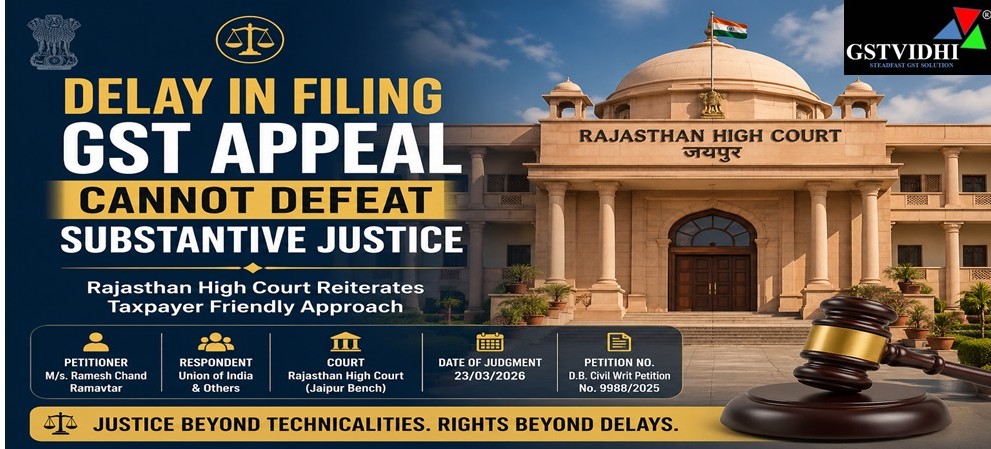
Delay in Filing GST Appeal Cannot Defeat Substantive Justice:
Rajasthan High Court
(M/s. Ramesh Chand Ramavtar Vs. Union of India & Others / High
Court of Judicature for Rajasthan / Date of Judgment: 23/03/2026 / Petition
No.: D.B. Civil Writ Petition No. 9988/2025)
Introduction
The present writ petition
before the Rajasthan High Court deals with a significant issue concerning delay
in filing of appeals under GST law and whether such delay should automatically
result in dismissal without considering the merits of the case. The matter
highlights the ongoing judicial approach towards balancing procedural
limitations with the principles of natural justice and substantive justice.
Facts of
the Case
The petitioner, M/s.
Ramesh Chand Ramavtar, is a registered taxpayer engaged in business activities
in Rajasthan. The dispute arose when the petitioner filed an appeal under
Section 107 of the GST Act against an order passed by the tax authorities.
However, the appeal was dismissed on the ground of delay, as it was filed
beyond the prescribed limitation period.
Aggrieved by such
dismissal, the petitioner approached the Hon’ble High Court by way of a writ
petition, challenging the rejection of the appeal solely on the ground of
limitation without adjudicating the case on merits.
Issue
Involved
The core issue before the
Hon’ble Court was whether the dismissal of an appeal due to delay under Section
107 of the CGST/RGST Act is justified, particularly when similar issues have
already been settled by the Court in earlier judgments.
Submissions
by the Parties
During the course of
hearing, both the learned Additional Solicitor General representing the Union
of India and the learned Additional Advocate General representing the State
fairly submitted that the issue is no longer res integra. They acknowledged that
similar matters involving delay in filing appeals under Section 107 of the GST
Act have already been examined and decided by the Court in earlier cases.
Reference was made to
previous judgments, including Jagdamba Motors vs. Union of India & Ors.
and M/s Komal Marble vs. State of Rajasthan & Ors., wherein the
Court had taken a consistent view on the issue of limitation and delay in GST
appeals.
Findings of
the Court
The Hon’ble Court
observed that the issue raised in the present writ petition is squarely covered
by earlier decisions of the Court. It noted that strict adherence to limitation
provisions should not result in denial of justice, especially when the matter
involves substantial rights of the taxpayer.
The Court emphasized that
procedural technicalities should not override the principles of fairness and
justice, and where precedent exists, similar relief should be granted to ensure
consistency in judicial decisions.
Judgment
In light of the
submissions made and the precedents relied upon, the Hon’ble Rajasthan High
Court disposed of the writ petition in terms of earlier judgments. The Court
effectively extended the benefit of its previous rulings to the present
petitioner, thereby providing relief against dismissal of appeal on the ground
of delay.
Conclusion
This judgment reinforces
the principle that procedural delays should not automatically deprive taxpayers
of their right to appeal, especially when higher courts have already clarified
the legal position. It reflects a taxpayer-friendly approach, ensuring that
justice is not denied merely due to technical limitations.
The ruling is
particularly important for taxpayers whose appeals have been dismissed due to
delay, as it opens the door for seeking relief based on judicial precedents. It
also highlights the need for authorities to adopt a balanced approach while
dealing with limitation-related issues under GST law.
Disclaimer: All the Information is based on the notification, circular advisory and order issued by the Govt. authority and judgement delivered by the court or the authority information is strictly for educational purposes and on the basis of our best understanding of laws & not binding on anyone.
Click here