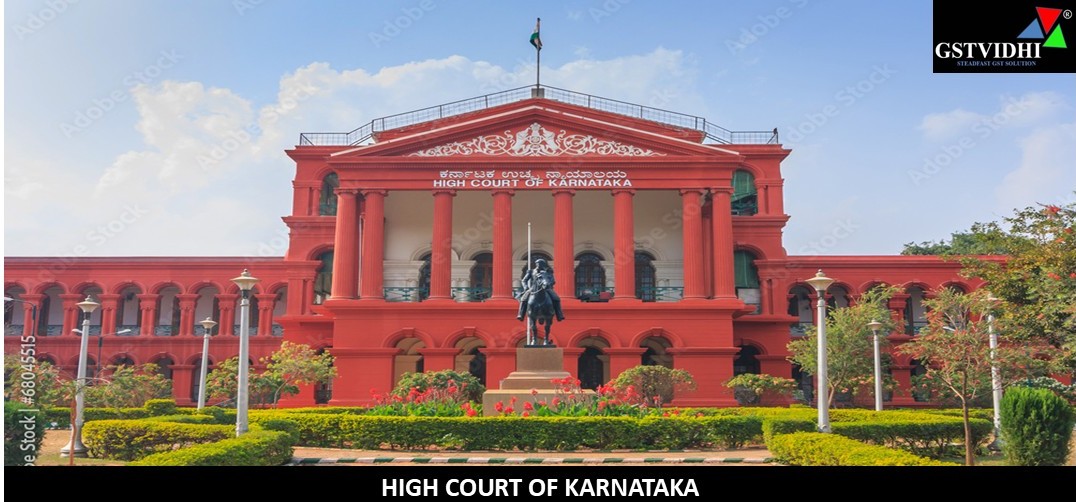
GST Assessment Order Set Aside for Violation of Principles of
Natural Justice Due to Non-Consideration of Reply and Lack of Personal Hearing
M/s Amigo Vending Machines Vs. Union of India
& Joint Commissioner of Central Tax, / High Court of Karnataka at Bengaluru
/ 12 January 2026 / Writ Petition No. 20866 of 2025 (T-RES)
Introduction
of the Case
The present case was
decided by the High Court of Karnataka in a writ petition filed by M/s Amigo
Vending Machines. The petitioner challenged an order passed by the GST
authorities under Section 74 of the CGST/KGST Act, 2017. The main grievance of
the petitioner was that the tax authorities passed the assessment order without
properly considering the reply submitted by the petitioner and without giving a
sufficient opportunity of personal hearing. The case mainly dealt with the
principles of natural justice and the requirement of fair hearing before
passing any adverse order under GST law.
Facts of
the Case
M/s Amigo Vending
Machines is a company registered under the Companies Act and also registered
under GST. A show cause notice dated 02.03.2021 was issued by the Joint
Commissioner of Central Tax under Section 74 of the CGST/KGST Act for the tax
period from July 2017 to May 2020. In response to the show cause notice, the
petitioner submitted a detailed reply on 18.02.2022.
However, according to the
petitioner, despite submission of the reply, the respondent authority passed
the impugned order dated 16.03.2022 without considering the explanation and
documents filed by the petitioner. It was also alleged that no sufficient opportunity
of personal hearing was granted before passing the order. Aggrieved by the
demand of tax, interest, and penalty imposed through the order, the petitioner
approached the High Court by filing the writ petition seeking quashing of the
impugned order and remand of the matter for fresh consideration.
Submissions
by the Petitioner
The petitioner argued
that the impugned order was passed in violation of the principles of natural
justice. It was submitted that the petitioner had already filed a reply to the
show cause notice on 18.02.2022, but the same was not considered by the adjudicating
authority.
The petitioner further
contended that the respondent failed to provide a proper opportunity of
personal hearing and did not allow the petitioner to produce supporting
documents. Therefore, the order was arbitrary and illegal. The petitioner
requested the Court to set aside the impugned order and remand the matter back
to the adjudicating authority for fresh consideration after giving adequate
opportunity to submit documents and arguments.
Submissions
by the Respondents
The respondents supported
the validity of the impugned order and argued that the proceedings were
conducted in accordance with law. The counsel appearing for the respondents
submitted that there was no illegality in the order passed by the authority and
therefore the writ petition deserved to be dismissed.
Analysis
and Judgment of the Court
The High Court carefully
examined the material available on record. The Court observed that it was an
undisputed fact that the petitioner had submitted a reply to the show cause
notice. However, the impugned order appeared to have been passed without granting
sufficient opportunity to the petitioner to produce relevant documents and
defend the case properly.
The Court held that in
such circumstances, it would be appropriate to adopt a justice-oriented
approach and provide one more opportunity to the petitioner. The Court
emphasized that principles of natural justice require that a person should be
given a fair opportunity to present his case before any adverse order is
passed.
Accordingly, the High
Court set aside the impugned order dated 16.03.2022 and remitted the matter
back to the Joint Commissioner for fresh adjudication in accordance with law.
The Court directed the petitioner to appear before the authority on 23.01.2026
and submit all relevant documents and reply. The authority was further directed
to provide reasonable opportunity of hearing and decide the matter within one
month thereafter.
The Court also clarified
that if the petitioner failed to appear before the authority on the specified
date, the benefit of the order passed by the High Court would automatically
stand recalled.
Conclusion
The judgment in M/s Amigo
Vending Machines v. Union of India highlights the importance of following the
principles of natural justice in GST proceedings. The High Court reaffirmed
that tax authorities must provide adequate opportunity to taxpayers to submit
replies, documents, and explanations before passing adverse orders involving
tax, interest, and penalty. The decision also demonstrates that courts are
willing to intervene where procedural fairness is not followed by adjudicating
authorities. This case serves as an important reminder that fair hearing and
proper consideration of replies are essential components of lawful adjudication
under GST law.
Disclaimer: All the Information is based on the notification, circular advisory and order issued by the Govt. authority and judgement delivered by the court or the authority information is strictly for educational purposes and on the basis of our best understanding of laws & not binding on anyone.
Click here