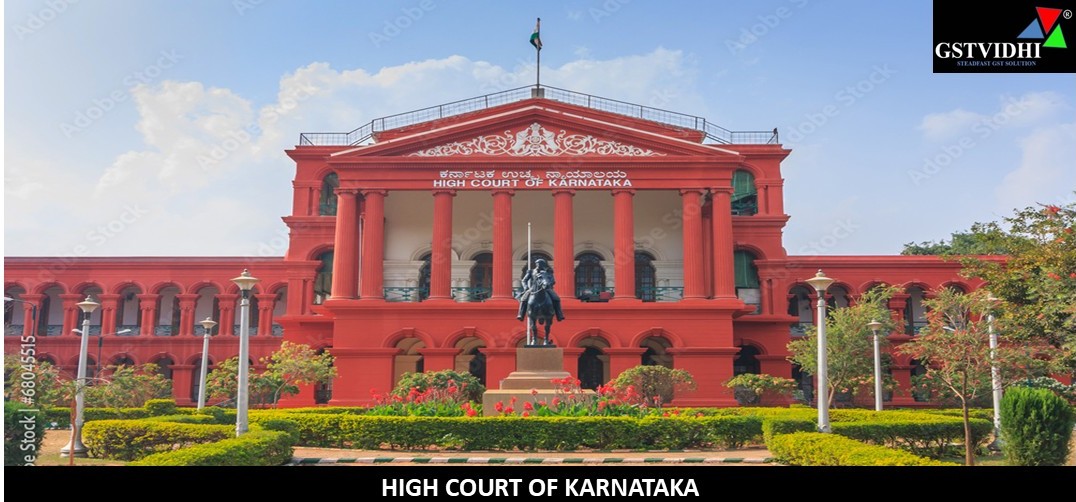
Karnataka High Court Directs Refund of GST Recovery Amount
During Pendency of Tribunal Appeal After Treating Intimation to Appellate
Authority as Sufficient Compliance Under Circular No. 224/18/2024-GST
Divyasree
Tarbus Builders Private Limited v. Deputy Commissioner of Commercial Taxes
& Others / High Court of Karnataka / 21 January 2026 / Writ Petition No.
39323 of 2025 (T-RES)
Introduction
of the Case
The present case was
decided by the High Court of Karnataka in a writ petition filed by Divyasree
Tarbus Builders Private Limited seeking refund of amounts recovered by the GST
authorities during the pendency of appellate proceedings. The dispute mainly related
to the applicability of Circular No. 224/18/2024-GST issued in the context of
non-constitution of the GST Appellate Tribunal.
The petitioner contended
that once an assessee expresses intention to file an appeal before the Tribunal
and complies with the requirements mentioned in the circular, coercive recovery
proceedings should not be initiated. The case examined the interpretation of
paragraph 6 of the circular and the conditions necessary for obtaining
protection against recovery proceedings.
Facts of
the Case
The petitioner company
challenged recovery proceedings initiated by the GST authorities pursuant to a
summary of demand issued against it. The petitioner intended to challenge the
appellate order under Section 112 of the Central Goods and Services Tax Act,
2017 before the GST Appellate Tribunal.
However, since the GST
Tribunal had not yet been constituted, the petitioner relied upon Circular
No.224/18/2024-GST, which provided interim protection against recovery
proceedings in such situations.
The petitioner submitted
that it had already furnished an intimation expressing intention to file an
appeal. Despite this, the GST authorities proceeded to recover the entire
demand amount. Aggrieved by such recovery, the petitioner approached the High Court
seeking refund of the recovered amount along with interest.
Submissions
by the Petitioner
The petitioner argued
that paragraph 6 of Circular No.224/18/2024-GST clearly provided that where an
assessee intends to file an appeal before the Tribunal and furnishes the
required declaration or undertaking, recovery proceedings should not be
initiated.
It was contended that the
authorities ignored the protection granted under the circular and recovered the
entire amount covered under the demand summary. The petitioner therefore sought
refund of the recovered amount.
During the hearing, the
petitioner further submitted that without prejudice to its legal rights, it was
willing to permit the authorities to retain the statutory pre-deposit amount
contemplated under Section 112 of the CGST Act and sought refund only of the
remaining recovered amount. The petitioner also agreed not to insist upon
interest for the time being.
Submissions
by the Respondents
The State authorities
opposed the petition and argued that the petitioner had failed to comply with
the mandatory conditions prescribed under paragraph 6 of the circular.
According to the
respondents, for availing the benefit of the circular, two requirements had to
be fulfilled: firstly, payment of the pre-deposit amount required under Section
112 of the CGST Act, and secondly, furnishing of the undertaking or declaration
to the proper officer.
The respondents contended
that the petitioner had not furnished the declaration before the proper officer
and therefore was not entitled to the protection contemplated under the
circular. It was also argued that interest could not be granted in the absence
of compliance with the prescribed conditions.
However, the respondents
fairly submitted that considering the peculiar facts of the case, the Court
could pass an appropriate order without treating the same as a binding
interpretation of the circular.
Analysis
and Judgment of the Court
The High Court examined
paragraph 6 of Circular No.224/18/2024-GST and observed that the circular
contemplated protection against recovery proceedings where the assessee
expressed intention to file an appeal before the Tribunal.
The Court noted that the
petitioner had furnished an intimation to the appellate authority within seven
days from communication of the summary of demand. The Court further took note
of the petitioner’s willingness to permit retention of the statutory pre-deposit
amount while seeking refund of the remaining recovered amount.
Considering the peculiar
facts of the case and adopting a practical approach, the Court held that the
intimation furnished by the petitioner to the appellate authority could be
treated as sufficient compliance with paragraph 6 of the circular.
Accordingly, the High
Court directed the GST authorities to refund the amount recovered pursuant to
the summary of demand after retaining the statutory pre-deposit amount
contemplated under Section 112 of the CGST Act.
The Court clarified that
the petitioner had given up the claim for interest on the refunded amount and
further clarified that all legal contentions regarding interpretation of the
circular were kept open.
The authorities were
directed to complete the refund within four weeks from receipt of the certified
copy of the order.
Conclusion
The judgment in Divyasree
Tarbus Builders Private Limited v. Deputy Commissioner of Commercial Taxes
& Others is an important decision concerning recovery proceedings during
the period when the GST Appellate Tribunal was not constituted. The Karnataka
High Court adopted a practical and justice-oriented approach while interpreting
Circular No.224/18/2024-GST and granted relief to the taxpayer by directing
refund of the recovered amount after retaining the statutory pre-deposit. The
ruling highlights that procedural requirements under beneficial circulars
should be interpreted reasonably, particularly in situations where appellate
remedies are practically unavailable due to non-functioning of the Tribunal.
Disclaimer: All the Information is based on the notification, circular advisory and order issued by the Govt. authority and judgement delivered by the court or the authority information is strictly for educational purposes and on the basis of our best understanding of laws & not binding on anyone.
Click here