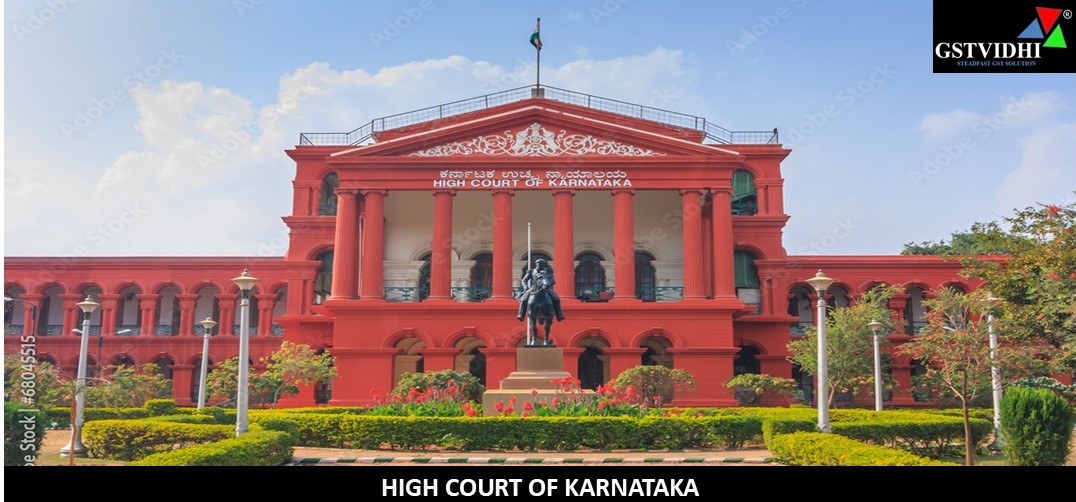
Karnataka High Court Holds That Limitation for GST Appeal
Against Rectification Order Must Be Calculated From Date of Rectification Order
and Not Original Assessment Order
M/s Informart (India) Private Ltd. v. Joint Commissioner of
Commercial Taxes (Appeals) & Another / High Court of Karnataka / 13 January
2026 / W.P. No. 38839 of 2025 (T-RES)
Introduction
of the Case
The Karnataka High Court
in M/s Informart (India) Private Ltd. v. Joint Commissioner of Commercial Taxes
(Appeals) & Another dealt with an important issue relating to limitation
for filing appeals under Section 107 of the Karnataka Goods and Services Tax
Act, 2017.
The dispute arose when
the appellate authority rejected the petitioner’s GST appeal on the ground of
delay by calculating limitation from the date of the original assessment order
instead of the subsequent rectification order passed under Section 161 of the
CGST/KGST Act.
The case highlights the
importance of correctly determining the starting point of limitation in GST
appellate proceedings and clarifies that when an appeal specifically challenges
a rectification order, limitation must be calculated from the date of such
rectification order.
Facts of
the Case
M/s Informart (India)
Private Ltd., a company based in Bengaluru, filed a writ petition before the
Karnataka High Court challenging an order passed by the appellate authority in
Form GST APL-04 dated 12.09.2025.
The appellate authority
had dismissed the petitioner’s appeal on the ground that the appeal was filed
beyond the limitation period prescribed under Section 107(1) of the KGST Act.
According to the appellate authority, there was a delay of 74 days beyond the
statutory period of three months, and the online appeal was allegedly delayed
by 164 days.
The petitioner, however,
contended that the appeal was not directed against the original assessment
order dated 14.02.2025. Instead, the appeal specifically challenged the
rectification order dated 25.06.2025 passed under Section 161 of the CGST/KGST
Act.
The petitioner argued
that since the appeal challenged the rectification order, the limitation period
should have been calculated from 25.06.2025 and not from the date of the
original order.
Submissions
by the Petitioner
The petitioner submitted
that the appellate authority committed a serious error while calculating
limitation from the date of the original order dated 14.02.2025.
Reliance was placed upon
the appeal memorandum filed in Form GST APL-01, wherein the petitioner had
clearly mentioned that the order challenged was the rectification order dated
25.06.2025.
The petitioner contended
that once the appeal was directed against the rectification order passed under
Section 161 of the CGST/KGST Act, the statutory period of limitation under
Section 107(1) had to be computed from the date of such rectification order.
It was therefore argued
that the appeal filed on 10.09.2025 was well within the statutory period of
limitation and rejection of the appeal on the ground of delay was illegal.
Submissions
by the Respondents
The State authorities
supported the impugned order passed by the appellate authority and justified
the rejection of the appeal on the ground of limitation.
However, the Court
primarily examined the appeal memorandum and the details of the order
challenged by the petitioner to determine whether the limitation had been
correctly calculated.
Analysis
and Judgment of the Court
The Karnataka High Court
carefully examined the appeal memorandum produced before the Court. The Court
noted that in Column No.7 of the appeal memorandum, the petitioner had
specifically mentioned the details of the order challenged as:
“ACCT(Audit)-4.8/DGSTO-4/Rect/24-25
dated 25-06-2025.”
The Court further
observed that Annexure-G1 was the rectification order passed under Section 161
of the CGST/KGST Act dated 25.06.2025. Therefore, the Court held that
limitation had to be calculated from the date of the rectification order and
not from the original assessment order.
The High Court referred
to Section 107(1) of the KGST Act, which prescribes a limitation period of
three months from the date of receipt of the order appealed against. The Court
noted that the three-month limitation period from 25.06.2025 would expire on
25.09.2025. Since the appeal was filed on 10.09.2025, it was clearly within
limitation.
Accordingly, the Court
held that the appellate authority had committed an error in rejecting the
appeal as time-barred.
The High Court therefore
set aside the impugned appellate order and remitted the matter back to the
appellate authority for fresh consideration. The Court directed the authority
to recalculate limitation in light of the observations made in the judgment and
clarified that all contentions of the parties were kept open.
Conclusion
The judgment in M/s
Informart (India) Private Ltd. v. Joint Commissioner of Commercial Taxes
(Appeals) & Another is an important ruling on computation of limitation
under GST appellate proceedings. The Karnataka High Court clarified that where
an appeal specifically challenges a rectification order passed under Section
161 of the CGST/KGST Act, the limitation period under Section 107(1) must be
calculated from the date of the rectification order and not from the original
assessment order.
The decision reinforces
the principle that appellate authorities must carefully examine the actual
order challenged in the appeal memorandum before rejecting appeals on technical
grounds of limitation. The ruling also provides relief to taxpayers by ensuring
that procedural rights of appeal are not defeated due to incorrect computation
of limitation periods.
Disclaimer: All the Information is based on the notification, circular advisory and order issued by the Govt. authority and judgement delivered by the court or the authority information is strictly for educational purposes and on the basis of our best understanding of laws & not binding on anyone.
Click here