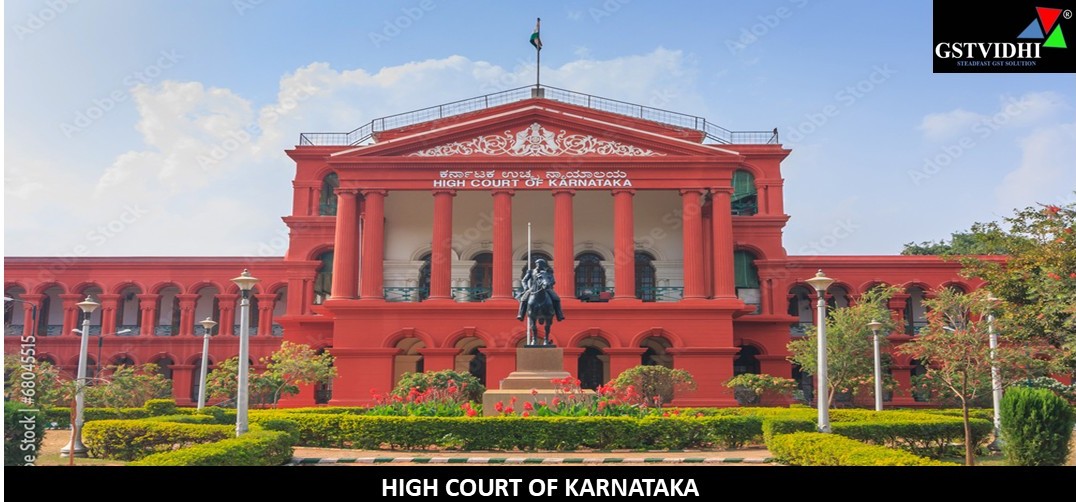
Karnataka High Court Refuses to Interfere With GST Arrest
Proceedings and Holds That Judicial Review Against Arrest Under Special Acts
Must Be Exercised Sparingly
E. Ishitha
& Another v. Union of India & Others / High Court of Karnataka
Introduction
of the Case
The Karnataka High Court
in E. Ishitha & Another v. Union of India & Others considered important
questions relating to arrest under the GST laws, scope of judicial review,
applicability of safeguards under the Code of Criminal Procedure (Cr.P.C.), and
the extent to which High Courts can interfere with arrest proceedings initiated
by GST authorities.
The petitioners
approached the High Court challenging the legality of arrest proceedings
initiated under Section 69 read with Section 132 of the CGST Act. The Court
examined recent judgments of the Supreme Court, particularly Radhika Agarwal v.
Union of India, and analyzed the safeguards governing arrest under special
statutes like GST law.
The judgment is
significant because it reiterates that while constitutional safeguards
protecting personal liberty are important, courts should exercise restraint
while interfering with arrest proceedings under special economic statutes
unless there is clear violation of statutory safeguards or manifest
arbitrariness.
Facts of
the Case
The petitioners
challenged the action of GST authorities relating to arrest proceedings
initiated against them under the CGST Act. The petitioners argued that the
arrest proceedings were illegal and contrary to the safeguards available under
criminal law.
The matter involved
allegations of GST offences attracting provisions of Section 132 of the CGST
Act relating to cognizable and non-bailable offences. The petitioners sought
protection from arrest and requested the High Court to exercise judicial review
over the legality of the proposed arrest.
The petitioners also
raised humanitarian grounds before the Court and submitted that one of the
petitioners had two minor children, including an 18-year-old daughter and an
11-year-old child, who would be left without proper care if arrest was
effected.
Submissions
by the Petitioners
The petitioners argued
that the GST authorities could not exercise powers of arrest mechanically
without complying with safeguards available under Sections 41 and 41A of the
Cr.P.C.
Reliance was placed upon
various judgments of the Supreme Court, particularly the decision in Radhika
Agarwal v. Union of India, where the Apex Court held that arrest cannot be made
merely on suspicion and must be supported by “reasons to believe” based on
credible material.
The petitioners contended
that the Court should exercise judicial review over the legality of arrest
proceedings and grant protection against coercive action.
The petitioners also
relied upon the judgment in Arnab Manoranjan Goswami v. State of Maharashtra to
argue that constitutional courts must protect personal liberty and can grant
interim protection in appropriate cases.
Humanitarian
considerations relating to the family circumstances of the petitioners were
also highlighted before the Court.
Submissions
by the Respondents
The Revenue authorities
opposed the petition and argued that the power of arrest under Section 69 of
the CGST Act was validly exercised based on material available with the
department.
It was submitted that the
Commissioner had formed “reasons to believe” regarding commission of cognizable
and non-bailable offences under Section 132 of the CGST Act.
The respondents further
argued that courts should not conduct a mini-trial or examine sufficiency of
evidence at the stage of investigation and arrest proceedings. According to the
department, judicial review in matters involving arrest under special statutes
should remain extremely limited.
Analysis
and Judgment of the Court
The Karnataka High Court
extensively referred to the Supreme Court judgment in Radhika Agarwal v. Union
of India and extracted important principles governing arrest under GST law. The
Court observed that the Supreme Court had clarified that GST Acts are not
complete codes and therefore provisions of the Cr.P.C. would apply wherever not
expressly excluded.
The Court noted that the
Supreme Court had held that arrest under GST law cannot be made merely on
suspicion and that “reasons to believe” must be based on credible material
establishing satisfaction regarding commission of non-bailable offences under
Section 132 of the CGST Act.
The High Court further
referred to the Supreme Court’s observations that judicial review in such
matters should not amount to a merits review or mini-trial. Courts are only
required to examine whether statutory safeguards have been complied with and
whether the arrest is supported by material enabling formation of “reasons to
believe.”
The Court also discussed
the earlier judgment of the Telangana High Court in P.V. Ramana Reddy v. Union
of India, where it was held that safeguards under Sections 41 and 41A of the
Cr.P.C. may have to be kept in mind while exercising powers under Section 69 of
the CGST Act. However, the Telangana High Court had also clarified that
“reasons to believe” need not necessarily be recorded in the arrest
authorization itself and could exist in departmental records.
The Karnataka High Court
observed that the Supreme Court in Radhika Agarwal had cautioned courts against
frequent or casual interference in proceedings under special economic statutes
such as GST law. The Court noted that such offences affect public revenue and
the financial system of the country and therefore judicial review must be
exercised very cautiously.
While considering the
humanitarian grounds urged by the petitioners, the Court referred to the
principles laid down by the Supreme Court in Arnab Manoranjan Goswami regarding
grant of bail and protection of liberty. However, the Court observed that the facts
of the present case did not justify grant of relief solely on that basis.
Ultimately, the High
Court held that it could not exercise judicial review akin to a merits
examination over the legality of arrest at the investigation stage. The Court
reiterated that unless there is manifest arbitrariness, gross illegality, or
non-compliance with statutory safeguards, interference with arrest proceedings
under GST law would not be justified.
Conclusion
The judgment in E.
Ishitha & Another v. Union of India & Others is an important decision
concerning arrest under GST law and the scope of judicial review by
constitutional courts. The Karnataka High Court reaffirmed that although
personal liberty is a valuable constitutional right, courts should exercise
restraint while interfering with arrest proceedings under special economic
statutes like GST law.
The decision reiterates
that arrest under Section 69 of the CGST Act must be supported by credible
material and valid “reasons to believe,” and cannot be made merely on
suspicion. At the same time, the Court clarified that judicial review at the
stage of arrest is limited to examining compliance with statutory safeguards
and does not permit detailed scrutiny of evidence or merits of the
investigation.
The ruling further
strengthens the legal framework governing GST arrest proceedings and highlights
the balance between protection of individual liberty and effective
investigation of serious economic offences.
Disclaimer: All the Information is based on the notification, circular advisory and order issued by the Govt. authority and judgement delivered by the court or the authority information is strictly for educational purposes and on the basis of our best understanding of laws & not binding on anyone.
Click here