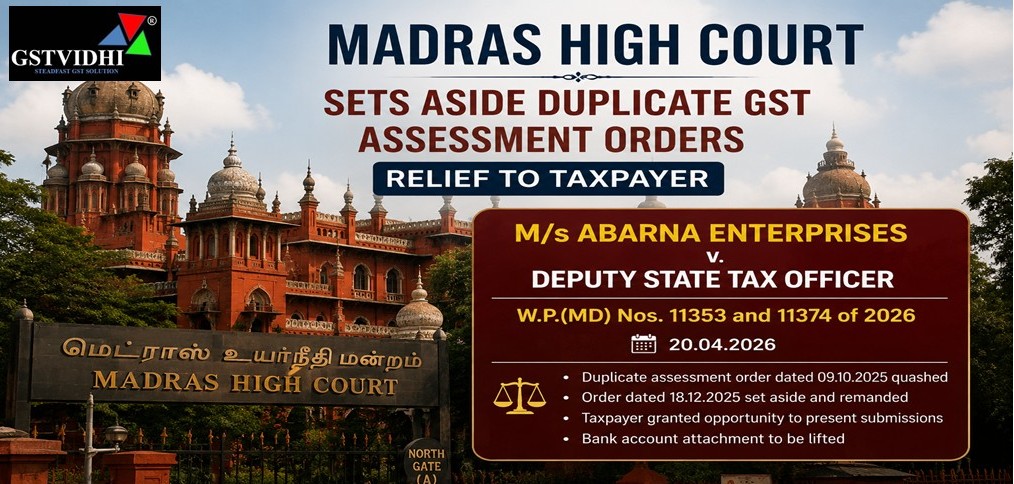
Madras High Court Sets Aside Duplicate GST Assessment Orders for
Same Tax Period – Relief to Taxpayer
The Madurai Bench of the
Madras High Court has delivered an important judgment in M/s Abarna
Enterprises v. Deputy State Tax Officer, W.P.(MD) Nos. 11353 and 11374 of
2026, dated 20.04.2026. The Court held that two separate assessment orders
cannot be passed for the same taxpayer covering the same discrepancies for the
same assessment year. The judgment also reiterates the principle that where
an assessment order is passed ex parte, courts may grant another opportunity to
the taxpayer to present their case if sufficient cause is shown.
Facts of the Case
The petitioner, M/s
Abarna Enterprises, challenged two GST assessment orders issued by the
department for the same tax period, FY 2021-22. One order was passed on
09.10.2025 and another on 18.12.2025. Both orders dealt with discrepancies
relating to the same assessment year. The taxpayer approached the High Court
seeking quashing of both orders.
The second order included
an additional discrepancy apart from those covered in the first order. The
taxpayer contended that issuance of two separate assessment orders for the same
period was legally unsustainable.
Issues Before the Court
The Court considered the
following questions:
1. Whether
two separate GST assessment orders can be passed for the same taxpayer and same
assessment year covering the same discrepancies?
2. Whether
an ex parte assessment order should be sustained when the taxpayer claims that
no effective opportunity of hearing was available?
3. Whether
the matter should be remanded for fresh consideration?
Findings of the Court
1. Two Assessment Orders
for the Same Period Not Permissible
The Court observed that
both impugned orders related to the same tax period, namely FY 2021-22.
Therefore, there could not be two separate assessment orders covering the same
discrepancies against the same taxpayer for the same assessment year.
Accordingly, the Court
quashed the assessment order dated 09.10.2025. The Court chose to retain the
second order for further consideration because it also included an additional
discrepancy that was not part of the earlier order.
2. Opportunity Should Be
Granted in Ex Parte Assessments
The Court noted that the
second assessment order was passed ex parte because the taxpayer did not
participate in the proceedings. The taxpayer explained that the GST
registration had already been cancelled and notices uploaded on the GST portal
were not effectively noticed by the petitioner. The petitioner therefore
remained unaware of the show cause notice and subsequent reminders.
The taxpayer also offered
explanations on merits regarding:
|
Discrepancy
|
|
Difference
between GSTR-1 and GSTR-3B turnover
|
|
Excess
ITC claimed compared to GSTR-2A
|
|
Late
fee relating to delayed filing of GSTR-1
|
The taxpayer attributed
these discrepancies primarily to errors committed by the consultant.
3. Equitable Relief
Granted
The Court observed that
the nature of the disputes required examination of supporting documents and
submissions. Considering the explanation offered and the fact that
approximately 46% of the disputed tax had already been recovered, the
Court found it appropriate to grant another opportunity to the taxpayer.
Final Directions Issued
by the Court
The High Court passed the
following directions:
- The assessment order dated 09.10.2025
was quashed.
- The assessment order dated 18.12.2025
was set aside and remanded.
- The taxpayer was directed to appear
before the assessing authority and file a detailed reply along with
supporting documents.
- The assessing authority was directed
to reconsider the matter afresh in accordance with law.
- Any bank account attachment made
pursuant to the impugned assessment order was directed to be lifted.
Significance of the
Judgment
This judgment is
significant for GST taxpayers for the following reasons:
A. No Multiple
Assessments for the Same Period
The ruling reinforces the
principle that the department cannot issue multiple assessment orders covering
the same discrepancies for the same tax period. Such duplication creates
uncertainty and violates principles of proper assessment.
B. Relief Against Ex
Parte Orders
Where a taxpayer can
demonstrate genuine reasons for non-participation in assessment proceedings,
courts may intervene and provide another opportunity to contest the demand,
particularly where substantial tax liabilities are involved.
C. Importance of Natural
Justice
The judgment highlights
that assessment proceedings should not become merely technical exercises.
Taxpayers must be given a meaningful opportunity to explain discrepancies and
produce supporting evidence before adverse orders attain finality.
Conclusion
The Madras High Court's
decision in M/s Abarna Enterprises provides valuable protection to
taxpayers facing duplicate assessments and ex parte GST orders. The Court
clearly held that two assessment orders for the same taxpayer and same
assessment year cannot coexist when they address the same discrepancies. At
the same time, it emphasized the importance of granting a fair opportunity to
taxpayers to present their case before final tax liability is determined. This
ruling strengthens the principles of natural justice and procedural fairness
under GST law.
Disclaimer: All the Information is based on the notification, circular advisory and order issued by the Govt. authority and judgement delivered by the court or the authority information is strictly for educational purposes and on the basis of our best understanding of laws & not binding on anyone.
Click here