Madras High Court Quashes Duplicate GST Interest Demand:
Department Cannot Initiate Proceedings Twice for the Same Cause
Background of the Case
The petitioner, M/s AMK
Athencottasan Muthamizh Kazhagam Man Power Services, had filed its GSTR-3B
returns belatedly and consequently paid GST after the prescribed due dates. Due
to the delay in payment of tax, the department initiated proceedings for recovery
of interest on the delayed payment.
A Show Cause Notice was
issued by the department, and after considering the taxpayer's reply, an order
dated 07.02.2023 was passed demanding interest on CGST, SGST, and IGST. The
taxpayer did not challenge the said order, and therefore it attained finality.
Subsequently, the
department again initiated proceedings for the very same tax period and the
same transactions and issued another Show Cause Notice. Based on this second
proceeding, an order dated 10.07.2025 was passed demanding interest once again
for the same delay.
Case Details
Case Name:
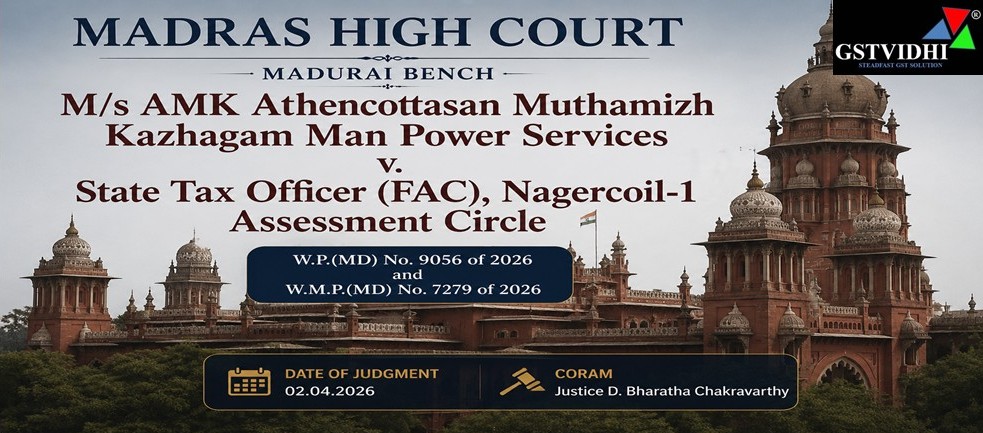
M/s AMK Athencottasan Muthamizh Kazhagam Man Power Services v. State Tax
Officer (FAC), Nagercoil-1 Assessment Circle
Court:
Madurai Bench of Madras High Court
Case No.:
W.P.(MD) No. 9056 of 2026
Date of Judgment:
02.04.2026
Petitioner's Contention
The petitioner argued
that:
- The department had already completed
proceedings regarding delayed payment of tax.
- An order demanding interest had
already been passed on 07.02.2023.
- The second Show Cause Notice and
consequential order related to the identical transactions and tax period.
- Therefore, the subsequent proceedings
amounted to duplication and were without jurisdiction.
Department's Stand
The department contended
that if there was any duplication, the matter could be remanded back to the
authorities for reconsideration and verification.
Findings of the High
Court
The High Court examined
the records and found that:
1. The
earlier proceedings had already culminated in an order dated 07.02.2023.
2. The
order had become final since no appeal had been filed.
3. The
second Show Cause Notice related to the same period and the same transactions.
4. The
department had failed to make any reference to the earlier order while
initiating fresh proceedings.
The Court observed that
once interest liability had already been adjudicated, the department could not
undertake another adjudication exercise on the identical subject matter. Such
action was merely a duplication of proceedings and was legally unsustainable.
Important Observation of
the Court
The Court clarified that
although the second order was invalid, the department was not prevented from
recovering the amount already determined under the original order dated
07.02.2023.
The authorities were free
to:
- Recover the interest already
determined under the first order.
- Compute further interest, if legally
permissible, until the date of payment.
- Initiate recovery proceedings based
on the earlier valid order.
However, they could not
pass a fresh order for the same liability.
Decision of the Court
The High Court held that
the second proceedings were unnecessary and duplicative.
Accordingly:
- The impugned order dated 10.07.2025
was set aside.
- Liberty was granted to the department
to recover dues pursuant to the earlier order dated 07.02.2023.
- The writ petition was allowed.
Key Legal Principle
Emerging from the Judgment
This judgment reinforces
an important principle of tax administration:
Once a matter has been
adjudicated and an order has attained finality, the department cannot reopen or
re-adjudicate the same issue through another set of proceedings unless
specifically authorized by law.
The GST authorities
cannot issue repeated demands for the same liability under the guise of fresh
proceedings. Such duplication results in harassment of taxpayers and violates
principles of certainty and finality in tax administration.
Practical Significance
for Taxpayers
This judgment can be
relied upon where:
- Multiple Show Cause Notices are
issued for the same transaction.
- Interest is demanded more than once
for the same delayed payment.
- Tax authorities initiate duplicate
adjudication proceedings.
- Fresh orders are passed on issues
already concluded by earlier orders.
Taxpayers facing repeated
GST demands on identical facts may rely on this decision to challenge such
proceedings before appellate authorities or constitutional courts.
Conclusion
The Madras High Court has
sent a clear message that GST authorities cannot undertake repetitive
adjudication on issues that have already been decided. While the department
retains the right to recover dues determined under a valid order, it cannot
pass a second order for the same cause of action. The ruling strengthens the
principles of finality, certainty, and fairness in GST administration and
offers significant protection against duplicate tax proceedings.
Disclaimer: All the Information is based on the notification, circular advisory and order issued by the Govt. authority and judgement delivered by the court or the authority information is strictly for educational purposes and on the basis of our best understanding of laws & not binding on anyone.
Click here