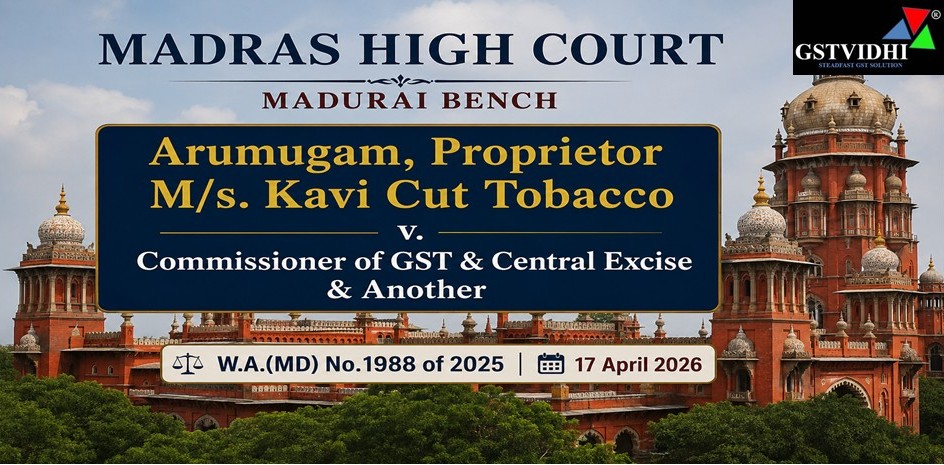
Madras High Court Holds Cut Tobacco Classifiable Under HSN 2401
and Clarifies Scope of Judicial Review Over GST Advance Rulings
Case Name: Arumugam,
Proprietor M/s. Kavi Cut Tobacco v. Commissioner of GST & Central Excise
& Another
Court:
Madurai Bench of Madras High Court
Case No.:
W.A.(MD) No.1988 of 2025
Date of Judgment:
17 April 2026
Introduction
The Madurai Bench of the
Madras High Court has delivered a significant judgment dealing with two
important aspects of GST law. First, it clarified the extent to which an
Advance Ruling can be challenged before the High Court. Secondly, it settled
the classification of a particular variety of cut tobacco by holding that mere
cleaning, curing, cutting and packing of tobacco leaves does not necessarily
convert the product into "manufactured chewing tobacco."
The judgment is important
not only for tobacco manufacturers but also for all taxpayers seeking certainty
through the Advance Ruling mechanism under the CGST Act.
Background
of the Case
The appellant, M/s. Kavi
Cut Tobacco, is engaged in the business of purchasing raw dried tobacco leaves
from wholesale dealers and growers. After purchase, the tobacco leaves undergo
a limited process in which stems and dust particles are removed. The leaves are
then treated with jaggery water only for the purpose of preventing moulding and
decay, a process commonly known as "liquoring." Thereafter, the
leaves are cut into smaller pieces using a cutting machine, packed into pouches
and sold under the brand name "Kulavi's Kavi Cut Tobacco."
According to the
appellant, these activities do not amount to manufacture and therefore the
product continues to remain unmanufactured tobacco classifiable under CETH
2401 20 90.
However, the GST
Department took the view that after undergoing these processes, the product
became "manufactured chewing tobacco" classifiable under HSN 2403
99 10, attracting a substantially higher GST and Compensation Cess.
Proceedings
Before the Advance Ruling Authorities
To obtain certainty
regarding the classification of its product, the appellant approached the
Authority for Advance Ruling under the CGST Act. The Authority held that the
product was classifiable as manufactured chewing tobacco falling under Heading
2403.
Aggrieved by the ruling,
the appellant preferred an appeal before the Tamil Nadu State Appellate
Authority for Advance Ruling. The Appellate Authority affirmed the findings of
the Advance Ruling Authority and dismissed the appeal.
The appellant thereafter
challenged both the orders before the Madras High Court by filing a writ
petition. The learned Single Judge dismissed the writ petition, following which
the matter reached the Division Bench in the present writ appeal.
Whether an
Advance Ruling Can Be Challenged Before the High Court?
One of the principal
questions before the Division Bench was whether an Advance Ruling, which is
declared to be binding under Section 103 of the CGST Act, can nevertheless be
challenged before the High Court.
The Court answered this
question in the affirmative. It observed that although an Advance Ruling is
binding upon the applicant and the jurisdictional officer, such statutory
binding effect cannot curtail the constitutional powers of judicial review
vested in the High Courts under Articles 226 and 227 of the Constitution.
The Court relied upon the
decision of the Supreme Court in Columbia Sportswear Co. v. Director of
Income Tax and observed that an Advance Ruling is always subject to
judicial scrutiny. Therefore, any person aggrieved by an Advance Ruling is
entitled to invoke the writ jurisdiction of the High Court.
Scope of
Judicial Review Over Advance Rulings
While recognising the
maintainability of a writ petition, the Court simultaneously clarified that the
scope of judicial review is extremely limited.
The High Court does not
function as an appellate authority over Advance Rulings. Its role is confined
to examining whether the Authority acted within its jurisdiction, committed any
error of law, violated the principles of natural justice or passed a decision
that is arbitrary or perverse.
The Court reiterated that
merely because another interpretation is possible, the High Court would not
substitute its own opinion in exercise of judicial review. Unless there is a
clear legal infirmity, the Court would ordinarily refrain from interfering with
the decision of the Advance Ruling Authority.
Important
Direction Regarding Listing of Writ Petitions
An important procedural
direction was also issued by the Division Bench. The Court observed that
whenever an Advance Ruling or an Appellate Advance Ruling is challenged under
Articles 226 or 227 of the Constitution, such writ petitions should be placed directly
before a Division Bench of the High Court instead of a Single Judge.
The Court noted that this
course is consistent with the observations made by the Supreme Court in Columbia
Sportswear Co. and would ensure expeditious disposal of matters involving
Advance Rulings.
Classification
of the Tobacco Product
The Division Bench then
examined the manufacturing activities carried out by the appellant. It found
that the appellant merely removed stems and dust, applied jaggery water for
preservation, cut the tobacco leaves into smaller pieces and packed them into
pouches for sale.
The Court held that these
limited activities did not change the essential character of the tobacco. The
product continued to remain unmanufactured tobacco and therefore deserved
classification under CETH 2401 20 90 rather than under Heading 2403 as
manufactured chewing tobacco.
While arriving at this
conclusion, the Court relied upon its earlier judgment in W.A.(MD) No.746 of
2021, where identical manufacturing processes had already been examined.
The Court also referred to the decision in Pachiappa Chettiar v. State of
Madras, wherein similar processing activities had been held insufficient to
amount to manufacture.
Principle
of Equality Applied by the Court
An interesting
constitutional aspect of the judgment relates to the principle of equality.
The Court observed that
another manufacturer carrying out exactly the same manufacturing process had
already been granted classification under Heading 2401 through an earlier
judgment. If the appellant were required to classify the identical product under
Heading 2403, similarly situated manufacturers would be subjected to different
tax treatments for identical products.
Such an approach,
according to the Court, would amount to an egregious violation of Article 14 of
the Constitution, which guarantees equality before law. Therefore, consistency
in classification was necessary to avoid discriminatory taxation.
Final
Decision of the High Court
After considering the
facts and the applicable legal principles, the Division Bench allowed the writ
appeal. The Court set aside the orders passed by the Authority for Advance
Ruling, the Appellate Authority for Advance Ruling as well as the judgment of the
learned Single Judge.
It was held that the
appellant's product would fall under CETH 2401 20 90, provided that the
manufacturing activities remain confined to the processes recognised in the
earlier judicial precedents.
Conclusion
The judgment is an
important precedent in GST law for two reasons. Firstly, it reinforces that
although an Advance Ruling is binding under the CGST Act, it is not immune from
constitutional judicial review. Secondly, it reiterates that classification disputes
must be decided on the basis of the actual nature of the product and the extent
of processing undertaken, rather than merely on the manner in which the product
is marketed.
The decision also
strengthens the principle of uniformity in tax administration by ensuring that
similarly placed taxpayers are not subjected to different tax treatments. For
businesses relying on Advance Rulings, the judgment serves as a reminder that while
such rulings provide certainty, they remain open to judicial scrutiny whenever
they suffer from legal or constitutional infirmities.
Disclaimer: All the Information is based on the notification, circular advisory and order issued by the Govt. authority and judgement delivered by the court or the authority information is strictly for educational purposes and on the basis of our best understanding of laws & not binding on anyone.
Click here