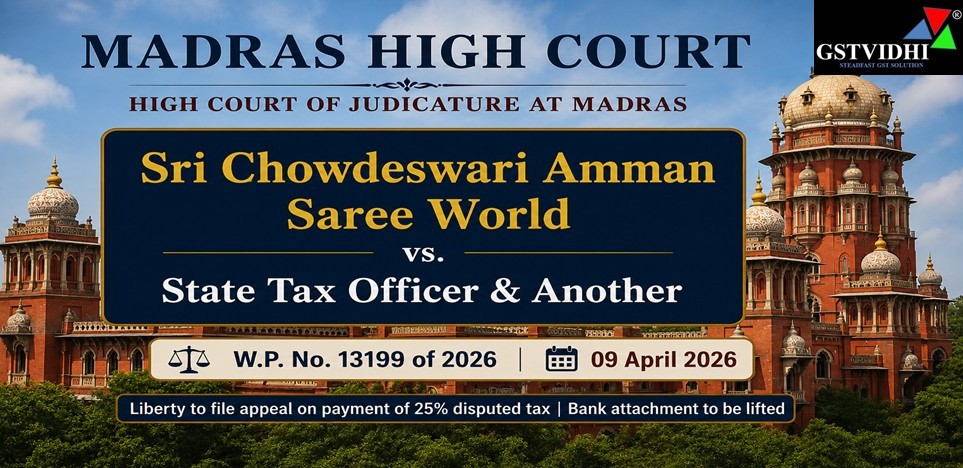
Madras High Court Permits Appeal Against GST Order Beyond
Limitation on Payment of 25% Disputed Tax and Orders Lifting of Bank Attachment
Case Name: Sri
Chowdeswari Amman Saree World v. State Tax Officer & Another
Court:
High Court of Judicature at Madras
Case No.:
W.P. No. 13199 of 2026
Date of Judgment:
09 April 2026
Introduction
In a taxpayer-friendly
order, the Madras High Court granted an opportunity to challenge a GST
assessment order even though the statutory time limit for filing an appeal had
expired. The Court permitted the petitioner to file an appeal before the
Appellate Authority without raising the issue of limitation, subject to the
condition that the petitioner deposits 25% of the disputed tax within
thirty days.
The Court also directed
that any bank attachment made by the GST Department shall stand automatically
lifted upon compliance with the above condition. The judgment demonstrates the
High Court's willingness to exercise its extraordinary jurisdiction under
Article 226 of the Constitution to ensure that disputes are decided on merits
rather than being defeated on technical grounds.
Background
of the Case
The petitioner, Sri
Chowdeswari Amman Saree World, was issued a Show Cause Notice in FORM
GST DRC-01 dated 26.12.2022 proposing demand under Section 74 of the
CGST Act, 2017 for the financial year 2018-19.
The Show Cause Notice
required the petitioner to submit a reply and appear for a personal hearing.
However, the petitioner did not respond to the notice nor avail the opportunity
of personal hearing. Consequently, the State Tax Officer passed an adjudication
order dated 25.03.2025 confirming the demand under Section 74.
Instead of filing an
appeal within the prescribed limitation period, the petitioner approached the
Madras High Court by filing a writ petition challenging the adjudication order.
Submission
Made Before the High Court
During the hearing, the
petitioner's counsel did not press for adjudication of the writ petition on
merits. Instead, it was submitted that the petitioner would be satisfied if
liberty was granted to pursue the statutory appellate remedy before the Appellate
Authority.
The petitioner also
voluntarily undertook before the Court to deposit 25% of the disputed tax
as a condition for filing the appeal. An endorsement to this effect was made
before the Court stating that the petitioner was willing to pay 25% of the
disputed tax without insisting upon the issue of limitation.
High Court
Grants Liberty to File Appeal
Taking note of the
voluntary undertaking given by the petitioner, the Madras High Court exercised
its writ jurisdiction and permitted the petitioner to file a statutory appeal
before the Appellate Authority.
The Court directed that
the petitioner shall deposit 25% of the disputed tax, either in cash or
through the Electronic Cash Ledger, within thirty days from the date of receipt
of the Court's order.
Upon compliance with this
condition, the petitioner would be entitled to file an appeal, and the
Appellate Authority was directed to decide the appeal strictly on merits
without rejecting it on the ground of limitation.
This relief is
significant because, under the GST law, an appeal filed beyond the statutory
limitation period is ordinarily not maintainable once the maximum condonable
period has expired.
Direction
to Decide the Appeal on Merits
The High Court
specifically directed the Appellate Authority not to examine whether the appeal
was filed beyond the prescribed period of limitation. Instead, once the
petitioner complied with the condition of depositing 25% of the disputed tax,
the appellate authority was required to hear the matter and pass a reasoned
order on merits in accordance with law.
This direction ensured
that the taxpayer's grievance would receive substantive consideration instead
of being rejected on procedural grounds.
Relief
Regarding Bank Attachment
The Court also considered
the issue of recovery proceedings initiated by the Department.
It directed that any
attachment of the petitioner's bank account shall stand automatically vacated
immediately after the petitioner deposits 25% of the disputed tax, provided
that the petitioner is not in default of any other tax dues for any other tax period.
This relief protects the
taxpayer from coercive recovery measures while the statutory appeal remains
pending before the Appellate Authority.
Consequences
of Non-Compliance
The Court clarified that
if the petitioner fails to deposit the required 25% of the disputed tax within
the stipulated period or violates any of the conditions imposed by the Court,
the Department would be free to recover the outstanding tax in accordance with
law.
The Court observed that,
in such an event, the Department could proceed as though the writ petition had
been dismissed. However, before initiating any coercive recovery proceedings,
the Department was directed to issue appropriate notice to the petitioner.
Significance
of the Judgment
This judgment reflects
the consistent approach adopted by the Madras High Court in several GST matters
where taxpayers have failed to file statutory appeals within the prescribed
limitation period.
Instead of denying relief
outright, the Court has, in appropriate cases, exercised its constitutional
jurisdiction to permit taxpayers to pursue the appellate remedy, subject to
payment of a higher pre-deposit than what is ordinarily prescribed under Section
107 of the CGST Act.
The decision reinforces
the principle that genuine disputes should preferably be adjudicated on their
merits, particularly where the taxpayer is willing to comply with reasonable
conditions imposed by the Court.
Conclusion
The decision in Sri
Chowdeswari Amman Saree World v. State Tax Officer provides important
relief for taxpayers who have missed the statutory limitation period for filing
appeals under the GST law. By permitting the appeal to be filed upon payment of
25% of the disputed tax and directing the lifting of bank attachment, the Madras
High Court ensured that the taxpayer was not deprived of the right to contest
the assessment merely on procedural grounds.
Although the relief was
granted in the peculiar facts of the case and based on the petitioner's
consent, the judgment highlights the wide powers of the High Court under
Article 226 of the Constitution to balance procedural requirements with the
interests of justice. Taxpayers facing similar situations may consider seeking
Disclaimer: All the Information is based on the notification, circular advisory and order issued by the Govt. authority and judgement delivered by the court or the authority information is strictly for educational purposes and on the basis of our best understanding of laws & not binding on anyone.
Click here