Madras High Court Sets Aside GST Assessment Order Due to Denial
of Effective Opportunity – Fresh Assessment Allowed on Deposit of 25% Disputed
Tax
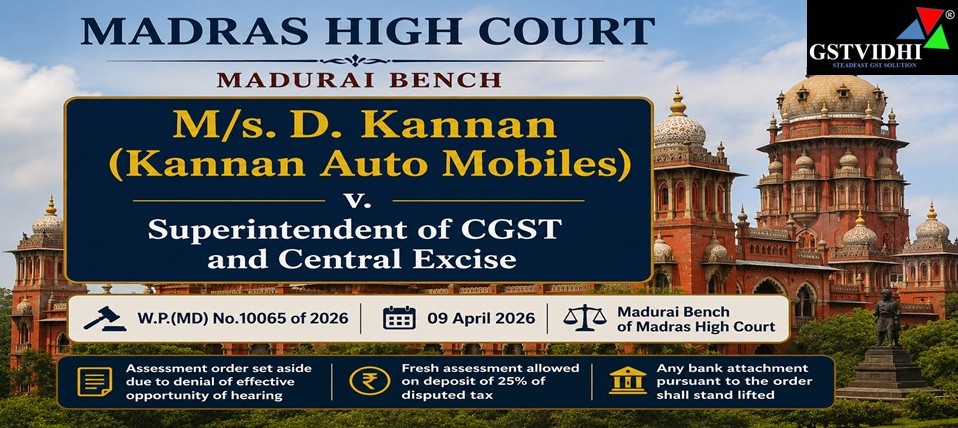
Case Name: M/s.
D. Kannan (Kannan Auto Mobiles) v. Superintendent of CGST and Central Excise
Court:
Madurai Bench of Madras High Court
Case No.:
W.P.(MD) No.10065 of 2026
Date of Judgment:
09 April 2026
Introduction
In another
taxpayer-friendly decision, the Madurai Bench of the Madras High Court has
reiterated that an assessment order passed without providing an effective
opportunity to the taxpayer deserves to be reconsidered. While balancing the
interests of the Revenue and the taxpayer, the Court set aside the assessment
order passed under Section 73 of the CGST Act, 2017, subject to the
condition that the petitioner deposits 25% of the disputed tax within
four weeks.
The Court further
directed that after such deposit, the matter shall be remanded to the
adjudicating authority for fresh consideration and any bank attachment made
pursuant to the impugned assessment order shall automatically stand lifted.
Facts of
the Case
The petitioner, M/s.
D. Kannan (Kannan Auto Mobiles), challenged an assessment order dated 09.12.2025
passed under Section 73 of the CGST Act, 2017 for the Financial Year
2021-22.
The proceedings were
initiated on the allegation that the petitioner had availed excess Input Tax
Credit (ITC). Accordingly, the department issued notices seeking an
explanation from the petitioner.
According to the
petitioner, he was suffering from illness during the relevant period and
therefore could not personally participate in the assessment proceedings.
Although his auditor submitted replies to some of the notices, the adjudicating
authority found those replies to be unsatisfactory. Thereafter, the auditor
sought an extension of thirty days to furnish a detailed explanation and
supporting documents.
However, without granting
the requested time or affording an effective opportunity of personal hearing,
the adjudicating authority proceeded to pass the impugned assessment order
confirming the demand.
Aggrieved by the
assessment order, the petitioner approached the Madras High Court.
Petitioner's
Contention
Before the High Court,
the petitioner submitted that due to his illness he was unable to effectively
participate in the proceedings and consequently failed to produce all the
relevant documents in support of his claim.
It was argued that if one
final opportunity were granted, the petitioner would submit all supporting
records and satisfactorily explain the alleged excess claim of Input Tax
Credit.
The petitioner therefore
requested the Court to set aside the assessment order and remand the matter for
fresh adjudication.
Findings of
the High Court
The High Court considered
the explanation offered by the petitioner and found that the petitioner had
been prevented by genuine circumstances from effectively availing the
opportunity of hearing, including the opportunity of personal hearing.
The Court observed that
the principles of natural justice require that every taxpayer should be given a
fair and effective opportunity to place his case before an adverse order is
passed.
Since the petitioner
expressed willingness to participate in the proceedings and produce all
relevant documents, the Court held that one final opportunity deserved to be
granted. At the same time, in order to safeguard the interests of the Revenue,
the Court considered it appropriate to impose a condition requiring payment of 25%
of the disputed tax amount.
Assessment
Order Set Aside Subject to Deposit of 25% Tax
The Court directed the
petitioner to deposit 25% of the disputed tax amount within four
weeks from the date of receipt of the web copy of the judgment, without
waiting for the certified copy.
Upon making such deposit,
the assessment order dated 09.12.2025 would automatically stand set
aside and the entire matter would stand remanded to the adjudicating authority
for fresh adjudication.
The Court thus granted
substantial relief while ensuring that the Revenue's interest remained
protected through the condition of pre-deposit.
Fresh
Opportunity to Produce Documents
The High Court
specifically directed the petitioner to appear before the adjudicating
authority and file a comprehensive reply along with all documents supporting
the claim of Input Tax Credit.
The Court further
directed the adjudicating authority to consider the reply, examine the
documents produced by the petitioner and thereafter pass a fresh order strictly
in accordance with law.
Thus, the Court ensured
that the assessment would be completed only after granting a proper hearing and
considering all relevant evidence.
Bank
Attachment Ordered to be Lifted
Since the assessment
order itself was directed to be set aside after compliance with the condition
of deposit, the Court also granted consequential relief regarding recovery
proceedings.
It directed that any
attachment of the petitioner's bank account made pursuant to the impugned
assessment order shall stand lifted immediately after the assessment order
is set aside.
This direction provided
immediate financial relief to the petitioner while the matter remains pending
for fresh adjudication.
Significance
of the Judgment
This judgment once again
reflects the liberal approach consistently adopted by the Madras High Court in
GST matters where assessment orders have been passed without granting an
effective opportunity of hearing.
Instead of compelling
taxpayers to undergo prolonged litigation, the Court has balanced the equities
by permitting fresh adjudication subject to reasonable conditions such as
deposit of 25% of the disputed tax.
The decision also
reinforces that compliance with the principles of natural justice is not an
empty formality. Even where allegations relate to excess availment of Input Tax
Credit, the adjudicating authority must provide sufficient opportunity to the
taxpayer to explain the discrepancies and produce supporting evidence before
confirming the demand.
Conclusion
The decision in M/s.
D. Kannan (Kannan Auto Mobiles) v. Superintendent of CGST and Central Excise
is another important precedent emphasizing that GST assessment proceedings must
be conducted in a fair and transparent manner. Where genuine reasons prevent a
taxpayer from participating in the proceedings, the Courts may exercise their
writ jurisdiction to restore the opportunity of hearing, subject to appropriate
safeguards for protecting the Revenue.
The judgment also
demonstrates that conditional remand of assessment proceedings upon deposit of
a portion of the disputed tax has become a pragmatic approach adopted by the
Madras High Court to strike a balance between taxpayer rights and revenue
interests. Taxpayers facing similar situations may rely upon this decision
while seeking restoration of assessment proceedings where adequate opportunity
of hearing was not effectively available.
Disclaimer: All the Information is based on the notification, circular advisory and order issued by the Govt. authority and judgement delivered by the court or the authority information is strictly for educational purposes and on the basis of our best understanding of laws & not binding on anyone.
Click here