Madras High Court Remands GST Assessment Despite Expiry of
Appeal Limitation on Deposit of 10% Disputed Tax
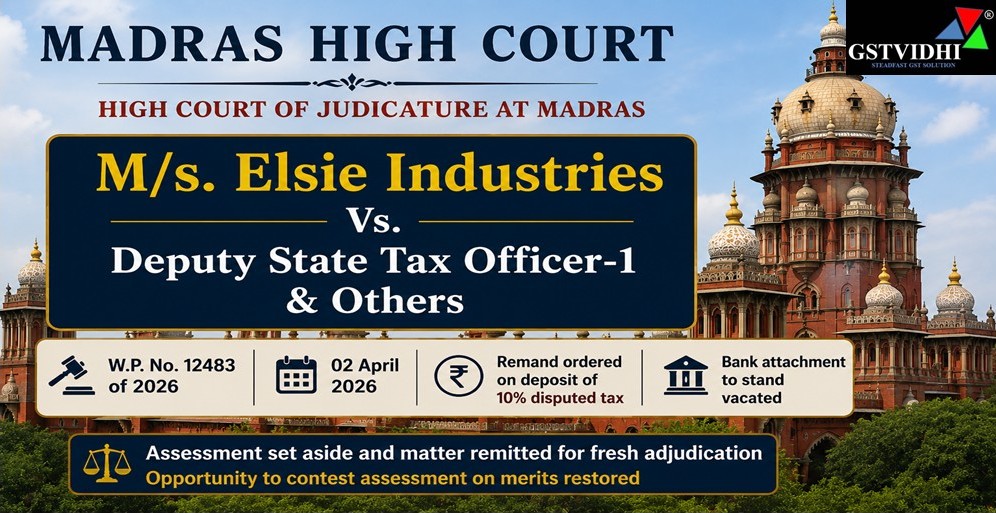
Case Name: M/s.
Elsie Industries v. Deputy State Tax Officer-1 & Others
Court:
High Court of Judicature at Madras
Case No.:
W.P. No. 12483 of 2026
Date of Judgment:
02 April 2026
Introduction
In a significant relief
to taxpayers, the Madras High Court exercised its extraordinary writ
jurisdiction to set aside a GST assessment order even though the statutory
limitation period for filing an appeal under Section 107 of the CGST Act had
already expired. The Court remanded the matter to the adjudicating authority
for fresh consideration, subject to the condition that the petitioner deposits 10%
of the disputed tax in cash within thirty days.
The judgment once again
demonstrates the liberal approach adopted by the Madras High Court in deserving
cases, where taxpayers are willing to comply with reasonable conditions and
seek an opportunity to contest the assessment on merits.
Facts of
the Case
The petitioner, M/s.
Elsie Industries, challenged the assessment order dated 10.11.2025
passed under Section 73 of the CGST/TNGST Act, 2017 for the Financial
Year 2021-22. Along with the assessment order, the petitioner also challenged
the consequential FORM GST DRC-07 and the subsequent order rejecting its
rectification application.
The assessment
proceedings commenced with the issuance of a Show Cause Notice in FORM GST
DRC-01 dated 06.08.2025, calling upon the petitioner to submit a reply by 06.09.2025.
Thereafter, the
department issued several reminder notices dated 09.09.2025, 06.10.2025 and
16.10.2025, requiring the petitioner to submit its reply and appear for
personal hearing. Despite these opportunities, the petitioner neither filed any
reply nor appeared before the adjudicating authority.
Consequently, the
assessing officer proceeded to pass the impugned assessment order confirming
the tax demand.
Appeal
Could Not Be Filed Within Limitation
Instead of preferring a
statutory appeal under Section 107 of the CGST Act, the petitioner approached
the Madras High Court by filing a writ petition.
The Court noted that the
statutory period available for filing an appeal had already expired by the time
the writ petition was instituted. Therefore, the petitioner no longer had any
effective alternative statutory remedy available under the GST law.
Petitioner's
Offer to Deposit 10% of the Disputed Tax
During the hearing, the
petitioner submitted that it was willing to deposit 10% of the disputed tax
as a condition for obtaining a fresh opportunity before the adjudicating
authority.
The petitioner also made
a written endorsement before the Court expressly consenting to the payment of
10% of the disputed tax.
Taking note of this
voluntary undertaking, the Court considered it appropriate to grant one more
opportunity to the petitioner to contest the assessment on merits.
High Court
Sets Aside Assessment Order
The Madras High Court
remanded the matter to the adjudicating authority after directing the
petitioner to deposit 10% of the disputed tax in cash through the Electronic
Cash Register within thirty days from the date of receipt of the
order.
The Court held that upon
compliance with this condition, the assessment order would stand set aside and
the matter would be reconsidered afresh by the jurisdictional authority.
This relief enabled the
petitioner to secure a fresh adjudication despite having lost the statutory
right of appeal due to expiry of limitation.
Fresh Reply
to Show Cause Notice Permitted
The Court further
directed the petitioner to file a comprehensive reply to the original Show
Cause Notice in FORM GST DRC-01 dated 06.08.2025, along with all supporting
documents.
Interestingly, the Court
directed that the impugned assessment order itself should be treated as an addendum
to the Show Cause Notice, thereby permitting the petitioner to respond not
only to the allegations contained in the original notice but also to the
findings recorded in the assessment order.
After receiving the reply
and supporting documents, the adjudicating authority was directed to pass a
fresh order on merits in accordance with law.
Time Limit
Prescribed for Fresh Adjudication
The High Court directed
the adjudicating authority to complete the fresh assessment proceedings as
expeditiously as possible, preferably within three months from the date
on which the petitioner files its reply and makes the required pre-deposit.
This direction was
intended to ensure that the remanded proceedings are concluded within a
reasonable period and that the dispute does not remain pending indefinitely.
Bank
Attachment to Stand Automatically Vacated
The Court also granted
consequential relief with respect to recovery proceedings.
It directed that once the
petitioner complies with the conditions imposed by the Court, the attachment
of the petitioner's bank account shall automatically stand vacated,
provided that the petitioner is not in default of any other tax dues relating
to any other tax period.
This direction offers
immediate financial relief by enabling the petitioner to resume normal banking
operations while the assessment proceedings are reconsidered.
Consequences
of Non-Compliance
The Court made it clear
that if the petitioner fails to deposit the required 10% of the disputed tax or
violates any of the other conditions imposed in the order, the department would
be at liberty to recover the outstanding tax in accordance with law as though
the writ petition had been dismissed.
However, before
initiating such recovery proceedings, the department was directed to issue due
notice to the petitioner.
Significance
of the Judgment
This judgment forms part
of a series of decisions delivered by the Madras High Court where taxpayers
have been granted one final opportunity to contest GST assessments despite the
expiry of the statutory limitation for filing appeals.
Unlike earlier cases
where the Court directed a deposit of 25% of the disputed tax, the
present case is noteworthy because the Court accepted the petitioner's
undertaking to deposit only 10% of the disputed tax before remanding the
matter.
The decision reflects the
Court's balanced approach of protecting revenue interests while simultaneously
ensuring that genuine disputes are adjudicated on merits rather than being
rejected solely on technical grounds.
Conclusion
The judgment in M/s.
Elsie Industries v. Deputy State Tax Officer-1 & Others reiterates the
Madras High Court's commitment to ensuring fairness in GST adjudication. Even
after the statutory period for filing an appeal had expired, the Court
exercised its extraordinary jurisdiction under Article 226 of the Constitution
to restore the taxpayer's opportunity of hearing, subject to reasonable
safeguards.
The ruling highlights
that where a taxpayer demonstrates bona fide intentions and agrees to comply
with conditions such as pre-deposit of the disputed tax, the High Court may
intervene to secure substantial justice by remanding the matter for fresh consideration.
The decision also provides valuable guidance for taxpayers facing similar
circumstances where assessment orders have attained finality due to the expiry
of the appellate limitation period.
Disclaimer: All the Information is based on the notification, circular advisory and order issued by the Govt. authority and judgement delivered by the court or the authority information is strictly for educational purposes and on the basis of our best understanding of laws & not binding on anyone.
Click here