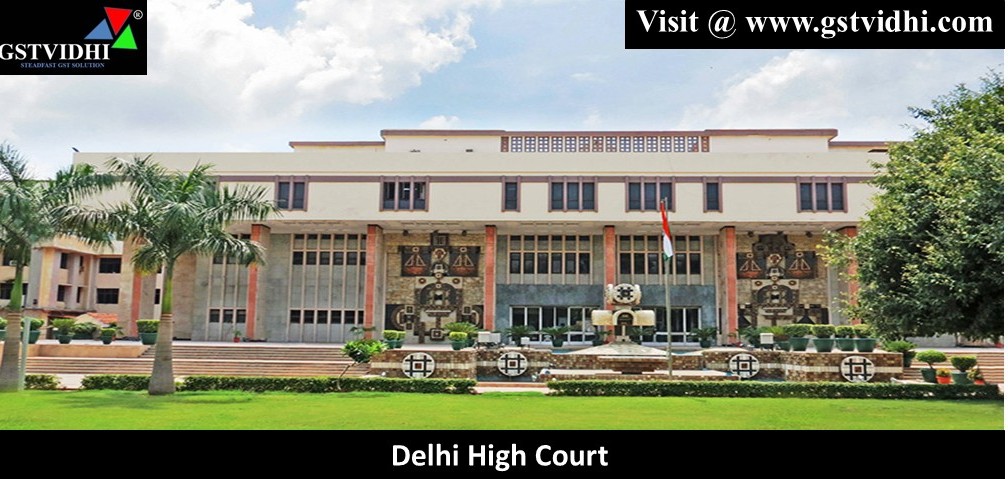
GST Refund Deficiency Memo – Department Must Specify Exact
Deficiencies Before Rejecting Refund Claim
Introduction
In a significant ruling
protecting the rights of taxpayers, the Delhi High Court has held that a deficiency
memo issued in Form GST RFD-03 cannot be vague or ambiguous. If the GST
Department alleges that supporting documents are incomplete, it must clearly
specify the exact deficiencies instead of making a general observation. The
Court observed that a taxpayer cannot be expected to rectify defects unless the
deficiencies are specifically communicated.
The judgment reinforces
the principles of natural justice and transparency in GST refund
proceedings.
Case
Details
- Case Title:
Krishna International and Another v. Commissioner, Central Goods and
Service Tax and Another
- Court:
High Court of Delhi at New Delhi
- Case No.:
W.P.(C) 16962/2025
- Date of Decision:
24 April 2026
- Coram:
Hon'ble Mr. Justice Nitin Wasudeo Sambre and Hon'ble Mr. Justice Ajay
Digpaul
Brief Facts
of the Case
The petitioners,
registered under the CGST Act, 2017, filed a refund application in Form GST
RFD-01 on 18 October 2024, claiming a refund of ₹74,967.
The GST Department issued
a Deficiency Memo in Form GST RFD-03 dated 10 September 2025, stating
that the supporting documents attached with the refund application were
incomplete and did not satisfy the requirements prescribed under Circular No.
125/44/2019-GST.
Aggrieved by the issuance
of the deficiency memo, the petitioners approached the Delhi High Court
contending that the memo did not specify which documents were deficient or
missing and therefore could not be complied with effectively.
Submissions
by the Petitioners
The petitioners submitted
that:
1. The
deficiency memo merely stated that the supporting documents were incomplete
without identifying the specific defects.
2. Such
a vague deficiency memo deprived the petitioners of a meaningful opportunity to
rectify the alleged deficiencies.
3. Since
the department failed to specify the documents required, the impugned
deficiency memo was arbitrary, contrary to law, and liable to be quashed.
Submissions
by the Respondents
The respondents contended
that:
1. Form
GST RFD-03 permits the applicant to file a fresh refund application after
rectifying the deficiencies.
2. If
granted time, the department would communicate the detailed deficiencies
noticed in the refund application.
Accordingly, the
respondents sought to justify the issuance of the deficiency memo while
expressing their willingness to provide detailed particulars subsequently.
Observations
of the Delhi High Court
After considering the
submissions of both parties, the High Court made the following important
observations:
1. Deficiency Memo Must
Contain Specific Reasons
The Court observed that
the deficiency memo merely mentioned that the supporting documents were
incomplete and did not satisfy the requirements of Circular No.
125/44/2019-GST. Such a general observation does not disclose the actual
deficiencies and is too vague to enable the taxpayer to rectify the defects.
2. Vague Deficiency Memo
Cannot Sustain Rejection of Refund
The Court held that
although the department may permit filing of a fresh refund application, it
cannot reject or obstruct a refund claim through a vague deficiency memo which
fails to specify the shortcomings in the application.
3. Speaking and Reasoned
Communication is Mandatory
The Court observed that
even if the deficiency memo is treated as an order affecting the refund claim,
the reasons mentioned therein are insufficient and cannot sustain the action of
the department. Administrative orders affecting taxpayers must disclose clear
and specific reasons.
4. Taxpayer Must Be Given
a Fair Opportunity
The Court emphasized that
the taxpayer should be informed of the precise deficiencies so that the same
can be rectified within a reasonable period. Without such disclosure, the
principles of natural justice stand violated.
Decision of
the High Court
The Delhi High Court
allowed the writ petition and issued the following directions:
- The impugned deficiency memo was set
aside.
- The GST Department was directed to
communicate the specific deficiencies in the refund application
within four weeks.
- Upon receipt of the deficiency
communication, the petitioners were granted four weeks to submit
the required documents and rectify the deficiencies.
- Thereafter, the department was
directed to pass a fresh speaking order on the refund claim in
accordance with law.
Conclusion
The judgment of the Delhi
High Court is a welcome safeguard for taxpayers seeking GST refunds. The Court
has reaffirmed that transparency, fairness, and adherence to the principles
of natural justice are integral to GST administration. By directing the
department to specify the exact deficiencies instead of issuing vague
observations, the Court has ensured that refund applicants receive a fair
opportunity to comply with statutory requirements.
This decision will serve
as an important precedent against the routine issuance of non-specific
deficiency memos and will encourage GST authorities to adopt a more transparent
and reasoned approach while processing refund claims.
Disclaimer: All the Information is based on the notification, circular advisory and order issued by the Govt. authority and judgement delivered by the court or the authority information is strictly for educational purposes and on the basis of our best understanding of laws & not binding on anyone.
Click here