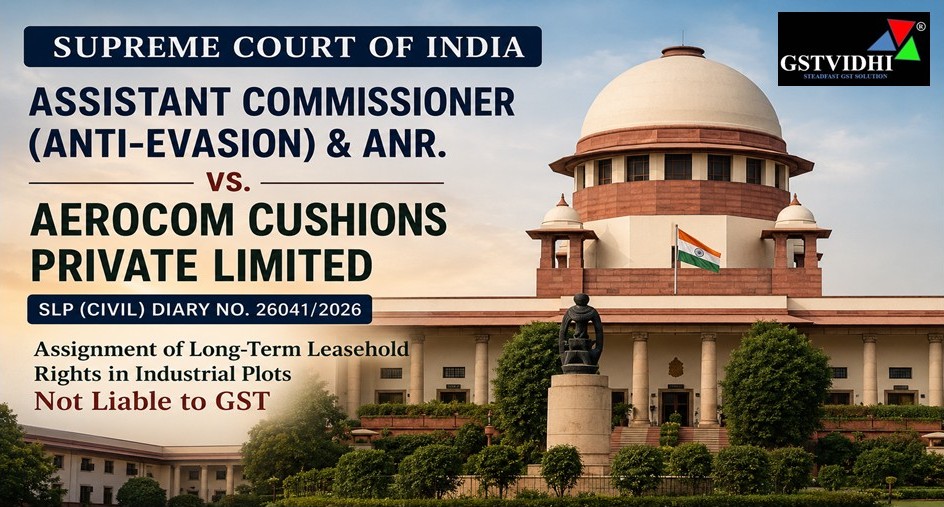
Supreme Court Affirms Bombay High Court Ruling: Assignment of
Long-Term Leasehold Rights in Industrial Plots Not Liable to GST
The Hon'ble Supreme Court
has provided significant relief to industrial units and businesses dealing with
the transfer of leasehold rights in industrial plots by dismissing the Special
Leave Petition (SLP) filed by the GST Department against the judgment of the
Bombay High Court in Assistant Commissioner (Anti-Evasion) & Anr. v.
Aerocom Cushions Private Limited. By refusing to interfere with the Bombay
High Court's decision, the Supreme Court has effectively affirmed the legal
position that assignment of long-term leasehold rights in an industrial plot
does not constitute a taxable supply under the Goods and Services Tax (GST)
law.
Background
of the Dispute
Aerocom Cushions Private
Limited had been allotted an industrial plot by the Maharashtra Industrial
Development Corporation (MIDC) on a long-term lease of 95 years. The lease deed
permitted the company to transfer or assign its leasehold rights with the prior
approval of MIDC. Exercising this contractual right, the company assigned its
leasehold interest in the industrial plot, along with the factory building
constructed thereon, to another industrial unit after obtaining the requisite
permission from MIDC and paying the prescribed transfer charges.
Subsequently, the GST
Department issued a Show Cause Notice under Section 74(1) of the CGST Act
alleging that the assignment of leasehold rights amounted to a supply of
services liable to GST. The Department proposed to recover GST amounting to ₹27
lakh on the consideration received for the transfer, treating the transaction
as a taxable service.
Department's
Allegation
According to the
Department, the transfer of leasehold rights constituted a "supply"
under Section 7 of the CGST Act read with Schedule II. It was argued that
although the transaction was not a lease or sub-lease in the traditional sense,
it nevertheless amounted to a taxable service. The Department further
classified the activity under the residual category of "Other
Miscellaneous Services" falling under Entry No. 35 of Notification No.
11/2017-Central Tax (Rate), thereby proposing to levy GST at the rate of 18%.
Assignment
of Leasehold Rights is Different from a Lease
The Bombay High Court
carefully examined the nature of the transaction and observed that there is a
fundamental distinction between a lease and an assignment of leasehold rights.
In the present case, the original lessee completely divested itself of all rights
in the property, and those rights were permanently transferred to the assignee.
Consequently, the transaction did not create a fresh lease nor did it amount to
a sub-lease. Rather, it resulted in the complete extinguishment of the
assignor's rights in favour of the assignee. Even the Show Cause Notice itself
acknowledged that the transaction was not a sub-lease.
Improper
Classification as Miscellaneous Services
The Court strongly
disagreed with the Department's attempt to classify the assignment of leasehold
rights under the category of "Other Miscellaneous Services." It
observed that the relevant entry in Notification No. 11/2017 primarily covers
services such as washing, cleaning, dyeing, beauty services, physical
well-being services and other similar miscellaneous activities. Assignment of
valuable rights in immovable property bears no resemblance to such services and
therefore cannot be artificially brought within the scope of the residual entry
merely because no specific entry exists. Accordingly, the Court held that the
proposed classification was legally unsustainable.
Transfer of
Benefits Arising Out of Immovable Property
The Court further held
that a lease of ninety-five years confers substantial and valuable rights upon
the lessee. Such rights are recognized as transferable under the lease deed
executed by MIDC. Therefore, when the lessee assigns those rights with the approval
of MIDC, what is transferred is nothing but the bundle of rights and benefits
arising from an immovable property.
The Court observed that
the transaction essentially amounts to a transfer of immovable property and not
the provision of any service. Moreover, the transfer had no nexus with the
business activities of supplying goods or services by the petitioner. Since
Section 7 of the CGST Act requires a supply to be made in the course or
furtherance of business, the essential ingredients necessary to attract GST
were absent in the present case.
Reliance on
the Gujarat High Court Judgment
While deciding the
matter, the Bombay High Court relied extensively upon the earlier judgment of
the Gujarat High Court in Gujarat Chamber of Commerce and Industry v. Union
of India (2025), which dealt with an almost identical issue concerning the
assignment of leasehold rights in industrial plots allotted by the Gujarat
Industrial Development Corporation (GIDC).
The Gujarat High Court
had undertaken a detailed analysis of the CGST Act, the Transfer of Property
Act, the Registration Act, the General Clauses Act and other statutory
provisions before concluding that assignment of leasehold rights amounts to a
transfer of benefits arising from immovable property. Such transactions,
therefore, fall outside the scope of "supply" under Section 7 of the
CGST Act and cannot be subjected to GST.
Bombay High
Court Endorses the Gujarat High Court View
The Bombay High Court
expressly agreed with the reasoning adopted by the Gujarat High Court and held
that assignment by sale or transfer of leasehold rights in industrial plots
allotted by development corporations such as MIDC or GIDC constitutes transfer
of benefits arising out of immovable property. Consequently, such transactions
cannot be regarded as supply of goods or supply of services under the GST law
and therefore do not attract GST.
The Court further
observed that until a contrary view is taken by another competent High Court or
the Supreme Court, the authorities within the State are expected to follow the
law laid down by another High Court on an identical issue. Accordingly, the Show
Cause Notice issued by the Department was quashed and set aside.
Supreme
Court Declines to Interfere
The GST Department
challenged the Bombay High Court judgment before the Supreme Court by filing a
Special Leave Petition. After hearing the parties, the Supreme Court held that
it was not inclined to interfere with the judgment of the Bombay High
Court and dismissed the SLP. Consequently, the findings recorded by the Bombay
High Court continue to hold the field and provide substantial support to
taxpayers facing similar disputes across the country.
Legal
Significance of the Judgment
The judgment is of
considerable importance because it reinforces the principle that not every
transfer involving consideration amounts to a taxable supply under GST. The
decision clearly distinguishes between a lease, which may constitute a supply
of services, and an assignment of leasehold rights, which results in the
transfer of benefits arising from immovable property. The ruling also limits
the Department's ability to invoke residual service classifications merely to
levy GST where the transaction is otherwise outside the statutory definition of
"supply."
The decision is expected
to have far-reaching implications for industrial units that acquire plots from
industrial development corporations such as MIDC, GIDC, RIICO, UPSIDC and
similar statutory authorities. Taxpayers who have received show cause notices
or are involved in litigation relating to the assignment of long-term leasehold
rights can now rely upon this judgment as a strong judicial precedent.
Conclusion
The decision of the
Bombay High Court in Aerocom Cushions Private Limited, now affirmed by
the Supreme Court through dismissal of the Department's SLP, represents a
significant milestone in GST jurisprudence relating to immovable property
transactions. The Courts have categorically held that the assignment of
long-term leasehold rights in industrial plots is essentially a transfer of
benefits arising from immovable property and does not amount to a taxable
supply of services under the CGST Act. This judgment not only provides
certainty to industrial undertakings but also serves as an important safeguard
against unwarranted GST demands on genuine transfers of leasehold rights. As a
result, taxpayers involved in similar transactions can confidently rely on this
precedent while responding to departmental proceedings or pursuing appropriate
legal remedies.
Disclaimer: All the Information is based on the notification, circular advisory and order issued by the Govt. authority and judgement delivered by the court or the authority information is strictly for educational purposes and on the basis of our best understanding of laws & not binding on anyone.
Click here