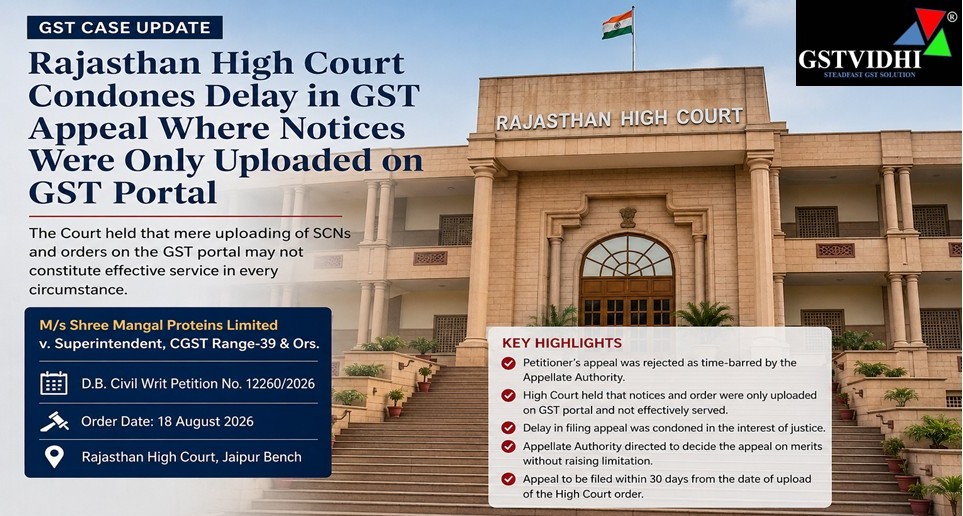
Rajasthan High Court Allows Delayed GST Appeal Where Notices and
Order Were Only Uploaded on GST Portal
Rajasthan
High Court | M/s Shree Mangal Proteins Limited v. Superintendent, CGST Range-39
& Ors. | D.B. Civil Writ Petition No. 12260/2026 | Order dated 18 August
2026
The Rajasthan High Court,
Jaipur Bench, has delivered an important judgment concerning delayed appeals
under Section 107 of the CGST/RGST Act, 2017, particularly where the
taxpayer claims that the Show Cause Notice (SCN) and the adjudication order
were merely uploaded on the GST portal and were not effectively served.
The Division Bench
comprising Hon’ble Mr. Justice Arun Monga and Hon’ble Mr. Justice Ashutosh
Kumar held that, in appropriate circumstances, a delay in filing the
statutory appeal can be condoned by the High Court in exercise of its writ
jurisdiction where refusal to examine the matter on merits would cause serious
prejudice to the taxpayer.
Background
of the Case
The petitioner, M/s
Shree Mangal Proteins Limited, challenged an order passed by the GST
authorities raising a demand of ₹7,48,336 for FY 2019-20 on account of
alleged wrongful availment of Input Tax Credit (ITC).
The adjudication order
was passed on 22 August 2024. The taxpayer subsequently filed an appeal
on 29 January 2025. However, the Appellate Authority rejected the appeal
on 19 January 2026, holding that the appeal was filed beyond the
prescribed limitation period and that the Appellate Authority did not have the
power to condone the delay beyond the statutory period.
The taxpayer therefore
approached the Rajasthan High Court by way of a writ petition.
Taxpayer's
Main Contention
The taxpayer submitted
that the delay was neither deliberate nor intentional. According to the
petitioner, the SCNs dated 29 May 2024 and 3 August 2024 had not been
effectively served and were merely uploaded on the GST portal.
As a result, the
petitioner claimed that it did not become aware of the proceedings and could
not file a reply to the SCNs. The subsequent Order-in-Original dated 22 August
2024 was also stated to have been merely uploaded on the GST portal and not
physically served upon the petitioner.
The petitioner further
argued that the Order-in-Original had been passed pursuant to the SCN dated 3
August 2024, without providing an effective and meaningful opportunity to
respond to that notice.
Importantly, the
petitioner pointed out that its appeal had been rejected only on limitation
and not on merits.
Department's
Argument
The Department opposed
the writ petition and submitted that the Order-in-Original dated 22 August 2024
had been issued and dispatched to the petitioner's principal place of business
and was also made available on the GST portal.
According to the
Department, the taxpayer had sufficient time to file an appeal under Section
107(1) of the CGST Act, 2017, but failed to do so within the prescribed
period.
Findings of
the Rajasthan High Court
The High Court
acknowledged that the Appellate Authority is bound by the statutory limitation
provisions contained in Section 107 of the CGST/RGST Act.
However, the Court also
observed that the circumstances which prevented the petitioner from filing the
appeal were beyond its control. In such circumstances, refusing to examine the
appeal on merits could cause grave injury and prejudice to the taxpayer.
The Court relied upon
earlier judgments of the Rajasthan High Court, including cases concerning
delayed GST appeals where sufficient cause was shown for the delay.
Important
Observation Regarding GST Portal Service
A particularly
significant aspect of the judgment is the Court's reliance on the judgment of
the Punjab and Haryana High Court in Luxmi Traders v. Union Territory of
Chandigarh & Ors.
The Court referred to the
principle that service of an SCN cannot automatically be treated as sufficient
merely because the notice has been uploaded on the common GST portal,
particularly where its receipt has not been acknowledged and no reply has been filed.
The Rajasthan High Court
also agreed with the principles laid down in that judgment, including that
where an Order-in-Original is served only by uploading it on the common portal,
the limitation period for filing an appeal may not be treated as having been
triggered in the circumstances contemplated by the judgment.
High Court
Condones the Delay
After considering the
entire matter, the Rajasthan High Court took a wholesome view of the
circumstances and condoned the delay in filing the appeal under Section
107.
The Court set aside the
appellate order dated 19 January 2026 and directed the Appellate
Authority to entertain the taxpayer's appeal and decide it on merits without
raising the issue of limitation.
However, the Court
imposed a condition that the appeal must be filed within 30 days from the
date on which the High Court order was uploaded on its website.
Key
Takeaways for GST Taxpayers
This judgment is
significant for taxpayers facing GST demands where the statutory appeal has
become time-barred due to circumstances such as lack of effective service of
SCNs or adjudication orders.
The important principles
emerging from the order are:
1. Mere
uploading of an SCN on the GST portal may not, in every circumstance, be
sufficient to establish effective service.
2. Where
the taxpayer can demonstrate that the SCN or adjudication order was not
effectively served and that the delay occurred for reasons beyond the
taxpayer's control, the High Court may intervene in appropriate cases.
3. An
Appellate Authority is bound by the statutory limitation under Section 107,
but the High Court, exercising writ jurisdiction, may provide appropriate
relief in exceptional circumstances.
4. If
an appeal is rejected solely on the ground of limitation without examination of
the merits, the taxpayer may have a remedy before the High Court where
sufficient cause and violation of effective opportunity can be demonstrated.
5. The
judgment reinforces the importance of natural justice and meaningful
opportunity of hearing in GST adjudication.
6. Taxpayers
should maintain evidence regarding the actual service of SCNs and orders,
including portal communications, email communications, physical delivery
records and other relevant documents.
Conclusion
The decision in M/s
Shree Mangal Proteins Limited v. Superintendent, CGST Range-39 & Ors.
provides an important relief to taxpayers who have lost their statutory
appellate remedy because of circumstances relating to non-effective service of
GST notices and orders.
The judgment does not
mean that every delayed GST appeal will automatically be condoned. The
taxpayer must demonstrate genuine circumstances explaining the delay and
establish sufficient grounds for invoking the writ jurisdiction of the High
Court.
In the present case,
considering the alleged lack of effective service, the circumstances resulting
in the delay, and the fact that the taxpayer's case had never been examined on
merits, the Rajasthan High Court considered it appropriate to condone the delay
and restore the taxpayer's right to have the appeal decided on merits.
Disclaimer: All the Information is strictly for educational purposes and on the basis of our best understanding of laws & not binding on anyone.
Click here