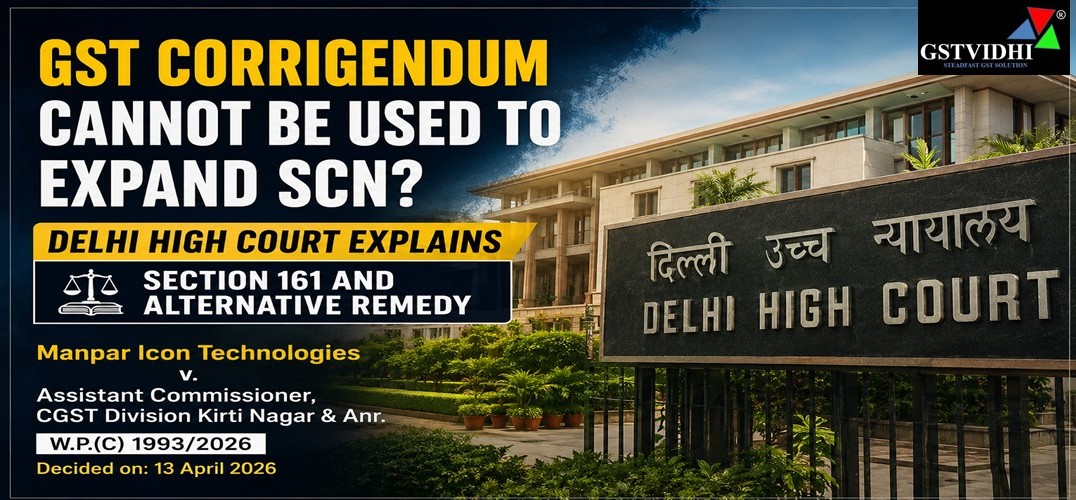
Can a GST Corrigendum Expand the Scope of a Show Cause Notice?
Delhi High Court Examines Section 161 and Alternative Remedy
Manpar Icon Technologies v. Assistant Commissioner, CGST
Division Kirti Nagar & Anr.
Court: Delhi High Court
Case No.: W.P.(C) 1993/2026
Date of Judgment: 13 April 2026
Relevant Provisions: Sections 74, 160, 161 and 107 of the CGST Act, 2017
Introduction
The Delhi High Court
recently dealt with an important procedural issue under the Goods and Services
Tax law concerning the permissible scope of a corrigendum issued to a Show
Cause Notice.
The question arose in Manpar
Icon Technologies v. Assistant Commissioner, CGST Division Kirti Nagar &
Anr., where the taxpayer challenged a corrigendum issued to a Section 74
Show Cause Notice which originally referred to one financial year but was
subsequently amended to include another financial year.
The taxpayer argued that
the corrigendum was not merely a correction of a typographical error but
effectively introduced a new financial year and, therefore, amounted to
initiation of fresh proceedings after expiry of limitation.
The Delhi High Court,
however, did not decide this controversy on merits. The Court held that the
taxpayer had an efficacious alternative remedy of appeal under Section 107 of
the CGST Act and therefore declined to exercise its writ jurisdiction.
Importantly, the Court
expressly clarified that it had not examined or expressed any opinion on the
merits of the case.
Facts of
the Case
The proceedings against
the taxpayer originated from an Alert Notice dated 9 June 2025 issued by the
Additional Commissioner (AE), CGST Delhi South Commissionerate concerning
alleged fraudulent availment and passing on of Input Tax Credit by a non-existent
firm, M/s Advanta Sales.
Pursuant to the
investigation, a Show Cause Notice dated 28 June 2025 was issued to
Manpar Icon Technologies under Section 74 of the CGST Act, 2017.
The original Show Cause
Notice alleged wrongful utilisation of excess ITC from M/s Advanta Sales for FY
2018-19, involving an amount of ₹42,66,108/-.
The taxpayer disputed the
allegations. In its reply dated 10 November 2025, the petitioner contended that
during FY 2018-19 it had not availed the alleged manpower supply and,
therefore, there was no question of wrongful availment of ITC.
During the personal
hearing held on 19 November 2025, the taxpayer further stated that supplies
from M/s Advanta Sales, if any, related to FY 2019-20 and not FY 2018-19.
Subsequently, the
department issued a corrigendum dated 22 December 2025, stating that the
assessment period in the Show Cause Notice should be read as FY 2018-19 and
FY 2019-20.
The taxpayer challenged
this corrigendum, arguing that the department had effectively introduced a new
financial year after the adjudication process had already commenced.
What Was
the Dispute?
The dispute essentially
revolved around the question:
Can a department
introduce an additional financial year into an existing GST Show Cause Notice
through a corrigendum under Section 161 of the CGST Act?
The taxpayer's case was
that the original SCN concerned FY 2018-19, whereas the corrigendum
subsequently brought FY 2019-20 within its scope.
According to the
taxpayer, this was not a mere clerical correction. Rather, it substantially
changed the scope of the proceedings and created a new potential liability.
The taxpayer therefore
argued that the corrigendum effectively amounted to a fresh Show Cause
Notice for FY 2019-20.
Petitioner's
Arguments
1. Corrigendum Cannot Be
Used to Initiate Fresh Proceedings
The petitioner argued
that the power of rectification under Section 161 of the CGST Act is
limited.
According to the
petitioner, Section 161 permits correction of an error apparent on the face of
the record, including clerical or arithmetical errors.
It cannot be used to
introduce a new period of assessment or create a fresh liability.
The petitioner therefore
argued that inclusion of FY 2019-20 was beyond the permissible scope of a
corrigendum.
2. Corrigendum Was Issued
After Expiry of Limitation
The petitioner further
argued that the limitation for FY 2019-20 had already expired on 30
September 2025.
Therefore, according to
the petitioner, the department could not issue a fresh proceeding for FY
2019-20 on 22 December 2025 by describing it as a corrigendum.
The petitioner contended
that once limitation had expired, the proper officer could not revive the cause
of action through a corrigendum.
3. Section 161 Has a
Limited Scope
The petitioner relied
upon the legislative purpose of Section 161 and submitted that rectification
should be confined to errors which are apparent, self-evident, clerical or
arithmetical.
Where a correction
requires substantive examination or changes the scope of the proceedings, it
cannot properly be characterised as a mere rectification.
The petitioner also
relied upon the decision in Infeon Technologies AG v. Deputy Commissioner of
Income-Tax & Anr. in support of its contention regarding impermissible
expansion of proceedings through a corrigendum.
4. DRC-01 Issue
An additional contention
was raised concerning FORM GST DRC-01.
The petitioner argued
that although the Show Cause Notice was purportedly amended through the
corrigendum, the corresponding DRC-01 was not amended.
According to the
petitioner, DRC-01 forms an integral part of the statutory demand process and
any alteration in the financial year or demand should also be properly
reflected in the relevant summary.
Department's
Arguments
The department opposed
the writ petition primarily on the ground of alternative remedy.
It argued that the
taxpayer had an effective statutory remedy of appeal under Section 107 of
the CGST Act against the order-in-original.
The department relied
upon the Supreme Court's decision in Commissioner of State Tax v. Commercial
Steel Ltd. and submitted that the High Court should ordinarily not exercise
writ jurisdiction where an efficacious statutory remedy is available.
On merits, the department
contended that the corrigendum did not introduce a new transaction or fresh
liability.
According to the
department, the corrigendum merely corrected the financial year mentioned in
the original proceedings.
The department further
pointed out that the taxpayer had been given opportunities to respond to the
allegations and had been granted personal hearings both before and after the
corrigendum.
Issues
Before the Delhi High Court
The Court identified two
principal issues:
Issue 1
Whether inclusion of FY
2019-20 through the corrigendum amounted to initiation of fresh proceedings?
Issue 2
Whether the corrigendum
dated 22 December 2025 was barred by limitation?
However, before
determining these issues, the Court considered whether the writ petition itself
should be entertained in view of the alternative statutory remedy available
under the CGST Act.
Delhi High
Court's Analysis
Alternative Remedy Under
Section 107
The Court reiterated the
well-established principle that although the High Court has wide powers under
Article 226 of the Constitution, it ordinarily does not entertain a writ
petition when an efficacious alternative statutory remedy is available.
The Court referred to the
recognised exceptions to this rule, including:
1. Breach
of fundamental rights;
2. Violation
of principles of natural justice;
3. Lack
or excess of jurisdiction; and
4. Challenge
to the vires of a statute or delegated legislation.
The Court referred to the
Supreme Court decisions in Whirlpool Corporation v. Registrar of Trademarks,
Mumbai, Harbanslal Sahnia v. Indian Oil Corporation Ltd., and Commissioner
of State Tax v. Commercial Steel Ltd.
Scope of
Writ Jurisdiction
The Court also referred
to the principles governing the writ of certiorari.
Relying upon Syed
Yakoob v. K.S. Radhakrishnan & Ors., the Court noted that certiorari
jurisdiction is supervisory rather than appellate.
The High Court does not
ordinarily reappreciate facts which have already been examined by the
adjudicating authority.
Interference is generally
confined to patent and manifest errors of law apparent from the record.
This principle was
particularly relevant in the present case because determining whether the
corrigendum was merely a correction or actually introduced a new financial year
would require examination of the underlying factual record.
Section 160
and Section 161 of the CGST Act
The Court specifically
considered Sections 160 and 161 of the CGST Act.
Section 160 provides that
proceedings should not be treated as invalid merely because of a mistake,
defect or omission where the proceedings are otherwise in conformity with the
intent and purpose of the Act.
Section 161, on the other
hand, permits rectification of an error apparent on the face of the record,
including clerical or arithmetical errors.
The Court recognised that
the statutory framework therefore provides a limited power of rectification.
However, the Court did
not finally determine whether the particular corrigendum issued in the present
case fell within or outside that limited power.
The reason was
significant.
The Court observed that
deciding whether the correction was permissible would require examination of
the nature of the correction and the material available on record. Such an
exercise would involve appreciation of facts, which the Court considered inappropriate
in the present Article 226 proceedings.
Why the
Court Did Not Decide the Corrigendum Issue
This is perhaps the most
important aspect of the judgment.
The Court did not
hold that the department was legally entitled to add FY 2019-20 through the
corrigendum.
It also did not
hold that the corrigendum was valid on merits.
Instead, the Court held
that the question required examination of the factual record and that the
taxpayer had an alternative appellate remedy.
Since the adjudicating
authority had already considered the issue in the order-in-original, the
taxpayer could challenge that finding before the appellate authority.
The Court observed that
mere disagreement with the conclusion of the adjudicating authority does not by
itself justify bypassing the statutory appellate mechanism.
Final
Decision
The Delhi High Court held
that an efficacious alternative remedy was available to the petitioner under Section
107 of the CGST Act read with Rule 109A of the CGST Rules.
Accordingly, the Court
declined to interfere with the order-in-original and granted liberty to the
petitioner to avail the remedies available under law.
The writ petition was
therefore dismissed.
However, the Court made
an important clarification:
The Court had not
examined or expressed any opinion on the merits of the case.
Thus, the dismissal of
the writ petition was essentially on the ground of availability of an
alternative statutory remedy, and not because the Court found the
department's case on limitation or corrigendum to be correct.
Conclusion
The Delhi High Court's
decision in Manpar Icon Technologies v. Assistant Commissioner, CGST
Division Kirti Nagar & Anr. is significant from the perspective of GST
procedural litigation.
The case raised an
important question concerning the power of the department to correct or modify
a Show Cause Notice through a corrigendum, particularly where the correction
introduces an additional financial year after the taxpayer has already responded
to the original notice.
The taxpayer argued that
such an amendment amounted to initiation of fresh proceedings and was barred by
limitation. The department, on the other hand, maintained that the corrigendum
merely corrected the financial year and did not introduce any new liability.
The Delhi High Court did
not decide which interpretation was correct.
Instead, the Court
emphasised the availability of the statutory appellate remedy under Section 107
and declined to exercise writ jurisdiction.
The judgment therefore
serves as an important reminder that the existence of a strong legal ground
does not automatically justify direct invocation of Article 226 where an
effective statutory appeal is available.
At the same time, the
judgment leaves open an important question for GST litigation: whether a
corrigendum which materially expands the scope of a Show Cause Notice can be
treated as a mere rectification under Section 161, particularly after the
expiry of limitation.
That question may
ultimately require determination by the appropriate appellate forum on the
facts and record of the particular case.
Disclaimer: All the Information is strictly for educational purposes and on the basis of our best understanding of laws & not binding on anyone.
Click here