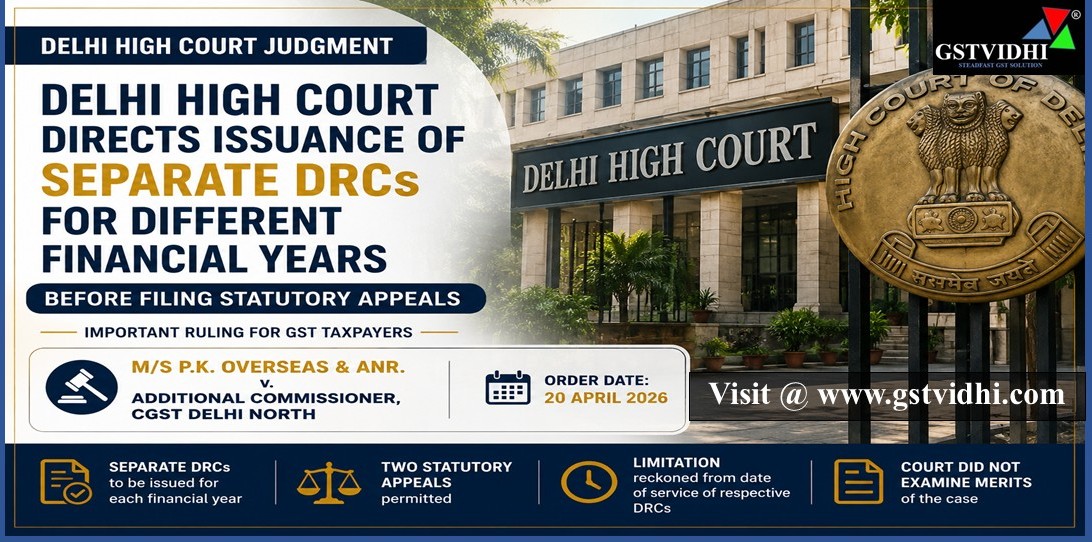
Delhi High Court Directs Issuance of Separate DRCs for Different
Financial Years Before Filing Statutory Appeals
· Case:
M/s P.K. Overseas & Anr. v. Additional Commissioner, CGST Delhi North
·
Court:
High Court of Delhi at New Delhi
·
Writ Petition:
W.P.(C) 4407/2025 & W.P.(C) 4416/2025
·
Date of Order:
20 April 2026
Introduction
The Hon’ble Delhi High
Court has recently dealt with an important procedural issue under the Goods and
Services Tax law concerning the issuance of a common demand for more than one
financial year.
In M/s P.K. Overseas
and M/s AMA Overseas Pvt. Ltd. v. Additional Commissioner, CGST Delhi North,
the dispute before the Court concerned tax demands pertaining to Financial
Years 2021-22 and 2022-23.
Although the department
submitted a year-wise breakup of the demand, the petitioners sought appropriate
separate documents for the respective financial years so that they could
exercise their statutory right of appeal independently.
The Delhi High Court
directed the respondents to issue two separate DRCs, one for each
financial year. The Court further clarified that the limitation for filing the
statutory appeals would be reckoned from the date on which the respective DRCs
were served upon the petitioners.
This order is significant
because GST proceedings and demands are required to be considered with
reference to the relevant tax period, particularly when separate statutory
remedies and limitation periods are involved.
Facts of
the Case
The petitioners, M/s
P.K. Overseas and M/s AMA Overseas Pvt. Ltd., approached the Hon’ble
Delhi High Court by way of writ petitions against the Additional
Commissioner, CGST Delhi North.
During the proceedings,
the respondents filed a reply in W.P.(C) 4407/2025. The department specifically
provided a year-wise breakup of the tax demand for FY 2021-22 and FY 2022-23.
As per the breakup placed
before the Court, the demand was as follows:
|
Financial
Year
|
Central
Tax
|
State/UT
Tax
|
Total
Tax
|
|
2021-22
|
₹70,36,610
|
₹70,36,610
|
₹1,40,73,219
|
|
2022-23
|
₹44,03,210
|
₹44,03,210
|
₹88,06,419
|
|
Grand
Total
|
₹1,14,39,819
|
₹1,14,39,819
|
₹2,28,79,638
|
The department contended
that the impugned order did not suffer from any infirmity merely because the
demand had been consolidated, since the demand had been quantified year-wise
and was traceable to the respective financial years.
However, during the
hearing, the learned counsel appearing for the respondents stated that
appropriate DRCs for the two financial years would be issued separately within
the prescribed period.
Observation
of the Delhi High Court
After considering the
submissions, the Hon’ble Court noted that the assessment and tax breakup
related to two distinct financial years, namely FY 2021-22 and FY 2022-23.
The Court therefore
directed the respondents to issue two different DRCs, corresponding to
the respective financial years, within one week from the date of the order.
The Court thereafter made
an important observation concerning the petitioners' statutory right of appeal.
It specifically held that
after issuance of the separate DRCs, the petitioners would be at liberty to
file two separate statutory appeals, and the limitation period would be
calculated from the date on which the respective DRCs were served upon them.
Separate
DRCs and Right of Appeal
The most important aspect
of this order is the direction for issuance of separate DRCs for separate
financial years.
GST proceedings are
intrinsically connected with the relevant tax period. When demands relate to
different financial years, the taxpayer may have separate factual and legal
grounds in relation to each year.
For example, the issues
involved in FY 2021-22 may be different from those involved in FY 2022-23. The
documents, reconciliations, returns, invoices, ITC records and statutory
provisions applicable to the respective periods may also require separate consideration.
Therefore, a taxpayer
should not be deprived of an effective statutory remedy merely because the
department has consolidated demands pertaining to different financial years.
The Delhi High Court's
direction ensures that the taxpayer receives separate DRCs corresponding to the
respective financial years and can thereafter exercise the statutory right of
appeal separately.
Limitation
for Filing Appeal
Another significant
aspect of the order relates to limitation.
The Court expressly
directed that the limitation period for filing the statutory appeals would be
reckoned from the date on which the respective DRCs were served upon the
petitioners.
This observation can be
particularly relevant where the department has passed or communicated a
consolidated demand but the taxpayer requires separate demand documents for
different tax periods.
The Court's direction
prevents uncertainty regarding the starting point of limitation and gives the
taxpayer a definite date from which the statutory appellate period is to be
calculated.
Important
Legal Takeaway
The order demonstrates
that procedural fairness is an important component of GST adjudication.
Where a demand relates to
more than one financial year and the department itself is able to quantify the
liability separately for each year, the issuance of separate DRCs can
facilitate the taxpayer's statutory appellate remedy.
The Court did not decide
the merits of the underlying tax dispute. In fact, the Court expressly
clarified that it had not gone into the merits of the matters.
Thus, the judgment should
primarily be understood as a procedural order concerning:
1. Year-wise
identification of GST demand;
2. Issuance
of separate DRCs for separate financial years;
3. Availability
of separate statutory appeals; and
4. Computation
of limitation from service of the respective DRCs.
Whether
Consolidated GST Demand Can Affect the Right of Appeal?
The order provides an
important practical lesson for taxpayers.
Suppose a GST order
contains demands for FY 2021-22, FY 2022-23 and FY 2023-24 in a consolidated
manner. Even if the department provides a year-wise calculation, questions may
arise regarding the appropriate statutory document against which an appeal is to
be filed and the commencement of limitation.
In such circumstances,
the taxpayer can rely upon the principle emerging from this order that where
demands relate to distinct financial years, separate DRCs may be required so
that the taxpayer can exercise the statutory appellate remedy effectively.
However, it is important
to note that the Delhi High Court did not lay down a general proposition
that every consolidated GST order is automatically invalid. The Court
specifically recorded that the department had quantified the demand year-wise
and that the demand was traceable to the respective financial years.
Therefore, the case
should be applied carefully depending upon the facts of each matter.
Conclusion
The Delhi High Court's
order in M/s P.K. Overseas & M/s AMA Overseas Pvt. Ltd. v. Additional
Commissioner, CGST Delhi North reinforces the importance of a clear and
effective statutory appellate mechanism under GST.
Where tax demands relate
to separate financial years, the Court directed the department to issue separate
DRCs for each financial year. It further protected the taxpayer's appellate
remedy by directing that the limitation period would be reckoned from the date
of service of the respective DRCs.
Although the Court did
not examine the merits of the tax dispute, the order is nevertheless
significant from a procedural and litigation perspective.
For GST taxpayers facing
consolidated demands covering multiple financial years, this decision may
provide a useful basis for seeking clarity regarding year-wise demands,
separate DRCs and the commencement of the limitation period for statutory
appeals.
Disclaimer: All the Information is strictly for educational purposes and on the basis of our best understanding of laws & not binding on anyone.
Click here