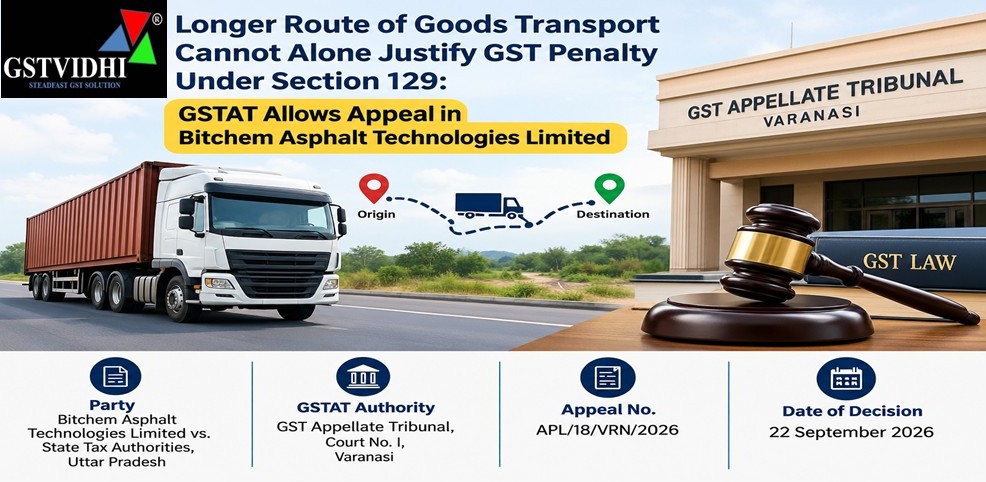
Longer Route of Goods Transport Cannot Alone Justify GST
Penalty Under Section 129: GSTAT Allows Appeal in Bitchem Asphalt Technologies
Limited
Summary of
the Case:
The present case deals
with the levy of penalty under Section 129 of the GST Act where a
vehicle carrying taxable goods was intercepted while travelling through a route
that was considerably longer than the available shorter route.
The vehicle was carrying 29
metric tonnes of Tailor Made Cold Binder packed in 145 drums. The vehicle
was intercepted by the Mobile Squad at Chandauli, Uttar Pradesh. The department
noticed that the vehicle had travelled through a route which was around 200 km
longer than the shorter route available to reach the destination. On this
basis, the authorities suspected that the goods might actually have been
intended for delivery to another recipient in Uttar Pradesh and that there
could be an intention to evade tax.
The taxpayer explained
that the longer route was deliberately selected because the shorter route
passed through difficult/hilly terrain, which created difficulty in operating a
heavily loaded commercial vehicle. The taxpayer also relied upon safety considerations.
However, the explanation was not accepted by the Proper Officer, who imposed a
penalty of Rs. 6,48,366/- under IGST. The amount was paid under protest
for release of the vehicle and goods.
The first appellate
authority also dismissed the taxpayer's appeal. The matter was thereafter taken
before the GST Appellate Tribunal.
The GSTAT allowed the
appeal and held that the goods were being transported with valid documents and
there was no statutory requirement under the GST law to declare or follow a
particular route. The Tribunal also found the taxpayer's explanation regarding
difficult terrain to be plausible and reasonable. Consequently, the impugned
orders were quashed and the penalty amount deposited under protest was directed
to be refunded.
Section of
the Case:
The principal statutory
provision involved in the case is:
Section 129 of the GST
Act – Detention, seizure and release of goods and conveyances in transit.
The dispute before the
Tribunal was whether the provisions of Section 129 could be invoked merely
because the vehicle had travelled through a longer route than the shorter route
available, in circumstances where the goods were accompanied by valid documents
and there was no concrete evidence of an intention to evade tax.
The Tribunal also
considered the legal position regarding the absence of any requirement under
the GST law to declare or follow a specific route for transportation of goods.
Facts of
the Case:
The appellant, Bitchem
Asphalt Technologies Limited, was transporting 29 metric tonnes of
Tailor Made Cold Binder packed in 145 drums through vehicle number CG 04
MD 9585.
On 09 June 2025,
the vehicle was intercepted by the Mobile Squad, Unit-I, Naubatpur, Chandauli,
at Saiyyadraja, District Chandauli, Uttar Pradesh, while travelling on NH-2.
The reason mentioned for detention was that the vehicle had travelled
approximately 150 km beyond the distance expected from the destination and had
entered Uttar Pradesh without, according to the department, any apparent
necessity. This raised a suspicion that the goods could have been intended for
delivery to another recipient in Uttar Pradesh.
The appellant submitted
before the Proper Officer that the longer route had been selected because the
shorter route passed through a difficult/hilly area. According to the
appellant, the difficult terrain created problems for heavily loaded commercial
vehicles and the longer route was selected for safety reasons.
The Proper Officer did
not accept the explanation and passed an order dated 16 June 2025,
imposing a penalty of Rs. 6,48,366/- (IGST). The appellant deposited the
amount under protest to secure release of the vehicle and goods so that the
goods could be safely delivered to the consignee.
The appellant challenged
the order before the First Appellate Authority. However, the Additional
Commissioner, Grade-II (Appeal-I), State Tax, Varanasi dismissed the appeal
vide order dated 31 December 2025. Aggrieved by both orders, the
appellant filed the present appeal before the GST Appellate Tribunal.
Submission
by the Appellant:
The appellant submitted
that the impugned orders were contrary to the facts and law because the
authorities had failed to identify any actual discrepancy in the documents
accompanying the goods.
It was submitted that the
GST law and Rules do not prescribe any particular route which a vehicle must
follow while transporting goods. According to the appellant, the E-Way Bill
contains details relating to the place of supply and delivery, but there is no
requirement to declare a specific route map which must necessarily be followed
by the vehicle.
The appellant further
explained that the longer route had been selected due to difficult terrain on
the shorter route and for safety reasons, particularly considering that the
vehicle was heavily loaded.
It was also submitted
that the explanation given by the appellant and the statement of the driver had
not been properly considered by the Proper Officer or the First Appellate
Authority. The appellant argued that merely travelling through a longer route could
not establish an intention to evade tax.
The appellant further
contended that Section 129 could not be invoked merely on the basis of
suspicion, conjectures or assumptions when there was no material evidence
showing an intention to evade tax. It was also submitted that the principles of
natural justice had not been properly followed.
The appellant relied upon
various judicial decisions, including M/s Vishal Steel Supplier v. State of
U.P., Excide Industries Ltd. v. Additional Commissioner Grade-II (Appeal)-1,
State Tax, AA Plastics Pvt. Ltd. v. Additional Commissioner Grade 2, M/s
Midtown Associates, M/s Falguni Steels, Hindustan Steel Ltd. v. State of Orissa
and Assistant Commissioner (ST) v. Satyam Shivam Papers Pvt. Ltd.
Accordingly, the
appellant prayed for setting aside of the impugned orders and refund of the
penalty amount deposited under protest.
Submission
by the Respondent:
The State authorities
opposed the submissions made by the appellant.
The Respondent argued
that where a shorter route was available, the taxpayer should not have
preferred a substantially longer route, particularly where the longer route
involved entering another State.
According to the
Respondent, the adoption of the longer route created a reasonable suspicion
that the appellant may have intended to evade tax by delivering the goods
somewhere within Uttar Pradesh.
The State representatives
also submitted that there was no sufficient justification for taking the longer
route and relied upon the decision of the Madras High Court in M/s J.R.
Metal Chennai Ltd. v. The State Tax Officer, decided on 21 July 2025.
Findings by
the Authority:
After considering the
submissions of both sides and examining the documents placed on record, the GST
Appellate Tribunal considered the main question as to whether travelling
through a longer route, instead of the shorter available route, established an intention
to evade tax.
The Tribunal noted that
the vehicle was carrying the goods with valid documents, and this fact
remained undisputed. The Tribunal therefore examined whether there was any
other material demonstrating that the taxpayer intended to evade tax.
An important finding of
the Tribunal was that the Respondent State had not shown the place of
destination in Uttar Pradesh where the appellant allegedly intended to consign
the goods.
The Tribunal found the
explanation given by the appellant to be plausible and reasonable. It was not
disputed that the shorter route passed through a hilly region which could
create difficulties for heavily loaded commercial vehicles. Therefore, the Tribunal
held that merely choosing a safer and longer route in such circumstances could
not, by itself, create a basis for alleging tax evasion.
The Tribunal further
observed that, unlike the earlier VAT regime, there is no provision under the
GST Act or Rules requiring the taxpayer to declare a particular route for
transportation of goods.
The Tribunal referred to
the decision of the Allahabad High Court in M/s Om Prakash Kuldeep Kumar v.
Additional Commissioner Gr. II, wherein it was observed that under the GST
law there is no requirement to declare or rigidly follow a designated route of
transportation. An alternative or longer route adopted for logistical reasons
does not, by itself, constitute a statutory basis for detention.
The Tribunal also found
that nothing had been brought on record to establish that the appellant
actually intended to evade tax. The goods were being transported with valid
documents and the route diversion was explained by the difficult terrain of the
shorter route.
Accordingly, the Tribunal
concluded that no statutory provision had been violated merely because the
vehicle had followed a longer route.
Decision:
The GST Appellate
Tribunal, Varanasi, allowed the appeal filed by Bitchem Asphalt
Technologies Limited.
The Tribunal quashed the
orders dated 16 June 2025 passed by the Adjudicating Authority and 31
December 2025 passed by the First Appellate Authority.
The Tribunal further
directed that the amount of Rs. 6,48,366/- deposited under protest as
penalty be refunded to the appellant in accordance with law and rules.
The Tribunal also ordered
that the parties would bear their respective costs.
Conclusion:
The decision provides an
important clarification in cases involving detention of goods merely because
the vehicle has travelled through a route different from the route expected by
the department.
The GSTAT has emphasized
that selection of a longer route, by itself, cannot establish an intention
to evade tax, particularly where the goods are accompanied by valid
statutory documents and the taxpayer provides a reasonable explanation for the
route deviation.
In the present case, the
appellant explained that the shorter route passed through difficult terrain and
that the longer route was chosen for the safe movement of a heavily loaded
commercial vehicle. The Tribunal accepted this explanation, particularly because
the department could not establish any actual alternative destination or other
material showing that the taxpayer intended to evade tax.
The decision also
highlights the distinction between the earlier VAT regime and the present GST
framework. As observed by the Tribunal, the GST law does not require a taxpayer
to declare or compulsorily follow a particular transportation route. Therefore,
a mere deviation from an expected route should not automatically be treated as
evidence of tax evasion.
The case is therefore
relevant for taxpayers and transporters facing proceedings under Section 129
of the GST Act, especially where the department's allegation is primarily
based upon route deviation rather than any actual discrepancy in the invoice,
E-Way Bill or other transportation documents.
Disclaimer: All the Information is strictly for educational purposes and on the basis of our best understanding of laws & not binding on anyone.
Click here