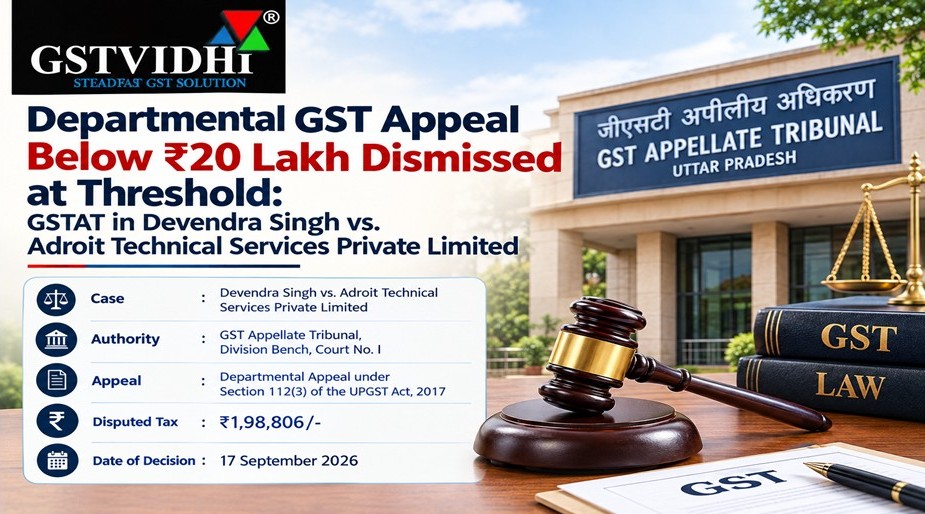
Devendra Singh vs. Adroit Technical Services Private Limited (GST Appellate Tribunal, Division Bench, Court No. I)
Summary of
the Case:
The present case concerns
the maintainability of a departmental appeal before the GST Appellate
Tribunal where the disputed tax amount is below the monetary limit prescribed
for filing departmental appeals.
The State Tax Department
filed an appeal against the order passed by the First Appellate Authority in
the case of Adroit Technical Services Private Limited, relating to FY
2020-21. The disputed tax amount involved in the matter was only ₹1,98,806/-,
whereas the monetary threshold prescribed for departmental appeals before GSTAT
was ₹20 lakh.
The GSTAT examined
whether the departmental appeal could be admitted despite the disputed amount
being below ₹20 lakh. The Tribunal also considered whether the Department had
established any of the recognised exceptions to the monetary limit and whether mere
approval or authorisation by the Commissioner was sufficient to maintain the
appeal.
The Tribunal held that
the disputed amount was below the prescribed monetary limit and that the
Revenue had failed to establish the applicability of any recognised exception.
The appeal was therefore dismissed at the threshold without examining the
merits of the underlying tax dispute.
Section of the Case
The case primarily deals
with the following provisions and administrative framework:
Section 112(3) of the
UPGST Act, 2017 – relating to filing of an
appeal/application before the Appellate Tribunal by the Commissioner or an
officer authorised by him.
Section 120 of the UPGST
Act, 2017 – titled “Appeal not to be filed in certain cases”,
under which the Commissioner may prescribe monetary limits for regulating
departmental appeals.
The Tribunal also
considered Circular No. 2425008 dated 05.07.2024, issued by the
Commissioner, State Tax, Uttar Pradesh, prescribing a monetary limit of ₹20,00,000/-
for departmental appeals before GSTAT, subject to specified exceptions. The
Tribunal further referred to Circular No. 252/2026-27/State Tax dated
22.05.2026, which continued the framework relating to monetary limits,
review mechanism and departmental litigation before GSTAT and higher courts.
Facts of
the Case:
The respondent, Adroit
Technical Services Private Limited, bearing GSTIN 09AAFCA3202J1ZY,
is engaged in the business of real estate appraisal services provided on a fee,
commission or contractual basis. The dispute related to FY 2020-21.
The original proceedings
resulted in an order under Section 73(9) of the UPGST Act, involving tax,
interest and other amounts under IGST, CGST and SGST. The First Appellate
Authority partially allowed the appeal and set aside the demand of tax and
interest imposed by the Assessing Officer.
The State Tax Department
thereafter preferred an appeal before the GST Appellate Tribunal against the
order of the First Appellate Authority.
At the stage of
admission, the Tribunal noticed that the amount in dispute was ₹1,98,806/-,
which was substantially below the prescribed monetary threshold of ₹20 lakh for
departmental appeals before GSTAT.
The Tribunal therefore
considered whether the Department could nevertheless maintain the appeal by
relying upon any of the exceptions provided under the applicable departmental
circular.
Submission
by the Appellant:
The appeal was filed by
the State Tax Department, represented before the Tribunal by its
Authorised Representative.
The Revenue sought
admission of the appeal and requested that the matter be heard on merits. The
Department explained the nature of the dispute and the grounds on which the
order of the First Appellate Authority was being challenged.
However, since the matter
was a departmental appeal and the disputed amount was below the prescribed
monetary threshold, the Tribunal specifically examined whether the Department
had satisfied the conditions applicable to departmental appeals.
The Tribunal noted that
the Department had filed the appeal under Section 112(3) of the UPGST Act.
However, the Revenue was required to establish that the case fell within one of
the recognised exceptions to the monetary limit if it wished to pursue the
appeal despite the disputed amount being below ₹20 lakh.
Submission
by the Respondent:
The respondent's case was
considered in the context of the maintainability of the departmental appeal.
The Tribunal focused on
whether the Department had complied with the monetary-limit framework governing
departmental litigation. The important question was not merely whether the
Department had a grievance against the appellate order, but whether the statutory
and administrative conditions governing the filing of the departmental appeal
had been satisfied.
The Tribunal observed
that once the disputed amount was found to be below ₹20 lakh, the burden was
upon the Revenue, which sought to maintain the appeal, to establish the
applicability of a recognised exception.
The Department was
required to disclose which exception was being invoked, the facts bringing the
case within that exception, the supporting statutory or administrative
provision and, where the residual discretion of the Commissioner was relied
upon, the specific order or recorded opinion demonstrating that such discretion
had actually been exercised in the particular case.
Findings by
Authority:
The GSTAT first observed
that the right of appeal is a statutory right. It does not exist as an
inherent right and can be exercised only in accordance with the conditions
prescribed by law.
The Tribunal relied upon
the principles laid down by the Supreme Court in Ganga Bai v. Vijay Kumar
and Anant Mills Company Limited v. State of Gujarat, relating to the
statutory nature of the right of appeal and the power of the legislature to
prescribe conditions governing its exercise.
The Tribunal thereafter
examined the monetary-limit policy applicable to departmental appeals in Uttar
Pradesh.
As per the applicable
framework, where a dispute involves tax, the aggregate amount of tax in
dispute is considered for determining whether the monetary threshold is
satisfied. In the present case, the disputed amount was ₹1,98,806/-,
which was below the prescribed threshold of ₹20 lakh.
The Tribunal then
examined the recognised exceptions to the monetary limit. These included
matters involving constitutional validity, rules or notifications being held
ultra vires, valuation, classification, refunds, place of supply, recurring
issues involving interpretation of law, adverse comments or costs against the
Department and certain cases where the Commissioner considers it necessary to
contest the matter in the interest of justice or revenue.
The Tribunal held that an
exception cannot simply be presumed because the Department wishes to pursue an
appeal. Once the disputed amount falls below the prescribed threshold, the
Revenue has to establish the particular exception on the basis of the relevant
facts and supporting material.
A significant observation
of the Tribunal was that mere approval or authorisation by the Commissioner
to file an appeal is not sufficient to disregard the monetary limit.
The Tribunal stated that
administrative permission to institute litigation and satisfaction of the
statutory conditions governing maintainability are two different matters. If
the Department relies upon the residual exception concerning the Commissioner's
opinion that the matter requires contest in the interest of justice or revenue,
the record should show that the Commissioner actually formed such opinion in
the particular case and the basis for such opinion should be discernible.
The Tribunal also
referred to the continuing litigation-management policy of Uttar Pradesh
through Circular No. 252/2026-27/State Tax dated 22.05.2026. According
to the Tribunal, the monetary-limit framework continued to operate as part of
the State's departmental litigation policy.
The Tribunal further
observed that the Department cannot rely upon the litigation-control mechanism
when it suits the Department and disregard the same mechanism when an adverse
order is passed. The Tribunal referred to the Supreme Court decision in M/s
Ranadey Micronutrients v. Collector of Central Excise concerning the
binding nature of departmental circulars.
The Tribunal also
considered Section 112(3) of the UPGST Act and observed that the Commissioner
is required to take the specific course of action contemplated by that
provision before directing an officer to file an appeal. The Tribunal should be
able to examine how the opinion was formed and on what basis. A bare assertion
that the Commissioner had granted permission was held to be insufficient.
Finally, the Tribunal
found that the Revenue had not specifically pleaded or established that the
present appeal fell within any of the recognised exceptions. There was no
material showing that the case involved an ultra vires challenge, a recurring
question of law requiring authoritative determination, adverse comments or
costs against the Department, or a specific and reasoned exercise of the
Commissioner's residual power in the particular case.
Decision:
The GST Appellate
Tribunal held that the departmental appeal involved disputed revenue of ₹1,98,806/-,
which was below the prescribed monetary limit of ₹20,00,000/-.
The Tribunal further held
that the Revenue had failed to establish the applicability of any recognised
exception to the monetary limit.
Accordingly, the appeal
did not satisfy the conditions governing its admission and maintainability
before the Tribunal.
The GSTAT therefore dismissed
the departmental appeal at the threshold on the ground of the prescribed
monetary limit and non-establishment of any applicable exception.
Importantly, the Tribunal
expressly clarified that it had not examined or adjudicated upon the merits
of the underlying tax dispute. The dismissal was confined to the
maintainability of the departmental appeal in view of the applicable
monetary-limit regime.
Conclusion:
The decision in Devendra
Singh vs. Adroit Technical Services Private Limited highlights the
importance of the monetary-limit framework applicable to departmental GST
appeals before the GST Appellate Tribunal.
The Tribunal has made it
clear that the existence of a statutory right of appeal does not mean that
every departmental appeal must automatically be admitted and heard on merits.
The Department is required to comply with the conditions governing the exercise
of that statutory right.
Where the disputed tax
amount is below the prescribed monetary threshold, the Department must
establish that the case falls within one of the recognised exceptions before
the appeal can proceed.
Another important aspect
of the decision is the distinction between permission to file an appeal and
compliance with the conditions for maintainability of the appeal. According
to the Tribunal, a general or bare assertion that the appeal has been filed
with the approval of the Commissioner cannot, by itself, take the matter
outside the monetary-limit restriction. The relevant exception and the basis
for invoking it must be established on record.
The decision also
reiterates the principle that maintainability is required to be examined
before the merits of an appeal. If the conditions necessary for admission
of a departmental appeal are not satisfied, the Tribunal need not enter into
the merits of the underlying tax dispute.
Thus, the case is
relevant for understanding the manner in which the ₹20 lakh monetary limit
for departmental GST appeals operates in Uttar Pradesh and the importance
of establishing a specific exception where the disputed amount falls below that
threshold.
Disclaimer: All the Information is strictly for educational purposes and on the basis of our best understanding of laws & not binding on anyone.
Click here