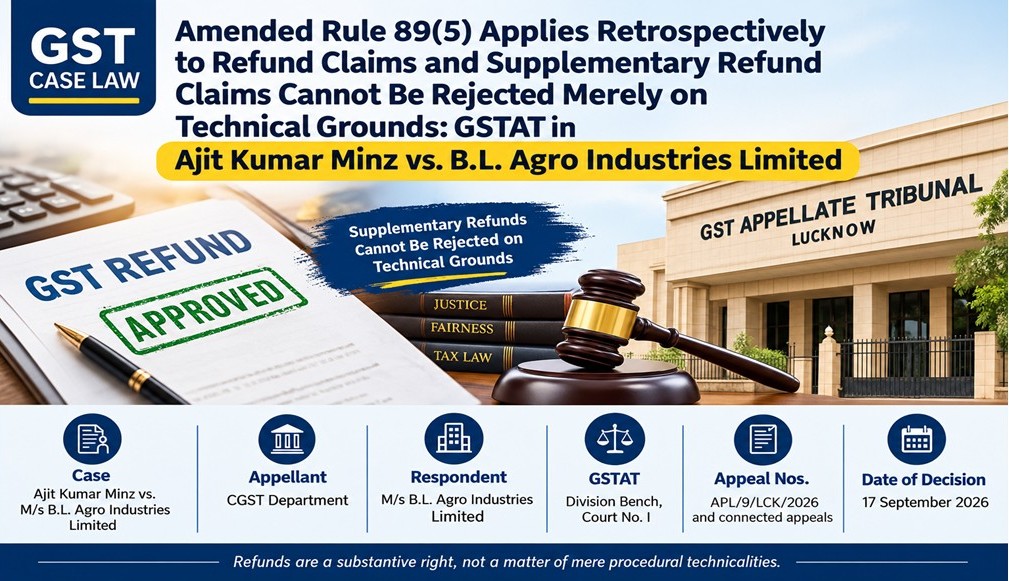
Amended Rule 89(5) Applies Retrospectively to Refund Claims and
Supplementary Refund Claims Cannot Be Rejected Merely on Technical Grounds:
GSTAT in Ajit Kumar Minz vs B.L. Agro Industries Limited
Summary of
the Case
The GST Appellate
Tribunal considered five departmental appeals concerning refund of accumulated
Input Tax Credit (ITC) arising due to an inverted duty structure under Section
54(3) of the CGST Act, 2017.
The respondent, M/s B.L.
Agro Industries Limited, is engaged in the manufacture and supply of edible
oils falling under Chapter 15. The dispute mainly concerned the applicability
of the amended formula under Rule 89(5) of the CGST Rules, 2017, which was substituted
through Notification No. 14/2022-Central Tax dated 05.07.2022 and included
input-service ITC in the computation of refund.
The Department challenged
the order of the First Appellate Authority which had allowed the respondent's
refund claims and directed sanction of the eligible refund after arithmetical
verification.
The GSTAT examined
whether the amended Rule 89(5) could be applied retrospectively, whether
supplementary/differential refund claims could be filed for the same tax
periods, whether the restriction under Notification No. 09/2022-Central Tax
(Rate) could operate against accumulated ITC, and whether the claims were
within the limitation period under Section 54.
After considering the
statutory provisions and judicial decisions, the Tribunal found no sufficient
ground to interfere with the findings of the First Appellate Authority. The
five departmental appeals were accordingly rejected.
Section of
Case
The principal statutory
provisions involved in the case were:
Section 54(3) of the CGST
Act, 2017 – relating to refund of unutilised ITC in cases of
zero-rated supplies and inverted duty structure.
Section 54(1) of the CGST
Act, 2017 – prescribing the limitation period for refund
applications.
Rule 89(5) of the CGST
Rules, 2017 – prescribing the formula for calculation
of refund of unutilised ITC on account of inverted duty structure.
The case also involved Notification
No. 14/2022-Central Tax dated 05.07.2022, through which Rule 89(5) was
amended, Circular No. 181/13/2022-GST dated 10.11.2022, Notification
No. 09/2022-Central Tax (Rate) dated 18.07.2022, and Notification No.
13/2022-Central Tax dated 05.07.2022 concerning exclusion of the COVID
period for limitation purposes.
Facts of
the Case
M/s B.L. Agro Industries
Limited, Bareilly, Uttar Pradesh, is engaged in the manufacture and supply of
various edible oils classifiable under Chapter 15 of the Customs Tariff Act,
1962. The company had accumulated ITC due to an inverted duty structure and was
claiming refund under Section 54(3) of the CGST Act, 2017.
Initially, the proper
officer rejected the refund claims by issuing deficiency memos, primarily on
the ground that the applications had been filed manually instead of
electronically through Form GST RFD-01 on the GST portal.
The respondent challenged
the rejection orders. The First Appellate Authority remanded the matters to the
proper officer with directions to consider the manually filed refund
applications on merits after following the principles of natural justice. Thereafter,
the respondent re-filed five refund claims relating to different periods from
October 2019 to September 2020.
The five refund claims
involved substantial amounts, including claims of Rs.1.90 crore, Rs.1.70 crore,
Rs.85 lakh, Rs.36 lakh and Rs.90 lakh for different periods.
During the remand
proceedings, the proper officer issued notices in Form GST RFD-08 proposing
rejection of the refund claims. The rejection was principally based on the
Department's view regarding the prospective applicability of amended Rule
89(5), restrictions under Notification No. 09/2022-Central Tax (Rate),
limitation, and classification of certain entries in the service annexure.
The respondent again
approached the First Appellate Authority. By Order-in-Appeal dated 03.07.2025,
the appellate authority allowed the appeals and directed sanction of the refund
after arithmetical verification of the eligible amount.
The First Appellate
Authority noted that the refund applications in question were filed after
05.07.2022 and held that the amended formula under Rule 89(5) was applicable.
It also held that the restriction introduced through Notification No.
09/2022-Central Tax (Rate) could not, merely through an administrative
circular, be extended contrary to the statutory provisions.
The Department thereafter
filed five appeals before the GSTAT challenging the Order-in-Appeal dated
03.07.2025.
Submission
by Appellant – CGST Department
The Department submitted
that the Order-in-Appeal passed by the First Appellate Authority was not
legally sustainable and should be set aside.
One of the principal
arguments of the Department was that the First Appellate Authority had wrongly
allowed supplementary refund claims relating to tax periods for which refund
applications had already been filed and adjudicated under Section 54(3) read with
Rule 89(5).
The Department further
argued that Notification No. 14/2022-Central Tax dated 05.07.2022, which
amended the formula under Rule 89(5), was prospective. According to the
Department, the amended formula could not be applied to supplementary refund
claims relating to earlier refund applications.
The Department relied
upon Circular No. 181/13/2022-GST dated 10.11.2022, according to which the
amended formula was applicable to refund applications filed on or after
05.07.2022.
The Department also
relied upon Notification No. 09/2022-Central Tax (Rate) dated 18.07.2022,
contending that refund of unutilised ITC relating to specified goods falling
under Chapters 15 and 27 had been restricted. Since the respondent manufactured
edible oils falling under Chapter 15, the Department argued that the refund
claims filed after 18.07.2022 were affected by the said restriction.
Another objection was
that certain items shown in the service annexure were actually inputs and not
input services, and that the corresponding ITC had already been considered
while sanctioning the earlier refund claims. Therefore, according to the Department,
the same could not be claimed again through supplementary refund claims.
The Department further
argued that merely filing the refund claims within the limitation period did
not automatically establish their admissibility because the substantive
conditions for refund were also required to be satisfied. The Department relied
upon the decision in Ruchisoya Industries Ltd. and requested restoration
of the orders passed by the adjudicating authority.
Submission
by Respondent – M/s B.L. Agro Industries Limited
The respondent supported
the Order-in-Appeal passed by the First Appellate Authority.
The respondent submitted
that the amended formula under Rule 89(5) should be applied to refund
applications filed after 05.07.2022. It was submitted that the amendment
incorporated input-service ITC into the calculation of refund and that various
judicial authorities had recognised the applicability of the amended formula.
Reliance was placed, among others, on Renuka Sugar Ltd. and Ascent
Meditech Ltd.
The respondent further
contended that the restriction introduced through Notification No.
09/2022-Central Tax (Rate) could not be applied to ITC accumulated before
18.07.2022. It was argued that the right to claim refund was governed by
Section 54 of the CGST Act and that an administrative circular could not take
away a benefit otherwise available under the statute.
With regard to the
service annexure, the respondent submitted that even if certain entries were
treated as inputs rather than input services, the eligible refund would not
decrease. Therefore, the refund claim should not be rejected outright merely
because of the manner in which some entries had been classified.
On limitation, the
respondent relied upon Notification No. 13/2022-Central Tax dated 05.07.2022,
which excluded the period from 01.03.2020 to 28.02.2022 for computation of
limitation because of the COVID-19 disruptions. Accordingly, the respondent
submitted that the refund claims were filed within the prescribed period.
The respondent also
submitted that there was no specific prohibition under Section 54 or Rule 89
against filing a supplementary or differential refund claim where the claim was
otherwise within the prescribed limitation period. Therefore, merely because an
earlier refund application had been filed, the respondent could not be denied
the differential amount legally available.
The respondent further
relied upon Ascent Meditech Ltd., where the Gujarat High Court had held
the amendment to Rule 89(5) to be curative and clarificatory in nature. The
respondent also pointed out that the Department's SLP against that decision had
been dismissed by the Supreme Court on 28.03.2025.
Findings by
the GST Appellate Tribunal
The GSTAT carefully
considered the facts, the Orders-in-Original, grounds of appeal, submissions of
both sides and the findings of the First Appellate Authority.
The principal issue
considered by the Tribunal was whether refund applications filed after
05.07.2022 could be considered under the amended formula prescribed under Rule
89(5) of the CGST Rules. The Tribunal noted that the First Appellate Authority
had recorded that the refund applications in the present case were filed after
05.07.2022.
The Tribunal referred to
the decision of the Gujarat High Court in Ascent Meditech Ltd., reported
in 2025 (93) G.S.T.L. 85 (Guj.). The High Court had held that the amendment
made through Notification No. 14/2022-Central Tax was curative and
clarificatory and was applicable retrospectively to refund or rectification
applications filed within the period prescribed under Section 54(1).
The Tribunal also noted
that the Department's SLP against the Gujarat High Court decision was dismissed
by the Supreme Court on 28.03.2025.
This finding was
important because Circular No. 181/13/2022-GST had taken the position that the
amended formula was not clarificatory and would apply prospectively. However,
the Tribunal took note of the judicial determination in Ascent Meditech Ltd.
regarding the nature and retrospective application of the amendment.
The Tribunal also
considered the principle laid down by the Supreme Court in Commissioner of
Central Excise, Bolpur v. Ratan Melting & Wire Industries, that a
departmental circular cannot prevail over statutory provisions where there is
inconsistency between the circular and the Act.
Supplementary
Refund Claims
The Tribunal specifically
considered whether supplementary refund claims could be filed.
It referred to the
Supreme Court's order dated 28.03.2025 dismissing the Department's SLP against
the decision in Ascent Meditech Ltd. and observed that the view of the
High Court regarding retrospective application of the amended Rule 89(5) was
thereby relevant to the issue.
The Tribunal also relied
upon Renuka Sugar Ltd., where the Gujarat High Court dealt with a
situation in which the taxpayer had initially claimed a lower refund amount due
to an inadvertent arithmetical error and subsequently filed a supplementary
refund claim for the differential amount. The Court had held that such claim
could not be rejected merely on a technical ground where the substantive
conditions were satisfied and directed consideration of the claim in accordance
with law.
Thus, the Tribunal found
support for the proposition that a supplementary/differential refund claim
cannot be rejected merely because an earlier refund claim for the same period
had already been filed, particularly where the substantive eligibility and limitation
requirements are otherwise satisfied.
Limitation
The First Appellate
Authority had also considered the limitation issue and found that Notification
No. 13/2022-Central Tax dated 05.07.2022 excluded the period from 01.03.2020 to
28.02.2022 for computation of limitation because of COVID-19 disruptions.
Accordingly, the refund
claims relating to October 2019, December 2019, January 2020, July-August 2020
and September 2020 were considered to be within the prescribed period after
giving effect to the statutory exclusion.
Overall
Finding
After considering the
entire matter, the Tribunal found that the First Appellate Authority had
examined the relevant issues and had given reasons for allowing the refund
claims.
The Tribunal recorded
that the findings of the First Appellate Authority were based on the provisions
of the CGST Act and Rules and the judicial decisions referred to in the
appellate order. Therefore, the Tribunal found no sufficient ground to take a
different view.
Decision of
the GSTAT
The GST Appellate
Tribunal upheld the Order-in-Appeal dated 03.07.2025 passed by the First
Appellate Authority.
Consequently, all five
departmental appeals were rejected. The Tribunal specifically recorded the five
appeal numbers and upheld the findings allowing the refund claims.
The final decision can
therefore be summarised as follows:
The Order-in-Appeal dated
03.07.2025 was upheld and all five appeals filed by the CGST Department were
rejected.
Conclusion
This decision of the
GSTAT is significant in the context of refund of accumulated ITC under the
inverted duty structure.
The Tribunal accepted the
legal position emerging from Ascent Meditech Ltd. regarding the nature
of the amendment made to Rule 89(5) through Notification No. 14/2022-Central
Tax. The Tribunal took note of the finding that the amendment was curative and
clarificatory and could operate retrospectively for refund or rectification applications
filed within the limitation prescribed under Section 54(1).
The order also recognises
the importance of examining the substantive entitlement to refund rather than
rejecting a claim merely on technical grounds. In particular, the Tribunal
relied upon Renuka Sugar Ltd. in considering supplementary/differential
refund claims where the taxpayer seeks an amount that was not included in the
original claim.
For taxpayers having
accumulated ITC on account of an inverted duty structure, the ruling is
relevant where additional refund becomes claimable because of the amended Rule
89(5) formula. However, the entitlement remains subject to verification of the
applicable statutory conditions, eligible ITC, limitation and other
requirements under the CGST Act and Rules.
The GSTAT ultimately
found that the First Appellate Authority had correctly considered these issues
and therefore refused to interfere with the refund orders.
Disclaimer: All the Information is strictly for educational purposes and on the basis of our best understanding of laws & not binding on anyone.
Click here