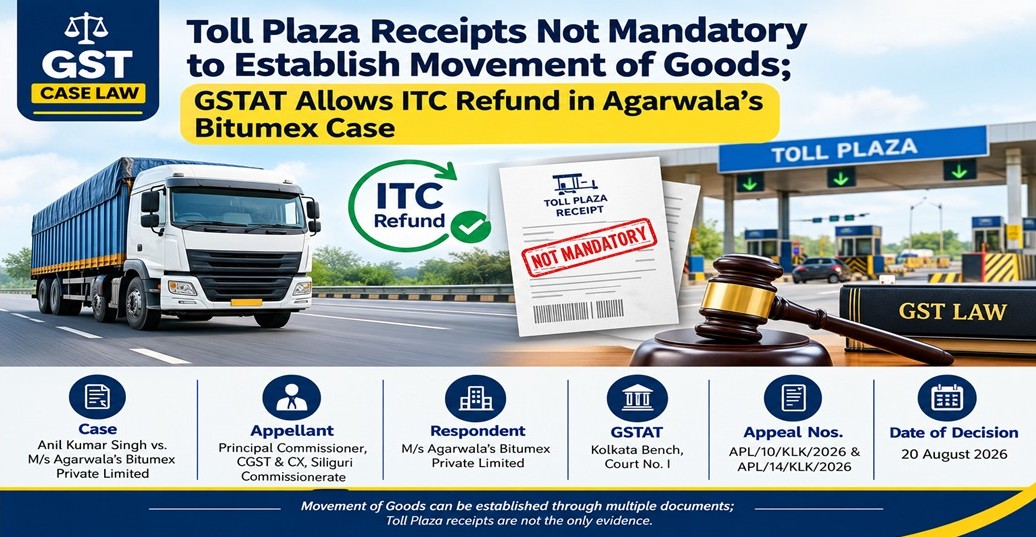
Toll Plaza Receipts Not Mandatory to Establish Movement of
Goods; GSTAT Allows ITC Refund in Agarwala’s Bitumex Case
Summary of
the Case
The GST Appellate
Tribunal, Kolkata Bench, has held that toll plaza receipts are not a
mandatory document for establishing physical movement of goods or for availing
Input Tax Credit (ITC) when the taxpayer has otherwise produced supporting
documents such as tax invoices, e-way bills, bilty, banking records and export
documents.
The case concerned refund
of accumulated ITC claimed by M/s Agarwala’s Bitumex Private Limited on account
of export of goods. The Department disputed the refund mainly on the ground
that the toll plaza data did not show movement of the vehicles through West
Bengal, even though the supplier was located in Kolkata. The Department also
questioned the ITC because the supplier of the respondent's supplier had
allegedly obtained goods from two suppliers whose GST registrations had been
cancelled ab initio.
The GSTAT found that the
goods had admittedly been received at the declared Ship To location and
subsequently exported. The Tribunal also found that the transactions were
supported by e-way bills, bilty copies, shipping bills, Export General Manifest
(EGM), transporter certificate and bank statements. The Tribunal held that the
GST law does not require goods in a Bill-to-Ship-to transaction to necessarily
commence from the registered premises of the supplier.
The Tribunal further held
that the respondent could not be denied ITC merely because of alleged
irregularities committed by a second-line supplier with whom the respondent had
no direct transaction.
Accordingly, the GSTAT
dismissed both Revenue appeals and upheld the refund allowed by the First
Appellate Authority.
Section of
the Case
The principal provisions
considered in the matter were:
Section 16(2) of the CGST
Act, 2017 – relating to the conditions for availment of Input
Tax Credit.
Section 54 of the CGST
Act, 2017 – relating to refund of tax and accumulated ITC.
Rule 112(1) of the CGST
Rules, 2017 – concerning production of evidence
before the Appellate Authority or Appellate Tribunal.
Rule 45(1) of the GSTAT
(Procedure) Rules, 2025 – relating to production of
additional evidence before the GST Appellate Tribunal.
The dispute primarily
revolved around whether the absence of toll plaza movement in West Bengal could
establish that the goods were not actually supplied and whether alleged
irregularities in the upstream supply chain could justify denial of ITC and
consequential refund.
Facts of
the Case
M/s Agarwala’s Bitumex
Private Limited, having GSTIN 19ABACA8140P1Z9, is engaged in the supply
of iron/non-alloy steel products and bitumen falling under HSN 7214 and 2714.
The company is also engaged in export of goods outside India and claimed refund
of accumulated ITC under Section 54 of the CGST Act, 2017.
The respondent filed
refund claims of ₹11,41,828/- for January 2025 and ₹27,65,697/- for
February 2025 in respect of accumulated ITC relating to exported goods.
During scrutiny of the
refund claims, the original adjudicating authority identified certain alleged
deficiencies and issued show cause notices to the respondent.
After considering the
replies, the Assistant Commissioner rejected both refund claims through
Orders-in-Original dated 28.05.2025 and 05.06.2025.
The respondent challenged
the rejection before the First Appellate Authority. The appellate authority
allowed the refund claims and set aside the Orders-in-Original through
Orders-in-Appeal dated 12.09.2025.
The Revenue, being
aggrieved by the appellate orders, filed the present appeals before the GSTAT,
Kolkata Bench.
The Revenue's principal
objection was based on the movement of the vehicles carrying the goods.
According to the Revenue, the toll data showed that the vehicles did not cross
any toll plaza in West Bengal and instead their movements were reflected in Bihar
and Uttar Pradesh. The Department therefore questioned the genuineness of the
declared supply chain.
The Department also
pointed out that the respondent's immediate supplier, M/s KS Metals Pvt. Ltd.,
had procured goods from two suppliers whose GST registrations had allegedly
been cancelled ab initio. According to the Revenue, this raised doubts regarding
the existence of the goods and consequently the eligibility of ITC.
Submission
by Appellant – Revenue
The Revenue argued that
the First Appellate Authority had wrongly allowed refund of unutilised ITC
despite serious discrepancies in the inward supply chain.
The principal argument
was that the fourteen e-way bills involved in the two appeals did not show toll
movement through West Bengal. According to the Revenue, all the consignments
had their first toll crossing in Bihar instead of West Bengal, despite the
declared dispatch location being in Kolkata.
The Revenue argued that
the First Appellate Authority had wrongly relied upon the Bill-to-Ship-to
arrangement to explain the movement. According to the Department, such an
arrangement could explain a different destination but could not explain the
absence of movement from the declared dispatch location.
The Revenue further
submitted that the immediate supplier, M/s KS Metals Pvt. Ltd., had procured
goods from two suppliers whose registrations had been cancelled ab initio.
According to the Revenue, this indicated that the goods may not have been
available for genuine supply.
The Department also
argued that merely receiving goods and subsequently exporting them would not,
by itself, establish eligibility of ITC if the underlying inward supply was not
a genuine taxable supply.
The Revenue relied upon
Section 16(2)(b) of the CGST Act and argued that the receipt of goods must
arise from a genuine taxable supply from a genuine registered supplier.
The Revenue also raised
concerns regarding the licensing of suppliers dealing in bitumen and referred
to communications from Customs and other authorities concerning the
respondent's ITC and suppliers. It was argued that such issues further
supported the Department's case against the refund.
The Revenue further
contended that possession of tax invoices, e-way bills and reflection of ITC in
GSTR-2B alone could not establish actual receipt of goods where the supply
itself was doubtful or fictitious.
Submission
by Respondent – M/s Agarwala’s Bitumex Private Limited
The respondent strongly
disputed the allegations raised by the Revenue.
With regard to the
alleged irregularity in the upstream supply chain, the respondent submitted
that its direct supplier, M/s KS Metals Pvt. Ltd., was a valid and
registered supplier. The respondent had no direct transaction or business
relationship with the second-line suppliers whose registrations had allegedly
been cancelled.
Therefore, according to
the respondent, an alleged irregularity committed by an upstream supplier could
not automatically result in denial of ITC to a bona fide purchaser when the
direct supplier was genuine and the respondent had received the goods.
Bill-to-Ship-to
Arrangement
The respondent explained
that the transactions were undertaken under the Bill-to-Ship-to model.
The supplier was
instructed to deliver the goods directly to the Land Customs Station at Jogbani,
from where the goods were exported. The e-way bills reflected the Ship To
location at the customs station.
According to the
respondent, the arrangement was adopted to facilitate exports and reduce
operational time and costs. The goods received at the Ship To location were
subsequently exported, which was supported by shipping bills and EGM generated
by Customs.
The respondent also
submitted that it was not aware of the exact location from which its supplier
procured the goods or the precise route taken by the transporter. The e-way
bills were generated by the supplier and the respondent had received the goods
at the designated Ship To location.
Toll Plaza
Data
The respondent argued
that GST law does not prescribe toll plaza movement as a statutory condition
for availment of ITC.
It submitted that it had
produced valid transportation documents issued by registered GTA operators, and
the Revenue had not disputed the authenticity of those documents.
The respondent relied
upon the judgment of the Allahabad High Court in Raghuvansh Agro Farms
Limited v. State of U.P., wherein the Court considered the issue of toll
plaza receipts and observed that there was no GST provision requiring an
assessee to produce toll plaza receipts to establish physical movement of
goods.
The respondent also
produced supporting documents including e-way bills, bilty copies, shipping
bills, EGM details, transporter certificate and bank statements. According to
the respondent, these documents collectively established actual movement,
receipt of goods and subsequent export.
Additional
Grounds Raised by Revenue
The respondent further
objected to the Revenue raising new allegations before the GSTAT which were not
part of the original show cause notices.
It was submitted that the
proceedings under GST must remain within the scope of the allegations contained
in the SCN and that new evidence or new grounds could not ordinarily be
introduced for the first time at the Tribunal stage.
The respondent relied
upon Rule 45(1) of the GSTAT (Procedure) Rules, 2025 and Rule 112(1)
of the CGST Rules, 2017 regarding restrictions on production of additional
evidence.
Findings by
the GST Appellate Tribunal
The GSTAT examined the
show cause notices, the documents on record and the submissions of both
parties.
The Tribunal first noted
that the tax payments were reflected in the GST records, including GSTR-1,
GSTR-2B and GSTR-3B. It also noted that the refund applications filed in Form
GST RFD-01 had been verified by the Department.
Importantly, there was no
dispute that the goods had actually been exported.
No
Requirement That Goods Must Start From Supplier's Registered Premises
The first major dispute
concerned the alleged absence of toll movement in West Bengal.
The Revenue had relied on
toll plaza data to contend that the goods had not moved from the declared
location in West Bengal.
However, the Tribunal
found that the goods had been received at the Ship To point and were
subsequently exported. The export was verified by the Revenue authorities, the
Land Customs Station and other relevant records. A Bank Realization Statement
had also been received by the DGFT authorities.
The Tribunal examined the
e-way bills and found that the transactions were undertaken under the Bill-to-Ship-to
model.
The Tribunal specifically
held that there is no provision under GST law requiring goods to necessarily
start from the registered place of the supplier in a Bill-to-Ship-to
transaction.
Where the supplier is
instructed by the recipient/exporter to deliver the goods directly to the place
of export, the movement to such Ship To location is permissible.
Toll Plaza
Receipts Are Not Mandatory
The Tribunal considered
the judgment of the Allahabad High Court in Raghuvansh Agro Farms Limited v.
State of U.P.
The High Court had
observed that where purchases and sales are reflected on the GST portal and are
supported by tax invoices, e-way bills, bilty, banking transactions and other
supporting records, the absence of toll plaza receipts cannot by itself justify
an adverse finding.
The GSTAT relied upon
this principle and held that toll plaza receipts are not necessary documents
to establish transportation of goods.
The Tribunal observed
that the relevant supporting documents for transportation and export included
tax invoices, e-way bills, bilty copies and banking records. In the present
case, these documents had been submitted by the respondent and had not been disputed
by the Revenue.
Accordingly, the Tribunal
held that toll plaza receipts are not a mandatory requirement for availing
ITC.
Upstream
Supplier's Irregularity Cannot Automatically Deny ITC
The second major issue
concerned cancellation of GST registrations of the suppliers from whom M/s KS
Metals Pvt. Ltd. had allegedly procured goods.
The Tribunal noted that
the actual/direct supplier of the respondent, namely M/s KS Metals Pvt.
Ltd., had a valid GST registration.
The respondent had no
connection with the second-line suppliers. Therefore, the Tribunal held that
the respondent could not be held responsible for irregularities committed by
those suppliers when there was no direct transaction between them.
The Tribunal accordingly
held that the respondent could not be denied ITC and refund merely on the basis
of irregularities attributed to second-line suppliers.
New Grounds
and Additional Evidence Cannot Be Introduced at Tribunal Stage Without
Following the Procedure
The Revenue had also
raised certain additional allegations before the GSTAT concerning
investigations, licensing requirements for bitumen and other issues.
The Tribunal noted that
these allegations had not formed part of the original SCNs.
Further, no supporting
documents regarding the alleged investigation had been filed before the
Tribunal. The Revenue had merely referred to concerns regarding ITC and
supplier licences.
The Tribunal therefore
held that such issues could not be introduced at the appellate stage in the
manner attempted by the Revenue.
The Tribunal also
referred to Rule 45(1) of the GSTAT (Procedure) Rules, 2025 and Rule 112(1) of
the CGST Rules, 2017, observing that additional evidence is restricted except
in exceptional circumstances.
Decision
After considering the
entire matter, the GSTAT, Kolkata Bench dismissed both Revenue appeals bearing APL/14/KLK/2026
and APL/10/KLK/2026.
The Tribunal upheld the
Orders-in-Appeal through which the First Appellate Authority had allowed the
respondent's refund claims.
Thus, the refund of
accumulated ITC claimed by M/s Agarwala’s Bitumex Private Limited was allowed
to stand.
Conclusion
The decision is
significant for GST refund and ITC disputes where the Department relies heavily
on toll plaza data or alleged irregularities in the upstream supply chain.
The GSTAT has made it
clear in the facts of this case that the absence of toll plaza movement, by
itself, cannot be treated as conclusive proof that goods were not physically
moved when the taxpayer has produced other reliable documentary evidence such as
tax invoices, e-way bills, bilty, transporter documents, bank records, shipping
bills and EGM.
The Tribunal also
recognised the commercial nature of a Bill-to-Ship-to transaction and
held that GST law does not require goods to necessarily originate from the
registered premises of the supplier in such an arrangement.
Another important aspect
of the ruling is the treatment of upstream supplier discrepancies. Where the
taxpayer's direct supplier is registered and the taxpayer has documentary
evidence of receipt and subsequent export, an alleged irregularity involving a
second-line supplier cannot automatically be used to deny ITC to the taxpayer
who had no direct transaction with that supplier.
The ruling also
reinforces the importance of the show cause notice in GST proceedings.
Allegations and evidence introduced for the first time at the appellate stage
cannot simply be used to sustain a demand or deny a substantive benefit without
following the applicable procedural requirements and giving the taxpayer an opportunity
to respond.
For taxpayers facing ITC
or refund disputes based on toll plaza data, the decision highlights the
importance of maintaining a complete documentary trail, including e-way
bills, tax invoices, bilty, transporter records, bank payment evidence,
shipping bills, EGM and export-related documents.
However, the decision is
based on the facts and evidence available in this particular case. The
Tribunal's finding that ITC was admissible was based on its conclusion that the
respondent had fulfilled the conditions of Section 16(2), had produced supporting
documents, and had subsequently exported the goods.
Disclaimer: All the Information is strictly for educational purposes and on the basis of our best understanding of laws & not binding on anyone.
Click here