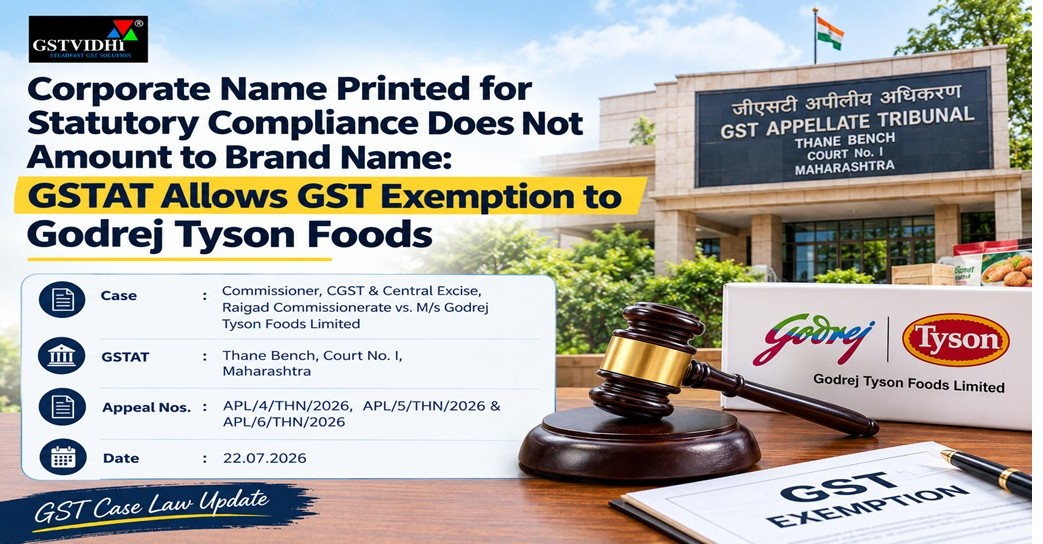
Corporate Name Printed for Statutory Compliance Does Not Amount
to Brand Name: GSTAT Allows GST Exemption to Godrej Tyson Foods
Summary of
the Case
The Goods and Services
Tax Appellate Tribunal (GSTAT), Thane Bench, has held that printing the
manufacturer's corporate name and address on the packaging of goods merely to
comply with statutory requirements under food safety and legal metrology laws
does not, by itself, amount to affixing a "brand name" for the
purpose of denying GST exemption.
The dispute concerned
supplies of fresh and frozen poultry and ready-to-cook products made by M/s
Godrej Tyson Foods Limited to institutional customers. The taxpayer had
removed specific brand logos from the packaging but continued to print its
corporate name, address and other mandatory declarations required under the
Food Safety and Standards Authority of India (FSSAI) regulations and Legal
Metrology law.
The Revenue argued that
the continued display of the corporate name created a brand connection and
therefore the goods could not qualify for exemption under Notification No.
02/2017-Central Tax (Rate).
GSTAT rejected this
contention. It observed that where the manufacturer's name is printed because
of a statutory obligation relating to identification, traceability and safety,
such declaration cannot automatically be treated as the use of a brand name.
The Tribunal also
considered the position after 18 July 2022, when the exemption entry was
amended in relation to "pre-packaged and labelled" goods. It held
that packages supplied to institutional consumers do not fall within the
relevant retail-sale concept under Rule 3 of the Legal Metrology (Packaged
Commodities) Rules, 2011.
Accordingly, the
Revenue's appeals were dismissed and the Order-in-Appeal granting the exemption
was upheld.
Section of
the Case
The case primarily
involved the interpretation of Sl. No. 9 of Notification No. 02/2017-Central
Tax (Rate) dated 28.06.2017, as amended.
The dispute involved two
important questions:
1. Whether
printing the manufacturer's corporate name and address on unit containers, when
required under FSSAI and Legal Metrology laws, amounts to use of a "brand
name" for GST exemption purposes.
2. Whether
supplies made to institutional consumers fall within the scope of
"pre-packaged and labelled" goods after the amendment introduced
through Notification No. 7/2022-Central Tax (Rate) dated 13.07.2022.
The proceedings also
involved the demand of tax, interest and penalty under Section 74 of the CGST
Act, 2017.
Facts of
the Case
M/s Godrej Tyson Foods
Limited was engaged in the supply of fresh and frozen poultry and ready-to-cook
products.
The respondent entered
into a Supply Agreement dated 01.12.2020 with Yum Restaurants (India) Private
Limited for supply of frozen chicken cuts to Sapphire Foods India Limited,
which operated quick-service restaurants.
During the period from 01.04.2020
to 04.01.2021, the goods were supplied in unit containers carrying the
brand logos "Godrej Tyson" and "Godrej Real Good",
and GST was discharged at the rate of 5%.
From 05.01.2021 to
17.07.2022, the respondent removed the specific brand logos from the
packaging for institutional supplies. However, the corporate name and address
continued to appear on the packaging because such information was required
under applicable FSSAI and Legal Metrology requirements.
On this basis, the
taxpayer claimed exemption under Sl. No. 9 of Notification No. 02/2017-CT(R).
Subsequently, from 18.07.2022
to 31.03.2023, after the amendment of the exemption notification, the
respondent continued to claim exemption on the ground that the supplies were
made to institutional consumers and therefore did not constitute
"pre-packaged and labelled" goods intended for retail sale.
A Show Cause Notice was
issued on 15.02.2024. The adjudicating authority subsequently passed an
Order-in-Original dated 02.08.2024, denying the exemption and confirming a GST
demand of ₹2,26,77,883, along with interest and an equivalent penalty
under Section 74(1) of the CGST Act.
The taxpayer challenged
the order before the appellate authority. The Commissioner (Appeals), through
Order-in-Appeal dated 21.03.2025, set aside the adjudication order and dropped
the demand in its entirety.
The Revenue thereafter
filed the present appeals before GSTAT.
Submission
by Appellant – Revenue
The Revenue argued that
merely removing the specific logo from the packaging did not mean that the
goods became unbranded.
According to the Revenue,
the corporate name "Godrej Tyson" continued to be printed on
the packaging along with the overall packaging style, which allegedly created
recognition and a connection between the goods and the brand.
The Revenue further
argued that the Supply Agreement required the respondent to maintain specified
quality standards and required the supplier's name to be printed prominently.
According to the Revenue, this went beyond mere statutory compliance and served
the purpose of branding.
Another argument was
based on the invoices issued by the respondent. The Revenue contended that the
invoices prominently carried the brand name and logo, thereby establishing a
connection between the goods and the brand.
The Revenue also
contended that the respondent had not filed a declaration or affidavit
voluntarily foregoing its actionable claim in the brand name, which was alleged
to be a requirement for claiming the exemption.
On this basis, the
Revenue argued that the exemption was not available and that the invocation of
Section 74 of the CGST Act was justified.
Submission
by Respondent – Godrej Tyson Foods Limited
The respondent submitted
that the corporate name, address and FSSAI licence details were printed on the
packaging because of mandatory statutory requirements under the Food Safety and
Standards (Labelling and Display) Regulations, 2020 and the Legal Metrology
Act, 2009.
It was argued that a
declaration required by law for identification, traceability and consumer
safety cannot automatically be treated as a commercial brand affixed to the
goods.
The respondent further
submitted that the exemption notification operates with reference to the goods
and their packaging. Therefore, merely mentioning a corporate name or brand
name on an invoice could not convert otherwise unbranded physical goods into
branded goods.
For the period after
18.07.2022, the respondent argued that the goods were supplied exclusively to
institutional buyers. Such packages were not intended for retail sale and
therefore did not fall within the relevant meaning of "pre-packaged and
labelled" commodities under the Legal Metrology framework.
The respondent also
disputed the invocation of Section 74. It submitted that the issue involved
interpretation of the exemption notification and there was no suppression of
facts or wilful misstatement with an intention to evade tax. Therefore, the
extended period, interest and equivalent penalty were not sustainable.
Findings by
GSTAT
Corporate Name Printed
Due to Statutory Requirement Is Not a Brand Name
The Tribunal first
examined the period prior to 18.07.2022.
It noted that the
exemption notification excluded goods bearing a registered brand name or a
brand name in respect of which an actionable claim existed.
However, the Tribunal
found that the respondent had discontinued the use of the specific brand logos "Godrej
Tyson" and "Godrej Real Good" on the packaging from
05.01.2021.
The Tribunal then
considered the continued printing of the manufacturer's name and address.
It observed that the
requirement to print the manufacturer's name and address was a statutory
obligation under the FSSAI regulations and Legal Metrology law. Such statutory
declarations are intended for identification, traceability and safety purposes.
Therefore, compliance
with a statutory requirement could not, by itself, be equated with the
commercial use of a brand name intended to establish a trade connection or
enhance the value of the goods.
Institutional Supplies
and "Pre-Packaged and Labelled" Goods
The Tribunal separately
considered the period from 18.07.2022 to 31.03.2023.
After the amendment, the
relevant exemption entry referred to "pre-packaged and labelled"
goods.
GSTAT examined Rule 3 of
the Legal Metrology (Packaged Commodities) Rules, 2011 and observed that
packages intended for institutional consumers do not qualify as pre-packaged
commodities meant for retail sale.
Since the supplies in
question were made to institutional consumers, the Tribunal held that the
Revenue had not produced sufficient material to displace this legal position.
Brand Name on Invoice
Does Not Make the Physical Goods Branded
The Revenue also relied
upon the fact that the invoices carried the brand name.
The Tribunal rejected
this argument.
It held that the relevant
condition of the exemption notification relates to the goods being affixed with
a brand name. Since the physical goods did not bear the brand name during the
relevant period, merely mentioning the brand name on an invoice would not make
the goods branded for purposes of the exemption.
Judicial
Precedents Considered by GSTAT
The Tribunal examined
several judicial decisions relied upon by both sides.
RDB Textiles Ltd. v. CCE
The Tribunal relied upon
the Supreme Court decision in RDB Textiles v. CCE, 2018 (359) E.L.T. 433
(S.C.).
In that case, the Supreme
Court considered markings made on jute bags pursuant to statutory requirements
and held that such markings, made under compulsion of law for identification
and control by government authorities, do not constitute a brand name.
GSTAT found the principle
applicable to the present case because the declarations on the Godrej packaging
were also made pursuant to statutory requirements.
Tarai Foods Ltd. v. CCE
The Tribunal also
considered Tarai Foods Ltd. v. CCE, Meerut, 2006 (198) E.L.T. 323 (S.C.).
The Supreme Court had
held that mandatory declaration of the manufacturer's name under weights and
measures legislation does not make a unit container branded.
GSTAT observed that this
decision supported the principle that statutory compliance cannot automatically
be treated as branding.
Narasus Sarathy
Enterprises Pvt. Ltd.
The Tribunal also
referred to the decision of the Madras High Court in Narasus Sarathy
Enterprises Pvt. Ltd. v. AC, GST & CE, Salem, 2026 VIL 299 (MAD).
The High Court had
considered the declaration of a corporate name on a unit container pursuant to
FSSAI and Legal Metrology requirements and held that such declaration was for
statutory compliance and did not create a brand connection for denying exemption.
GSTAT found this decision
directly relevant to the issue under the GST regime.
Grasim Industries Ltd.
The Revenue relied upon CCE
v. Grasim Industries Ltd., 2005 (183) E.L.T. 123 (S.C.), arguing that the
name of a company printed on a package could constitute a brand name.
However, the Tribunal
distinguished that decision. It observed that in Grasim Industries, the name
was voluntarily used to establish a trade connection, whereas in the present
case the corporate name was printed because of a statutory requirement.
Therefore, the factual
circumstances were materially different.
Australian Foods India
The Revenue also relied
upon CCE v. Australian Foods India (P) Ltd., 2013 (287) E.L.T. 385 (S.C.).
The Tribunal noted that
invoices alone cannot be the sole basis for determining whether the physical
goods are branded. The exemption condition applies to the goods and their
packaging, rather than merely to the invoice.
Therefore, the presence
of a brand name on an invoice could not, by itself, defeat the exemption where
the physical goods did not bear the brand name.
Advance
Rulings and Other Decisions Relied Upon by Revenue
The Tribunal also
considered the reliance placed by the adjudicating authority on certain Advance
Ruling decisions.
GSTAT observed that an
Advance Ruling is applicable to the concerned applicant and is not binding on
the Tribunal.
The Tribunal further
observed that the Advance Ruling decisions relied upon by the Revenue were
contrary to the principles emerging from the Supreme Court judgments discussed
in the order.
Accordingly, the Tribunal
held that such Advance Ruling decisions did not assist the Revenue in the
present matter.
The Tribunal also
distinguished the decision of the Tripura High Court in Sarvasidhi Agrotech
Pvt. Ltd. The Tribunal noted that the issue in that case concerned
ownership of the brand name affixed to the goods, whereas in the present matter
the goods did not bear the brand name during the relevant period.
Decision of
GSTAT
After considering the
facts, submissions and judicial precedents, GSTAT held that the respondent had
discontinued the use of the brand name on the packaging while continuing to
print the company's name only for statutory compliance.
The Tribunal concluded
that such statutory declaration did not amount to affixing a brand name.
For the period after
18.07.2022, the Tribunal further held that goods supplied to institutional
consumers did not fall within the relevant category of "pre-packaged and
labelled" goods intended for retail sale.
Accordingly, the goods
were eligible for exemption under Notification No. 02/2017-Central Tax
(Rate) dated 28.06.2017, as amended.
Since the exemption was
available, the consequential demand of tax, interest and penalty could not be
sustained.
The Tribunal therefore
upheld the Order-in-Appeal dated 21.03.2025 and dismissed all the appeals
filed by the Revenue.
Conclusion
The decision of GSTAT
Thane provides an important clarification regarding the distinction between a statutory
declaration and a commercial brand name.
The mere presence of a
manufacturer's corporate name on a package should not automatically result in
denial of a GST exemption where the name is printed to comply with mandatory
requirements under FSSAI or Legal Metrology laws. The nature and purpose of the
declaration are relevant.
The Tribunal has also
clarified that the presence of a brand name on an invoice cannot, by itself,
make the physical goods branded when the exemption notification applies to the
goods and their packaging.
For institutional
supplies, the Tribunal further recognized the significance of the Legal
Metrology framework while examining whether goods qualify as "pre-packaged
and labelled" commodities intended for retail sale.
The case is therefore
significant for manufacturers and suppliers of food and other regulated
products who are required by law to display their corporate name, address,
licence details or other statutory information on product packaging. The
decision indicates that mandatory statutory declarations should be examined
in their proper legal context and should not automatically be treated as
commercial branding for GST exemption purposes.
Disclaimer: All the Information is strictly for educational purposes and on the basis of our best understanding of laws & not binding on anyone.
Click here