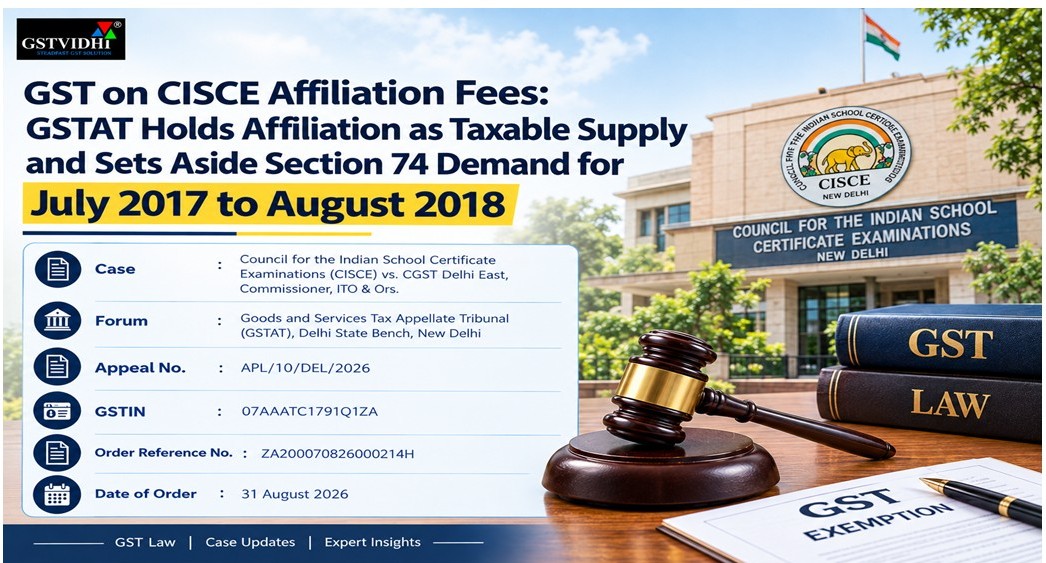
GST on CISCE Affiliation Fees: GSTAT Holds Affiliation
as Taxable Supply and Sets Aside Section 74 Demand for July 2017 to August 2018
Summary of
the Case
The Council for the
Indian School Certificate Examinations (CISCE) is an educational body engaged,
among other activities, in conducting ICSE and ISC examinations and granting
affiliation to schools.
The Department initiated
proceedings on the allegation that GST had not been discharged on various
amounts collected from affiliated schools. The Department proposed a
consolidated demand covering the period from July 2017 to November 2023,
invoking Section 74 for July 2017 to August 2018 and Section 73 for
the subsequent period.
The original proceedings
resulted in substantial tax demands. The first appellate authority granted
partial relief, particularly for certain receipts for the period up to 17 June
2021, but sustained GST on affiliation-related receipts for the period after 18
June 2021 and on annual registration and late registration charges.
Before GSTAT, CISCE
challenged the taxability of its receipts, the applicability of the exemption
under Entry 66 of Notification No. 12/2017-CT (Rate), the validity of the
extended period under Section 74, the consolidated show cause notice and the
levy of interest and penalties.
The GSTAT ultimately held
that CISCE's affiliation services constitute taxable supplies, and
affiliation is not covered by the exemption relating to services connected with
admission or conduct of examinations. However, the Tribunal also held that the
ingredients required for invoking Section 74 were not established for July
2017 to August 2018, resulting in the setting aside of the demand for that
period.
Background
and Facts of the Case
CISCE is a society
engaged in educational activities, including conducting ICSE and ISC
examinations. Schools seeking affiliation with CISCE pay affiliation fees and
annual charges for continuation of their affiliation.
The Department conducted
an investigation after receiving information that GST had not been paid on
various receipts collected by CISCE. An inspection under Section 67(1) was also
conducted on 5 December 2023.
The Department alleged
that GST had not been discharged on several categories of receipts, including:
- Affiliation fees;
- Affiliation form processing charges;
- Annual registration charges;
- Late registration charges;
- Documentation charges;
- Licence fees; and
- Late entry fees.
For the period July 2017
to November 2023, the Department initially computed GST liability at
approximately Rs.20.90 crore based on the financial information
furnished by CISCE.
For the period July
2017 to August 2018, the Department proposed a demand of Rs.3,35,93,661
under Section 74.
For the subsequent period
September 2018 to November 2023, a demand of Rs.17,54,57,628 was
proposed under Section 73.
Relevant
GST Provisions
The principal provisions
considered by the Tribunal were:
Section 7 – Scope of
Supply
The Tribunal examined
whether the activities undertaken by CISCE constituted a "supply"
under Section 7 of the CGST Act.
Section 9 – Levy of GST
Once the activity was
held to constitute a taxable supply, the charging provision under Section 9
became relevant.
Section 73 – Demand in
Cases Other Than Fraud
Section 73 deals with
determination of tax not paid or short paid, or ITC wrongly availed/utilised,
for reasons other than fraud, wilful misstatement or suppression of facts.
Section 74 – Demand
Involving Fraud, Wilful Misstatement or Suppression
The Department invoked
Section 74 for July 2017 to August 2018 alleging suppression of facts and
intent to evade tax.
The Tribunal specifically
examined whether the necessary ingredients for invoking Section 74 had actually
been established.
Entry 66 of Notification
No. 12/2017-CT (Rate)
The central exemption
dispute concerned services relating to admission to, or conduct of examinations
by, an educational institution.
Rule 35 of the CGST Rules
The appellant also
claimed that the amounts collected, if held taxable, should be treated as inclusive
of GST, thereby allowing the benefit of the cum-tax valuation.
Issue
Before the GSTAT
The Tribunal framed eight
principal issues.
The important questions
included:
1. Whether
a consolidated SCN could cover the period July 2017 to November 2023.
2. Whether
CISCE's activities constituted a supply under Section 7 read with Section 9.
3. Whether
affiliation and affiliation processing charges were exempt as services relating
to admission or conduct of examinations.
4. Whether
annual registration and late registration charges were exempt.
5. Whether
CBIC Circular No. 234/28/2024-GST was applicable.
6. Whether
the consideration collected by CISCE should be treated as inclusive of GST.
7. Whether
Section 74 could validly be invoked for July 2017 to August 2018.
8. Whether
interest and penalties were sustainable.
Submission
of the Appellant
CISCE argued that its
activities were primarily educational and were not undertaken with a commercial
or profit-making objective.
The appellant contended
that affiliation is an integral part of the examination system. According to
CISCE, schools require affiliation in order to present their students for
ICSE/ISC examinations. Therefore, affiliation could not be treated as an independent
commercial service.
The appellant relied upon
Section 7 and Section 2(17) of the CGST Act and argued that its activities were
not carried out in the course or furtherance of business.
It was also argued that
the affiliation charges were covered by Entry 66 of Notification No.
12/2017-CT (Rate) because affiliation was closely connected with the
examination system.
CISCE further challenged
Circular No. 234/28/2024-GST dated 11 October 2024, contending that the
Circular could not override the statutory exemption contained in the
notification.
On Section 74, the
appellant submitted that there was no fraud, wilful misstatement or suppression
of facts with intent to evade tax. The issue was essentially interpretational
because CISCE had bona fide believed that its receipts were exempt.
The appellant also argued
that the Department had already obtained information regarding its activities
before the inspection and therefore the allegation of suppression could not be
sustained.
Submission
of the Department
The Department contended
that CISCE was a registered society and that registration under the Income-tax
Act or recognition under education laws did not automatically determine GST
liability.
According to the
Department, affiliation fees, annual registration charges, late fees and
similar amounts were consideration for identifiable services such as granting
and continuing affiliation, monitoring compliance with prescribed standards and
undertaking administrative functions.
The Department therefore
treated these activities as supplies under Section 7 and taxable under Section
9.
With respect to Entry 66,
the Department argued that the exemption was restricted to services relating to
admission or conduct of examinations. Affiliation, according to the Department,
was a separate administrative activity involving examination of infrastructure,
faculty, governance and other prescribed standards.
The Department also
relied upon CBIC Circular No. 151/07/2021-GST dated 17 June 2021 and Circular
No. 234/28/2024-GST dated 11 October 2024 to support the taxability of
affiliation services.
Regarding Section 74, the
Department argued that CISCE had not disclosed the taxable nature of the
receipts in its GST returns and that the issue came to light only through
departmental investigation. Therefore, according to the Department, the
extended period was justified.
Finding of
GSTAT on Consolidated Show Cause Notice
One of the preliminary
objections raised by CISCE was that the Department had issued a single SCN
covering several financial years and had invoked both Sections 73 and 74.
The Tribunal examined the
statutory provisions as well as the judicial precedents cited before it.
It noted that the mere
fact that several tax periods were covered in a consolidated SCN would not, by
itself, invalidate the proceedings where there was no demonstrated prejudice,
confusion, denial of opportunity or jurisdictional incompetence.
The Tribunal therefore
held that the proceedings were not vitiated merely because the SCN covered
July 2017 to November 2023 in a consolidated manner.
Affiliation
Services Held to be Taxable Supply
The Tribunal examined
whether the affiliation activity constituted a supply under Section 7.
After considering the
statutory framework and the arguments of both sides, GSTAT held that the
activities undertaken by CISCE constitute supply under Section 7(1)(a) read
with Section 2(17) of the CGST Act.
A significant aspect of
the Tribunal's reasoning was that CISCE is a registered society under the
Societies Registration Act, 1860, and not a statutory university created by
a Parliamentary or State enactment for discharging compulsory statutory
functions.
The Tribunal therefore
distinguished cases concerning statutory universities and institutions
performing compulsory statutory functions from the activities of CISCE.
The Tribunal concluded
that the affiliation activity was an independent supply and was chargeable to
GST.
Affiliation
is Not Covered by Examination-Related Exemption
The Tribunal separately
considered Entry 66(b)(iv) of Notification No. 12/2017-CT (Rate).
The appellant argued that
affiliation is an integral and foundational part of the examination process
because affiliated schools are permitted to present students for CISCE
examinations.
However, the Tribunal
held that affiliation is distinct from the actual admission of students or
conduct of examinations.
The Tribunal ultimately
held that affiliation, including affiliation processing/form charges, is an
independent taxable supply and does not form an integral part of services
relating to admission to or conduct of examinations.
Accordingly, the
exemption under Entry 66 was not available to the affiliation services.
Effect of
Circular No. 234/28/2024-GST
The Tribunal considered
Circular No. 234/28/2024-GST dated 11 October 2024.
The Circular clarified
that affiliation services provided by Central or State educational boards,
councils or similar bodies to schools are taxable. It also provided for
regularisation on an “as is where is” basis for the period from 1 July 2017
to 17 June 2021.
The Tribunal noted that
the Circular was specifically concerned with affiliation services.
Importantly, the Tribunal
held that the regularisation provided by the Circular could not automatically
be extended to annual registration charges and late registration charges.
The Tribunal observed
that fiscal concessions must be strictly construed and cannot be extended by
implication to categories of receipts not expressly covered.
Accordingly, annual
registration charges and late registration charges were treated separately from
the affiliation charges.
Annual
Registration Charges and Late Charges
CISCE argued that annual
registration charges were essentially continuation charges for affiliation.
Since non-payment could result in discontinuation of affiliation, the appellant
contended that these charges should receive the same treatment as affiliation
fees.
The Department, on the
other hand, treated them as independent consideration for continuation of
affiliation, regulatory monitoring, administrative processing and renewal.
The GSTAT agreed with the
Department on this issue and held that the annual registration charges and late
registration charges constituted taxable supplies distinct from services
relating to admission or conduct of examinations.
The Tribunal further held
that the “as is where is” regularisation under Circular No. 234/28/2024 was
specifically confined to affiliation services and did not extend to annual
registration and late registration charges.
Section 74:
Tribunal Sets Aside Extended Period Demand
A significant relief was
granted by the Tribunal in relation to the period July 2017 to August 2018.
The Department had
invoked Section 74 alleging fraud, wilful misstatement and suppression of facts
with intent to evade tax.
The Tribunal examined
whether the statutory ingredients necessary for invoking Section 74 were
established.
After considering the
material on record and the arguments, the Tribunal concluded that the
ingredients of fraud, wilful misstatement or suppression of facts with intent
to evade tax were not established for the period July 2017 to August 2018.
Consequently, the
extended period under Section 74 was held to be unavailable.
The demand relating to
annual registration charges and late registration charges amounting to Rs. 1,29,60,720
for that period was therefore set aside in its entirety, both on account of
invalid invocation of Section 74 and limitation.
Interest
and Penalty
Since the demand for July
2017 to August 2018 was set aside, the consequential interest and penalty for
that period could not survive.
The Tribunal also held
that penalty and interest could not be imposed on affiliation fees and
affiliation processing/form charges for the period 1 July 2017 to 17 June
2021, considering the “as is where is” regularisation.
However, for the tax
demands sustained for the later period, the Tribunal upheld the applicable
penalty under Section 122(2)(a) read with Section 73.
The general penalty of Rs.
25,000 under Section 125 was also upheld.
Interest under Section 50
was held payable on the tax amounts ultimately confirmed, from the respective
dates of default.
Cum-Tax
Benefit
The Tribunal also granted
the benefit of treating the amount collected by CISCE as inclusive of GST,
thereby allowing the benefit of cum-tax value.
This modification was
specifically incorporated in the final order.
Thus, the final tax
computation was required to be made after applying the cum-tax principle to the
amounts collected by CISCE.
Final
Decision of GSTAT
The GSTAT modified the
impugned order and issued the following principal directions:
First,
invocation of Section 74 for the period July 2017 to August 2018 was set
aside and the corresponding demand for that period was also set aside.
Second,
GST demand on affiliation fees and affiliation form-processing charges for the
period 18 June 2021 to November 2023 was upheld.
Third,
GST demand on annual registration charges and late registration charges for the
period September 2018 to November 2023 was upheld.
Fourth,
the amounts collected by CISCE were directed to be treated as inclusive of
GST, allowing the cum-tax benefit.
Fifth,
penalties were modified in accordance with the tax liability ultimately
sustained.
Sixth,
interest under Section 50 was held payable only on the tax amounts confirmed
after giving effect to the Tribunal's findings.
The respondent was
directed to recompute the tax liability along with consequential interest and
penalty in accordance with the Tribunal's findings.
Final
Conclusion
The GSTAT Delhi decision
in Council for the Indian School Certificate Examinations provides an
important examination of the GST treatment of affiliation and other charges
collected by an educational board.
The Tribunal
distinguished affiliation services from the actual conduct of examinations
and held that affiliation is an independent taxable supply. It also held that
the regularisation granted by Circular No. 234/28/2024-GST for the period up to
17 June 2021 was specifically applicable to affiliation services and could not
automatically be extended to annual registration and late registration charges.
At the same time, the
Tribunal provided substantial relief for the earlier period by holding that the
necessary ingredients for invoking Section 74 were not established for July
2017 to August 2018. The demand for that period, along with consequential
interest and penalty, was therefore set aside.
The order is particularly
relevant for educational boards, examination bodies and other institutions
receiving affiliation, registration, accreditation or examination-related
charges, as it highlights the importance of examining the exact nature of
each receipt and the specific scope of the applicable exemption notification
rather than treating all educational receipts as either wholly taxable or
wholly exempt.
Disclaimer: All the Information is strictly for educational purposes and on the basis of our best understanding of laws & not binding on anyone.
Click here