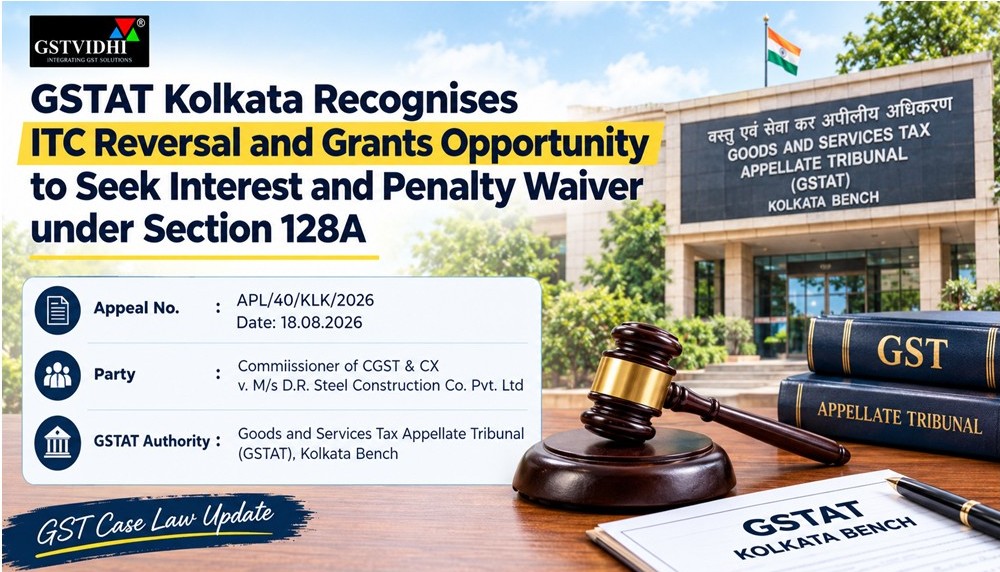
GSTAT Kolkata Recognises ITC Reversal and Grants
Opportunity to Seek Interest and Penalty Waiver under Section 128A
Summary of
the Case
The Goods and Services
Tax Appellate Tribunal (GSTAT), Kolkata Bench, in Commissioner of CGST &
CX v. M/s D.R. Steel Construction Co. Pvt. Ltd., Final Order dated 18
August 2026, examined a dispute concerning alleged excess Input Tax Credit
(ITC) of ₹53,95,795 for the financial years 2018–19, 2019–20 and 2020–21.
The Department had raised
the demand on the basis of differences between ITC claimed in GSTR-3B and ITC
reflected in GSTR-2A/2B. However, the taxpayer contended that the excess ITC
had already been reversed before the demand order was passed and supported its
claim through DRC-03, reconciliation statements and other documents.
The GSTAT accepted the
taxpayer’s position regarding the reversal of the disputed ITC. It also held
that the taxpayer could seek the benefit of Section 128A of the CGST Act, 2017,
subject to the applicable conditions. The matter was remanded to the first
appellate authority for fresh computation of interest and penalty after giving
the taxpayer an opportunity of hearing.
Background
and Facts of the Case
M/s D.R. Steel
Construction Co. Pvt. Ltd., engaged in works contract services, received a
show-cause-cum-demand notice dated 29 December 2023 under Section 73 of the
CGST Act, 2017.
The Department alleged
that the taxpayer had availed excess ITC amounting to ₹53,95,795 during the
financial years 2018–19 to 2020–21. The alleged excess credit arose from
differences between the ITC claimed in GSTR-3B and the credit reflected in
GSTR-2A/2B.
The Department proposed
recovery of the disputed amount along with applicable interest under Section 50
and penalty under Section 73.
The taxpayer submitted
reconciliation statements, copies of GST returns, invoices and Form GST DRC-03
to establish that the disputed credit had already been reversed. The taxpayer
also appeared for a personal hearing and challenged the demand.
Despite these
submissions, the adjudicating authority confirmed the demand of ₹53,95,795,
appropriated certain amounts already paid and imposed interest and penalty.
Findings of
the First Appellate Authority
The taxpayer challenged
the adjudication order before the first appellate authority. After examining
the reconciliation statements, invoices, GST returns and payment records, the
appellate authority found that a substantial portion of the disputed ITC had
already been reversed.
The appellate authority
reduced the remaining tax liability to ₹2,08,058.90, as against the original
demand of ₹53,95,795, and directed payment of the remaining amount along with
applicable interest and penalty.
The Department challenged
this relief before GSTAT, arguing that the taxpayer had not adequately
established that the earlier reversals related to the disputed demand and that
interest and penalty had not been properly considered.
Issues
Before GSTAT
The principal issues
before the Tribunal were:
1. Whether
the taxpayer had already reversed the disputed excess ITC through earlier debit
entries and Form GST DRC-03.
2. Whether
the Department could disregard the reversal merely because the taxpayer had not
specifically mentioned the reason in the relevant column of Form GST DRC-03.
3. Whether
the taxpayer was eligible to seek waiver of interest and penalty under Section
128A of the CGST Act, 2017.
4. Whether
the matter required fresh computation of any remaining liability.
GSTAT’s
Findings
1. Earlier ITC Reversal
Was Supported by Documentary Evidence
The Tribunal examined the
payment records, Form GST DRC-03, debit entries and reconciliation statements
submitted by the taxpayer.
It found that the
taxpayer had reversed the disputed ITC through debits from the electronic cash
ledger and electronic credit ledger. The Tribunal also noted that the
Department had acknowledged the payments by issuing Form GST DRC-04.
Accordingly, the
Department’s objection that the taxpayer had failed to establish the connection
between the reversals and the disputed demand was not accepted.
The Tribunal held that
the documentary evidence supported the taxpayer’s claim that the disputed ITC
had already been reversed.
2. Absence of Reasons in
Form GST DRC-03 Was Not Sufficient to Reject the Reversal
The Department had
questioned the reversals because the taxpayer had not specified the reasons in
the relevant column of Form GST DRC-03.
The Tribunal observed
that the relevant column requires the taxpayer to provide reasons, if any, and
is not a mandatory field that must necessarily be filled in every case.
Therefore, the absence of
an explanation in that column could not, by itself, justify rejection of the
reversal when the other records and supporting documents established the
payment.
3. Benefit of Section
16(5) of the CGST Act
The Tribunal also
examined the applicability of Section 16(5) of the CGST Act, 2017, which
provides a special time limit for availing ITC relating to invoices or debit
notes for the financial years 2017–18 to 2020–21.
Under this provision,
eligible ITC could be claimed in a return under Section 39 filed up to 30
November 2021, notwithstanding the time limit prescribed under Section 16(4).
The Tribunal held that
the adjudicating authority’s finding regarding the time limit for carrying
forward the credit could not be sustained without considering the benefit
available under Section 16(5).
4. Relief under Section
128A for Interest and Penalty
The Tribunal considered
Section 128A of the CGST Act, 2017, which provides for waiver of interest or
penalty, or both, in eligible cases involving demands under Section 73 for the
period from 1 July 2017 to 31 March 2020, subject to prescribed conditions.
Since the demand involved
the financial years 2018–19 and 2019–20, the Tribunal held that the taxpayer
was entitled to seek the benefit of Section 128A, subject to compliance with
the applicable procedure and conditions.
However, the Tribunal did
not grant an unconditional waiver of interest and penalty. Instead, it directed
that any remaining liability be freshly computed and that the taxpayer be given
an opportunity of hearing.
If any interest or
penalty remained payable after the fresh computation, the taxpayer would be at
liberty to apply for the benefit of Section 128A, and the appropriate authority
would consider the application in accordance with law.
Final
Decision of GSTAT
The GSTAT disposed of the
Department’s appeal and remanded the matter to the first appellate authority
for fresh computation of interest and penalty, if any.
The Tribunal directed
that:
- The taxpayer’s earlier ITC reversals
be recognised in light of the supporting documentary evidence.
- The remaining liability towards
interest and penalty, if any, be computed after giving the taxpayer an
opportunity of hearing.
- The applicable instructions under
Circular No. 192/04/2023-GST dated 17 July 2023 be considered during the
computation.
- The taxpayer be permitted to seek the
benefit of Section 128A, if any liability remained, subject to the
prescribed conditions.
- The entire exercise be completed
within three months from the date of communication of the Tribunal’s
order.
Conclusion
The decision in Commissioner
of CGST & CX v. M/s D.R. Steel Construction Co. Pvt. Ltd. highlights
the importance of examining reconciliation statements, payment records and Form
GST DRC-03 before confirming demands relating to excess ITC.
The Tribunal made it
clear that a reversal supported by documentary evidence and acknowledged by the
Department cannot be disregarded merely because the taxpayer has not entered
reasons in a non-mandatory field of Form GST DRC-03.
The decision also
highlights the importance of considering Section 16(5) where the relevant
financial years fall within its scope and of examining the possible benefit of
Section 128A for eligible demands under Section 73.
For taxpayers facing
similar ITC disputes, the ruling underscores the importance of maintaining
proper reconciliation statements, payment proofs and supporting documents. It
also reinforces the need for tax authorities to consider the complete record
before determining the remaining tax, interest and penalty liability.
Disclaimer: All the Information is strictly for educational purposes and on the basis of our best understanding of laws & not binding on anyone.
Click here