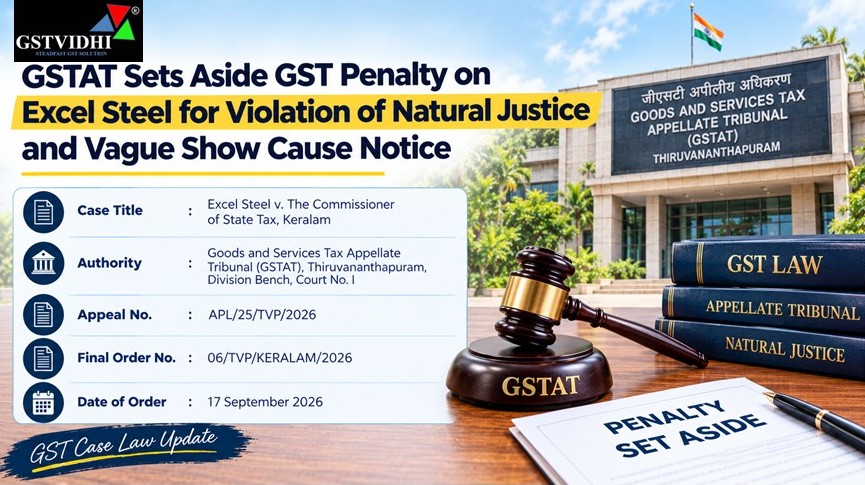
GSTAT Sets Aside GST Penalty on Excel Steel for
Violation of Natural Justice and Vague Show Cause Notice
Summary of
the Case
The Goods and Services
Tax Appellate Tribunal (GSTAT), Thiruvananthapuram, allowed the appeal filed by
Excel Steel and set aside the appellate order confirming tax and penalty under
Section 129 of the CGST/KGST Acts.
The Tribunal held that a
penalty under Section 129 cannot be imposed without identifying the specific
provisions of the Act or Rules allegedly violated. It also found that the
taxpayer was not given a proper opportunity of personal hearing and was not provided
copies of the statements relied upon by the department.
The Tribunal concluded
that these failures violated the principles of natural justice and set aside
the impugned appellate order with consequential relief.
Background
and Facts
Excel Steel, a
proprietorship concern based in Chengannur, Kerala, is engaged in trading iron
and steel TMT rods and pipes.
On 23 December 2019, the
State GST Department intercepted a vehicle transporting iron and steel goods
from M/s Sumangala Steel Private Limited, Pondicherry, to Excel Steel’s
registered office in Chengannur.
The department alleged
that the goods were being unloaded at the premises of M/s Michael Steels,
Cheriyakolla, instead of the destination mentioned in the tax invoice and e-way
bill.
An order in Form GST
MOV-09 was issued, imposing IGST and an equivalent penalty under Section 129.
The goods and vehicle were released after payment of the tax and penalty.
Excel Steel challenged
the order before the First Appellate Authority. However, the appeal was
rejected, leading the taxpayer to approach GSTAT.
Key Issues
Before the Tribunal
The Tribunal considered
the following issues:
1. Whether
a penalty under Section 129 could be imposed without specifying the particular
provision of the Act or Rules allegedly violated.
2. Whether
the adjudicating authority could pass an order without providing the taxpayer a
personal hearing.
3. Whether
the department could rely on statements without supplying copies to the
taxpayer.
4. Whether
the failure to consider the taxpayer’s objections and provide proper reasons
made the appellate order unsustainable.
Findings of
the Tribunal
A. The Show Cause Notice
Must Specify the Alleged Violation
The Tribunal observed
that Section 129 applies where goods are transported or stored in transit in
contravention of the provisions of the Act or Rules.
It held that the
department must identify and establish the specific contravention before
imposing a penalty. In the present case, the show cause notice did not clearly
specify which provision of the Act or Rules had been violated.
The Tribunal held that a
taxpayer cannot properly defend a case without knowing the precise allegation
against them.
B. Reliance on the
Supreme Court’s Decision in Brindavan Beverages
The Tribunal relied on
the Supreme Court’s decision in Commissioner of Central Excise v. Brindavan
Beverages (P) Ltd., decided on 15 June 2007.
The Supreme Court held
that a show cause notice is the foundation of the department’s case. If the
allegations are vague, lack necessary details or are unintelligible, the
taxpayer is not given a proper opportunity to defend the case.
Applying this principle,
GSTAT found that the notice in the present case was vague and did not identify
the specific statutory provisions allegedly contravened.
C. Non-Supply of
Statements Violated Natural Justice
The department relied on
statements allegedly recorded from the vehicle driver and the manager of M/s
Michael Steels to support its allegation that the goods were being unloaded at
an undeclared destination.
Excel Steel contended
that copies of these statements had not been supplied.
After examining the
records, the Tribunal found no evidence that the statements had been made
available to the taxpayer. The department’s representative also did not refute
this contention.
The Tribunal held that
relying on statements without providing copies to the taxpayer was a violation
of the principles of natural justice.
D. Order Passed Without
Personal Hearing
The show cause notice
provided an opportunity for a personal hearing on 26 December 2019. However,
the original order had already been passed on 24 December 2019.
The Tribunal noted that
the portion of the original order meant to record the taxpayer’s submissions
was left blank. It concluded that the order had been passed without giving the
taxpayer the promised opportunity of hearing.
This violated the
principle of audi alteram partem, which means that a person must be
given a fair opportunity to be heard before an adverse decision is made.
E. Original Order Was
Cryptic and Unreasoned
The Tribunal found that
the original order did not identify the allegedly defective documents or
specify the statutory provision that had been violated.
It held that the order
did not establish the essential basis for imposing a penalty under Section 129.
The Tribunal also
observed that the First Appellate Authority had failed to properly examine the
taxpayer’s contentions regarding the absence of a hearing and the non-supply of
statements. The appellate order therefore suffered from non-application of mind.
F. Route Deviation Alone
Was Not Enough
The department relied on
the fact that the vehicle had taken a route that was not the shortest route to
Chengannur and that the goods were allegedly being unloaded at another
premises.
However, the Tribunal
found that the proceedings were fundamentally defective because the specific
statutory violation had not been properly identified and the taxpayer had not
been given a fair opportunity to defend the case.
The Tribunal set aside
the appellate order on these grounds.
Final
Decision
GSTAT allowed the appeal
filed by Excel Steel and set aside the impugned Order-in-Appeal.
The Tribunal concluded
that:
- The department had not established a
specific violation of the Act or Rules to justify the penalty under
Section 129.
- The original order was passed without
providing the taxpayer a personal hearing.
- Copies of the statements relied upon
by the department were not supplied to the taxpayer.
- The appellate authority failed to
properly examine the taxpayer’s objections and provide adequate reasons.
The appeal was
accordingly allowed with consequential relief.
Conclusion
This ruling reinforces
the importance of following due process in GST detention and penalty
proceedings. A department must clearly state the alleged statutory violation,
provide the taxpayer with the material relied upon, offer a fair opportunity of
hearing and pass a reasoned order.
The decision also
highlights that a penalty cannot be sustained merely on the basis of
allegations where the show cause notice and adjudication proceedings fail to
meet these basic legal requirements.
Key Takeaway: A
valid show cause notice, disclosure of relied-upon evidence, a fair hearing and
a reasoned order are essential safeguards in GST proceedings under Section 129.
Disclaimer: All the Information is strictly for educational purposes and on the basis of our best understanding of laws & not binding on anyone.
Click here