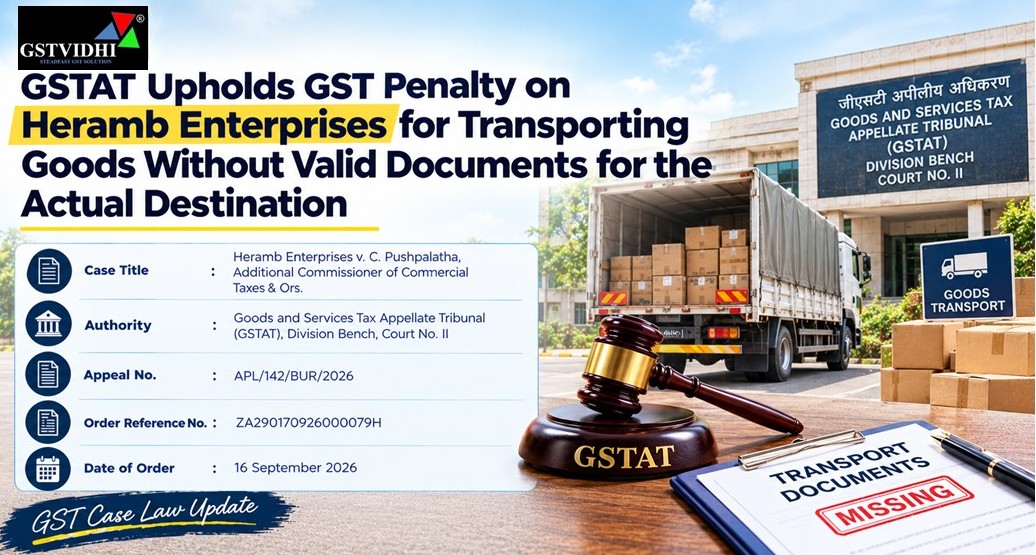
GSTAT Upholds GST Penalty on Heramb Enterprises for
Transporting Goods Without Valid Documents for the Actual Destination
Summary of
the Case
The Goods and Services
Tax Appellate Tribunal (GSTAT) dismissed the appeal filed by Heramb Enterprises
and upheld the order imposing tax and penalty under Section 129 of the
Karnataka GST Act, 2017.
The Tribunal held that
the goods were being unloaded at a destination different from the one mentioned
in the tax invoice and e-way bill. Since the required documents for the actual
destination were not available at the time of interception, the Tribunal
rejected the taxpayer’s claim that the lapse was caused by a technical glitch.
The Tribunal also held
that the revisional authority’s order was not barred by limitation because the
period excluded by the Supreme Court during COVID-19 applied to the
departmental proceedings in this case.
Background
and Facts
On 6 October 2020, the
GST department intercepted a vehicle carrying plywood at Udayambag, Belagavi,
Karnataka. The goods were being unloaded at the premises of REC Flow Technology
LLP.
The available tax invoice
and e-way bill covered transportation of the goods from Intercon Wood
Industries, Perumbavoor, Kerala, to Heramb Enterprises, Belagavi. However, the
required tax invoice and e-way bill for delivery to REC Flow Technology LLP were
not available at the time of interception.
The department issued a
notice in Form GST MOV-07 and subsequently passed an order in Form GST MOV-09,
imposing tax and penalty under Section 129(1).
Heramb Enterprises
challenged the order before the First Appellate Authority, which reduced the
penalty to Rs.500 each under the CGST and KGST Acts, relying on Section 126 and
the decision in Synergy Fertichem Pvt. Ltd. v. State of Gujarat.
However, the Revisional
Authority reversed that decision and restored the original order. Heramb
Enterprises then filed an appeal before GSTAT.
Key Issues
Before the Tribunal
The Tribunal considered
two main issues:
1. Whether
the revisional proceedings were barred by the limitation period prescribed
under Section 108(2)(b) of the KGST Act.
2. Whether
the Revisional Authority was justified in restoring the tax and penalty imposed
under Section 129.
Submissions
of the Taxpayer
Heramb Enterprises argued
that the supplier, transporter and recipient were registered dealers and that
the transaction was genuine and recorded in the books of accounts.
The taxpayer submitted
that the e-way bill could not be generated for the actual destination due to
technical glitches and that the lapse was procedural rather than an attempt to
evade tax.
The taxpayer also argued
that the revisional order dated 31 August 2024 was beyond the three-year
limitation period under Section 108(2)(b), calculated from the appellate order
dated 25 March 2021.
Findings of
the Tribunal
A. Revisional Proceedings
Were Within Limitation
The Tribunal examined the
three-year limitation period under Section 108(2)(b) of the KGST Act.
It considered the Supreme
Court’s decision in Cognizance for Extension of Limitation and its
subsequent decision in G.R. Infra Projects Ltd. v. State of Madhya Pradesh.
The Tribunal held that
the COVID-19 exclusion period applied to departmental proceedings as well.
After excluding the relevant period, the revisional order dated 31 August 2024
was within the permissible limitation period.
Therefore, the taxpayer’s
limitation objection was rejected.
B. Required Documents
Were Missing for the Actual Destination
The Tribunal observed
that Section 68 of the CGST Act requires the person in charge of a conveyance
to carry the prescribed documents, while Rule 138 requires the e-way bill to be
generated before the commencement of movement, where applicable.
Although the goods were
accompanied by an invoice and e-way bill, those documents covered delivery to
Heramb Enterprises, not unloading at REC Flow Technology LLP.
The Tribunal found that
the required documents for the actual destination were absent when the vehicle
was intercepted.
C. Technical Glitch
Argument Was Not Accepted
The taxpayer argued that
the e-way bill could not be generated due to a technical glitch. However, the
Tribunal noted that no evidence had been provided to support this claim.
It also found that the
new e-way bill and invoice were generated only after the goods had been
intercepted.
The Tribunal agreed with
the Revisional Authority that the subsequent generation of documents could not
cure the contravention that had already occurred.
D. Intention to Evade Tax
Was Inferred from the Facts
The Tribunal observed
that the goods were being unloaded at a destination different from the one
covered by the available documents.
It held that the absence
of the required tax invoice and e-way bill at the time of interception was a
wilful act to evade payment of tax in the circumstances of this case.
Accordingly, the Tribunal
upheld the imposition of tax and penalty under Section 129(1).
E.Distinction Between
Procedural and Serious Violations
The Tribunal considered
the principles laid down by the Gujarat High Court in Synergy Fertichem Pvt.
Ltd. v. State of Gujarat, which recognised the need to distinguish between
minor procedural lapses and serious contraventions involving an intention to
evade tax.
However, the Tribunal
found that those principles did not support the taxpayer on the facts before
it, because the necessary documents for the actual destination were missing and
the subsequent documentation was generated only after interception.
Final
Decision
GSTAT dismissed the
appeal filed by Heramb Enterprises and confirmed the Revisional Authority’s
order dated 31 August 2024.
The Tribunal upheld the
tax demand of Rs. 1,51,856 and penalty of Rs.1,51,854, making the total
confirmed demand Rs.3,03,710, as reflected in the Tribunal’s order summary.
The Tribunal also
rejected the taxpayer’s objection that the revisional proceedings were
time-barred.
Conclusion
This ruling highlights
the importance of ensuring that tax invoices and e-way bills accurately cover
the actual movement and destination of goods. Documents relating to a different
destination may not protect a taxpayer when goods are found being unloaded
elsewhere.
The decision also shows
that a claim of technical failure should be supported by evidence, and that
documents generated after interception may not remedy an existing
contravention.
Disclaimer: All the Information is strictly for educational purposes and on the basis of our best understanding of laws & not binding on anyone.
Click here