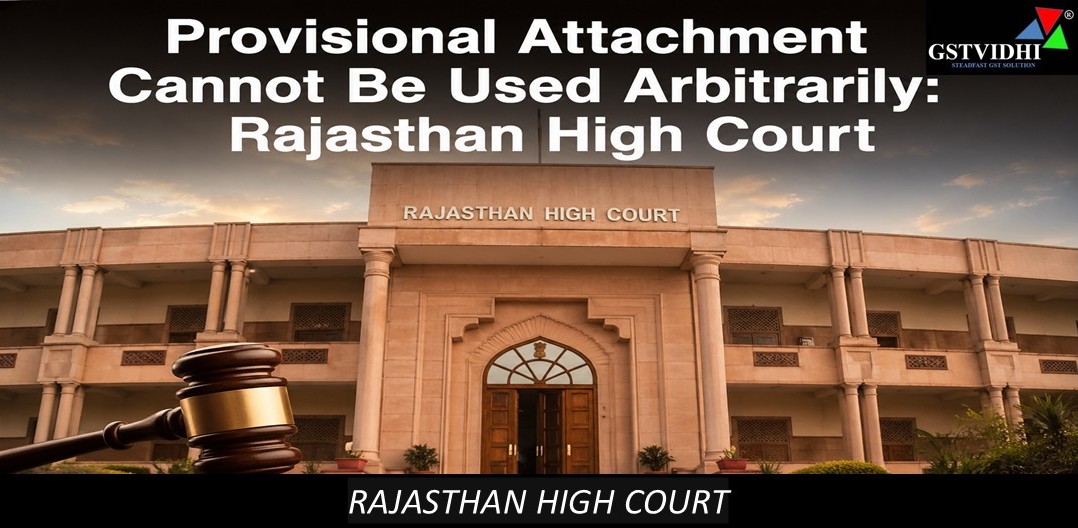
Provisional Attachment Cannot Be Used Arbitrarily: Rajasthan
High Court Protects Taxpayer from Excessive Action
Introduction
In a significant ruling,
the Rajasthan High Court has laid down important safeguards against the
arbitrary use of provisional attachment powers by tax authorities. The Court
held that such powers, being drastic in nature, must be exercised with utmost
caution and only in genuine cases where there is a real risk to government
revenue. The judgment reinforces that tax administration must balance revenue
protection with fairness towards honest taxpayers.
Facts of
the Case
The petitioner, ARL
Infratech Limited, is engaged in the business of manufacturing building
materials and has been a regular taxpayer with substantial tax payments over
the years. A search operation was conducted by the Income Tax Department,
resulting in a minor addition of approximately ₹4.40 lakh, without creating any
immediate demand. Subsequently, based on a possible future demand of around
₹1.30 crore for certain assessment years, the department issued an order of
provisional attachment under Section 281B of the Income Tax Act, attaching an
industrial property of the petitioner valued at several crores. Aggrieved by
this action, the petitioner approached the High Court challenging the
attachment as arbitrary and excessive.
Issue
Before the Court
The primary issue before
the Court was whether the Income Tax Department can invoke the power of
provisional attachment merely on the basis of an anticipated demand, without
concrete material indicating that the taxpayer is likely to default in payment.
Contentions
of the Petitioner
The petitioner contended
that the action of the department was unjustified as it was a compliant
taxpayer with a strong history of tax payments. It was argued that only a minor
addition had been made during the search and no substantial demand existed at
the time of attachment. The petitioner further submitted that as per CBDT
guidelines, even in cases where demand is raised, only a limited percentage
(generally 20%) is required to be deposited. Therefore, attaching a high-value
property was excessive, disproportionate, and amounted to misuse of power.
Contentions
of the Department
The department defended
its action by stating that Section 281B empowers it to provisionally attach
property to safeguard the interests of revenue. It was argued that such
attachment is a preventive measure and does not require prior notice. The
department also submitted that the property attached was the least valued among
the assets owned by the petitioner and that the action was taken after due
consideration.
Court’s
Analysis
The High Court analyzed
the scope and nature of provisional attachment powers and relied on the
principles laid down by the Hon’ble Supreme Court in Radha Krishan Industries
vs State of Himachal Pradesh. The Court observed that provisional attachment is
a serious and harsh measure which can adversely affect the business operations
and reputation of a taxpayer. Therefore, such power must be exercised only when
there is tangible material to indicate that the taxpayer may defeat the demand.
The Court further noted
that the petitioner was a regular taxpayer with a consistent record of
compliance and there was no material to suggest any intention to evade tax or
avoid payment. It emphasized that merely having an apprehension of future
demand is not sufficient to justify attachment of property. The Court also
highlighted that such actions can negatively impact the creditworthiness of
businesses and create unnecessary hardship.
Additionally, the Court
observed that even if a demand is raised, the law provides mechanisms such as
payment of a limited percentage of the demand (generally 20%) to secure the
interests of the revenue. In such circumstances, attaching high-value property
without first exploring less intrusive measures was found to be unjustified.
Findings
and Judgment
The Court held that the
action of the department in provisionally attaching the petitioner’s property
was arbitrary and not supported by adequate justification. It found that the
essential conditions for invoking Section 281B were not satisfied, particularly
the requirement of forming an opinion based on tangible material indicating
risk to revenue.
Accordingly, the High
Court quashed the provisional attachment order dated 01.01.2026. However, in
order to balance the interests of revenue, the Court directed the petitioner to
deposit 20% of the provisionally assessed demand within a specified period. It
was also clarified that if the demand is subsequently reduced or set aside, the
deposited amount shall be refunded along with applicable interest.
Key Legal
Principles
This judgment establishes
that provisional attachment powers cannot be exercised in a routine or
mechanical manner and must be backed by strong and valid reasons. It reiterates
that such powers are exceptional in nature and should be invoked only when absolutely
necessary to protect revenue. The ruling also reinforces the importance of
considering the taxpayer’s conduct and compliance history before taking such
drastic action.
Practical
Implications
The decision provides
significant relief to taxpayers by ensuring that coercive measures like
attachment of property are not used indiscriminately. It highlights that
taxpayers have the right to challenge arbitrary actions before constitutional
courts. At the same time, it serves as a reminder to tax authorities to act
fairly, proportionately, and in accordance with established guidelines.
Conclusion
The Rajasthan High Court
has delivered a balanced and reasoned judgment, protecting taxpayers from
excessive and unjustified use of power while safeguarding the interests of
revenue. The ruling underscores that tax laws should be implemented in a fair
and reasonable manner, ensuring that honest taxpayers are not subjected to
undue hardship. This decision stands as an important precedent in curbing
misuse of provisional attachment provisions and promoting a more accountable
tax administration system.
Disclaimer: All the Information is based on the notification, circular advisory and order issued by the Govt. authority and judgement delivered by the court or the authority information is strictly for educational purposes and on the basis of our best understanding of laws & not binding on anyone.
Click here