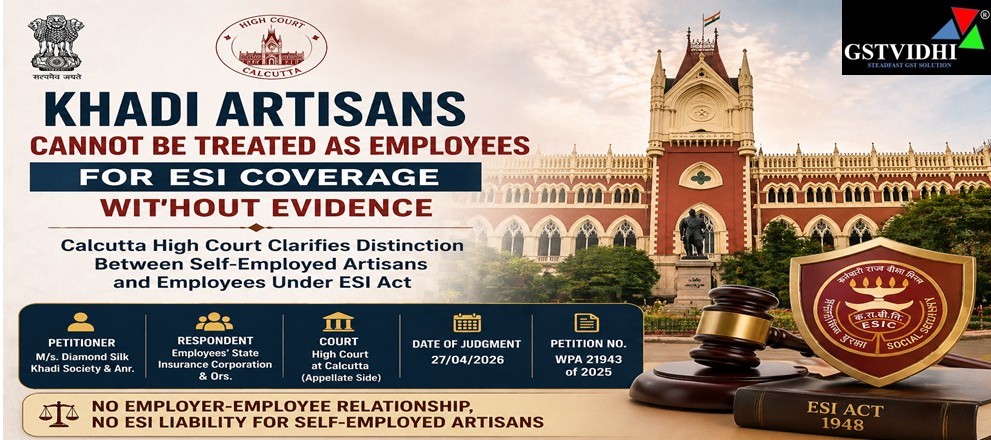
Khadi Artisans Cannot Be Treated as Employees for ESI Coverage
Without Evidence: Calcutta High Court
(M/s. Diamond Silk Khadi Society & Anr. Vs. Employees’ State
Insurance Corporation & Ors. / Court: High Court at Calcutta / Date of
Judgment: 27/04/2026 / Petition No.: WPA 21943 of 2025)
Introduction
This case before the
Calcutta High Court addresses a crucial issue regarding applicability of the
Employees’ State Insurance (ESI) Act to Khadi institutions and whether artisans
engaged in such activities can be treated as “employees” for the purpose of ESI
coverage. The judgment provides important clarity on the distinction between
self-employed artisans and formal employees within the framework of social
welfare legislation.
Facts of
the Case
The petitioner, M/s.
Diamond Silk Khadi Society, is a certified Khadi institution functioning under
the guidelines of the Khadi and Village Industries Commission (KVIC). The
institution is engaged in activities such as hand spinning and hand weaving,
primarily through artisans who work independently.
An inspection was
conducted by the ESI authorities, during which it was alleged that the
petitioner establishment employed more than the threshold number of employees,
thereby attracting the provisions of the ESI Act. Based on this inspection,
proceedings under Section 45A were initiated, and an order demanding
approximately ₹6.12 lakh was passed for the relevant period.
The petitioner challenged
the order, contending that artisans are self-employed individuals and not
employees, and therefore should not be counted for determining applicability of
the ESI Act.
Issues
Involved
The primary issue before
the Court was whether Khadi artisans, who are engaged in decentralized and
home-based production activities, can be treated as employees under the ESI
Act. Another issue was whether the petitioner establishment fulfilled the statutory
threshold of number of employees required for ESI coverage.
Contentions
of the Petitioner
The petitioner argued
that artisans working with the institution are self-employed and operate
independently without any employer-employee relationship. It was submitted that
these artisans work from their homes, have no fixed working hours, and are free
to associate or dissociate from the institution at will.
The petitioner further
contended that the establishment never employed 10 or more persons, and
therefore does not fall within the ambit of the ESI Act. It was also argued
that the inspection report wrongly included artisans as employees without any
supporting documentary evidence.
Additionally, the
petitioner highlighted that Khadi and related activities fall within the
unorganized sector, and artisans are specifically recognized as self-employed
under relevant laws and welfare schemes.
Contentions
of the Respondent (ESI Authority)
The ESI authorities
defended their action by stating that during inspection, it was found that the
establishment engaged more than 10 persons, including artisans and other
workers. It was argued that certain payments categorized as “allowances” were
in fact wages, and therefore those individuals should be treated as employees.
The department also
contended that since the establishment had GST registration and maintained
financial records, it could not be treated as part of the unorganized sector.
Findings of
the Court
The Hon’ble Court made a
detailed analysis of the nature of Khadi institutions and the role of artisans.
It observed that artisans are generally self-employed individuals who work
independently and are not subject to supervision or control by the institution.
The Court held that
merely because artisans are associated with a Khadi institution does not
automatically establish an employer-employee relationship. It further observed
that in the absence of documentary evidence such as wage records or employment
contracts, artisans cannot be treated as employees for ESI coverage.
However, the Court also
noted that certain individuals shown in the payment register and receiving
allowances with provident fund deductions could be treated as employees. Based
on available records, the Court found that the total number of employees exceeded
the statutory threshold.
Judgment
The Calcutta High Court
held that although artisans cannot be treated as employees without proper
evidence, the establishment in the present case had more than the minimum
number of employees required for ESI applicability.
Accordingly, the Court
upheld the orders passed under Sections 45A and 45AA of the ESI Act, confirming
that the petitioner establishment is covered under the ESI scheme.
The writ petition was
disposed of, and the challenge to ESI coverage was rejected.
Conclusion
This judgment draws a
clear distinction between self-employed artisans and formal employees under
labour welfare laws. While it protects artisans from being arbitrarily
classified as employees, it also emphasizes that establishments cannot evade
statutory obligations by misclassifying workers.
The ruling is significant
for Khadi institutions and similar organizations, as it clarifies that the
applicability of ESI depends on actual employment relationships and proper
documentation. It reinforces the importance of maintaining transparent records
and compliance with labour laws.
Disclaimer: All the Information is based on the notification, circular advisory and order issued by the Govt. authority and judgement delivered by the court or the authority information is strictly for educational purposes and on the basis of our best understanding of laws & not binding on anyone.
Click here