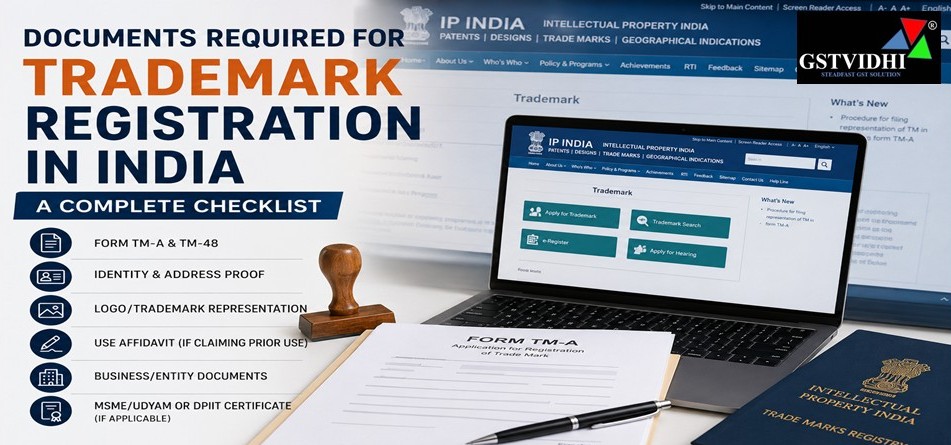
Documents
Required for Trademark Registration in India: A Practical Guide for Applicants
Starting a new business
often begins with a name, logo, tagline, or brand identity. But creating a
brand is only the first step. If you want legal protection for that brand in
India, you may need to register it as a trademark.
One of the first
questions applicants usually ask is:
“What documents do I need
for trademark registration?”
The answer is not the
same for everyone. A person applying in their own name will generally have a
simpler documentation requirement than a company, LLP, partnership firm, trust,
or foreign business.
This guide explains the
documents you should keep ready before filing a trademark application and, more
importantly, which documents are required only in specific situations.
What Is the Basic
Documentation for a Trademark Application?
For an ordinary trademark
filing, the application mainly requires information about:
- The applicant
- The trademark
- The goods or services covered by the
trademark
- The relevant trademark class
- The applicant's address and other
identification details
- The basis of use of the trademark
- The person or professional authorized
to handle the filing, where applicable
The official Trade Marks
Rules provide that an application for registration is filed in Form TM-A.
The application must also contain the required representation and description
of the trademark.
Therefore, before
starting the online filing process, it is sensible to prepare the supporting
documents first.
Core Documents You Should
Keep Ready
1. Identity Proof of the
Applicant
The Registry needs
sufficient information to identify the proprietor of the trademark.
Depending on the
applicant, this may include documents such as:
- PAN card
- Aadhaar card
- Passport
- Voter ID
- Driving licence
- Other appropriate identity documents
For a company, LLP,
partnership, trust, or society, the focus is not simply on the identity of one
individual. Documents establishing the legal identity of the organization and
the authority of the person acting for it become important.
2. Address Details and
Proof
The trademark application
requires the applicant's address and other particulars necessary for
identification. The Trade Marks Rules also prescribe requirements concerning
the applicant's address and principal place of business.
An appropriate address
document may therefore be kept ready, particularly where the filing
professional requires it for verification or supporting documentation.
For foreign applicants,
additional address-for-service requirements apply in India.
3. Trademark
Representation
If you are registering a
logo, device mark, label, or another visual representation, you need to provide
a clear representation of the mark.
The Rules specify that
the representation of the trademark should be clear and should not exceed 8
cm × 8 cm.
Before filing, make sure
the version submitted is the exact version you want to protect.
This is particularly
important where the logo contains:
- Special fonts
- Stylized words
- Symbols
- Graphic elements
- Specific colour combinations
- Taglines forming part of the mark
A mistake at the filing
stage can create unnecessary complications later.
4. Form TM-A
TM-A is the principal
application form for trademark registration.
It contains the essential
details of the application, including the applicant's information, trademark
details and goods or services for which protection is sought.
The application can cover
one or multiple classes, subject to the applicable rules and fees. The official
IP India fee schedule currently lists e-filing of TM-A at ₹4,500 per class for
an Individual/Startup/Small Enterprise and ₹9,000 per class in other cases.
The applicable applicant
category should therefore be determined correctly before filing.
5. Form TM-48 – When an
Agent Is Filing
You do not necessarily
need to personally handle the trademark application.
If a trademark agent or
other authorized representative is filing or acting on your behalf, an
appropriate authorization is required. Form TM-48 is the prescribed
authorization form for an agent under the relevant provisions.
The form identifies the
proprietor and authorizes the appointed agent to act in the specified trademark
matter.
Therefore, if you are
engaging a trademark professional, keep the authorization documentation ready
at the beginning rather than waiting for a later stage.
6. Proof of Trademark Use
– Only If You Claim Prior Use
This is one of the most
important distinctions in trademark filing.
You can apply for a
trademark on a proposed-to-be-used basis. In that situation, you are not
claiming that the mark was already commercially used before the application.
However, if you want to
claim that your trademark has already been used, the documentation becomes more
substantial.
Under Rule 25 of the
Trade Marks Rules, an applicant claiming use before the filing date must submit
an affidavit supporting the use along with supporting documents.
Possible supporting
evidence can include:
- Sales invoices
- Tax invoices
- Purchase orders
- Product packaging
- Advertising material
- Brochures
- Website material
- Promotional campaigns
- Business catalogues
- Online marketplace records
- Other documents demonstrating genuine
use
The important point is
not simply to collect a large number of documents. The evidence should actually
support the claimed date and nature of use.
7. Business Registration
Documents
The documentation changes
when the applicant is an organization rather than an individual.
For example:
Proprietorship
A proprietorship does not
have a separate legal personality from its proprietor. Accordingly, personal
identification documents of the proprietor are generally relevant, along with
suitable business details where required.
Partnership Firm
Documents establishing
the partnership and its partners may be required, such as:
- Partnership deed
- Registration details, where
applicable
- PAN of the firm
- Details of the authorized partner
The Trade Marks Rules
specifically require the names, addresses and nationalities of the partners to
be provided in the relevant application.
LLP
An LLP should keep its
incorporation/registration details, LLP agreement and authorization details
ready.
Company
A company should
generally keep:
- Certificate of Incorporation
- Company identification details
- PAN
- Authorization for the person handling
the trademark matter
A Board Resolution or
other appropriate authorization may be used depending on how the filing is
being handled.
8. Authorization
Documents for Organizations
A common mistake is to
assume that because a person is a director, partner, trustee, or office bearer,
they can automatically sign every document without any supporting
authorization.
It is better to maintain
a clear internal authorization where the applicant is an organization.
The authorization should
identify:
- The organization
- The authorized person
- The trademark/business matter
- The authority given to the person
This becomes particularly
useful when the trademark is filed, replied to, or subsequently defended by
someone other than the proprietor.
9. Documents for Trusts
and Societies
Where the applicant is a
trust or society, documents should establish both:
1. The
existence of the organization; and
2. The
authority of the person acting on its behalf.
Depending on the
structure, this may involve:
- Trust deed
- Registration certificate
- Society registration documents
- PAN
- Resolution or authorization
- Identity proof of the authorized
representative
The exact documents can
vary according to the constitution of the organization.
10. Documents for HUF
Applicants
Where the applicant is an
HUF, the application should properly identify the HUF and the person acting as
its Karta.
Documents relating to the
HUF and the Karta may be required depending on the filing circumstances.
The important
consideration is to ensure that the owner mentioned in the trademark
application is legally consistent with the documents being submitted.
11. Documents for Foreign
Applicants
A foreign applicant can
seek trademark protection in India.
The Trade Marks Rules
require applicants having no principal place of business in India to provide
their home-country address along with the applicable address for service in
India.
Depending on the
applicant, relevant documents may include:
- Passport or identity document, for an
individual
- Incorporation/business registration
document, for a foreign company
- Applicant's address details
- Trademark representation
- Authorization in favour of the Indian
representative, where applicable
- Prior-use evidence, if a prior-use
claim is made
Foreign applicants should
take particular care while providing their address and representation details
because communications from the Registry must be properly received.
12. Documents for a
Convention Priority Claim
Not every applicant needs
priority documents.
If an applicant is
claiming priority based on an earlier application filed in a convention
country, additional documentation is required.
The Rules provide for
submission of a certificate from the relevant trademark office or competent
authority containing details such as the earlier application, country and
filing date.
Therefore, applicants
claiming convention priority should not treat the Indian application as an
ordinary domestic filing.
13. Do You Need a Digital
Signature Certificate?
Trademark applications
are commonly filed electronically through the IP India system. The official
filing workflow provides for preparing the required information and documents,
uploading them and paying the prescribed fee.
The exact signing and
filing arrangement depends on who is submitting the application and how it is
being filed.
Therefore, rather than
assuming that every applicant needs the same type of DSC, it is better to check
the current portal requirements and the filing arrangement being used.
14. Is an Affidavit
Required in Every Trademark Application?
No.
An affidavit is
particularly relevant when the applicant claims that the trademark was used
before the filing date.
If the application is
filed on a proposed-to-be-used basis, a prior-use affidavit is generally not
required merely because a trademark application is being filed.
This distinction can
prevent applicants from preparing unnecessary documents.
15. Do You Need an MSME
or Udyam Certificate?
An MSME/Udyam document is
not what establishes ownership of the trademark.
However, the applicant
category can affect the official filing fee. The current IP India fee schedule
provides a lower fee category for Individual/Startup/Small Enterprise
applicants compared with other applicants.
Therefore, if you intend
to claim an applicable reduced-fee category, keep the relevant supporting
certificate or proof available.
Do not select a lower-fee
category merely to reduce the filing cost unless the applicant actually
satisfies the applicable requirements.
16. What Documents Should
You Prepare Before Filing?
A practical approach is
to divide your documents into three groups.
Group A – Almost Every
Filing
Keep ready:
- Applicant's full legal name
- Address details
- Identity information
- Trademark name/logo
- Details of goods or services
- Proposed trademark class
- Contact details
Group B – Only Where
Applicable
Prepare:
- Form TM-48
- Prior-use affidavit
- Prior-use evidence
- Authorization/Board Resolution
- Udyam/MSME documents
- DPIIT recognition documents
- Convention priority documents
Group C – Entity-Specific
Documents
Depending on the
applicant:
- Proprietorship documents
- Partnership deed
- LLP documents
- Certificate of Incorporation
- Trust deed
- Society registration documents
- HUF-related documents
- Foreign incorporation/identity
documents
This approach is much
more useful than assuming that every trademark applicant needs the same
document bundle.
17. A Simple Pre-Filing
Document Check
Before submitting the
application, check these points:
- Is the applicant's legal name
correct?
- Is the applicant type correctly
selected?
- Is the trademark representation
final?
- Is the correct class selected?
- Are the goods/services properly
described?
- Is the application
proposed-to-be-used or based on prior use?
- If prior use is claimed, is there
documentary evidence?
- If an agent is filing, is the
authorization properly prepared?
- If the applicant is a
company/LLP/firm, is the person filing duly authorized?
- If a reduced-fee category is claimed,
is the supporting eligibility document available?
- If priority is claimed, are the
priority documents available?
- Are the applicant's address and
contact details accurate?
The Most Important Point:
Correct Ownership
Among all the documents,
one of the most important things to get right is the name of the trademark
proprietor.
For example, if a
business is operated as a proprietorship, the owner may be the individual
proprietor. A company, on the other hand, is a separate legal entity and should
generally be identified as such.
The trademark application
should therefore be filed in the name of the person or entity that is actually
intended to own the trademark.
Changing ownership later
can involve additional procedures, documentation and expense.
Final Thoughts
Trademark registration
does not require every applicant to submit a huge bundle of documents.
For many applications,
the process begins with basic applicant information, the trademark
representation, Form TM-A, the appropriate class and the required filing
fee. Additional documents become necessary depending on factors such as prior
use, applicant type, authorization, priority claims and eligibility for a
particular fee category.
The official Trade Marks
Rules and IP India filing guidance should always be checked for the
requirements applicable at the time of filing, as forms, procedures and fees
can change.
Preparing the right
documents is therefore less about collecting “everything” and more about
identifying which documents apply to your particular trademark application.
Official reference: IP India – Forms
& Official Fees
Official reference: Trade Marks
Rules, 2017
Disclaimer: All the Information is strictly for educational purposes and on the basis of our best understanding of laws & not binding on anyone.
Click here